
A public-health records assistant needs to recall a resident's prior inquiries across separate visits without improperly persisting protected health information. What memory configuration approach fits this requirement?
Select an answer to reveal the explanation.
Short Explanation
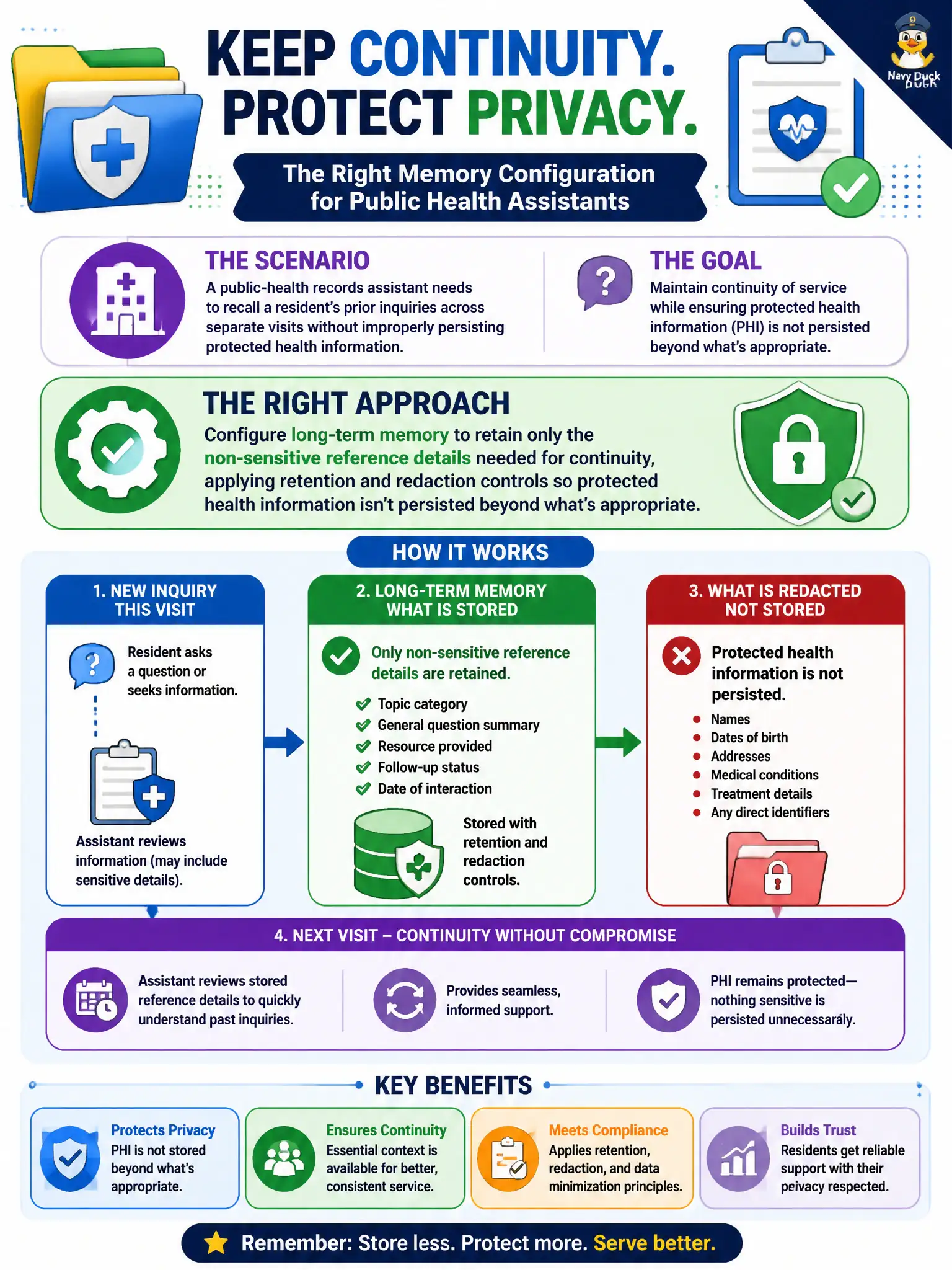
Think of it like a receptionist who remembers you've been in before and roughly why, without keeping a copy of your actual chart in a desk drawer. Configuring memory to keep just enough reference detail for continuity, while applying redaction and retention controls to keep protected health information out of it, gives the agent that same appropriate level of recall. Remembering everything, or remembering nothing, both miss what the task actually needs.
Full Explanation
Long-term memory configuration for a health-adjacent agent needs to balance genuine continuity across visits against the requirement not to improperly persist protected health information, which means deliberately scoping what gets stored and applying redaction or retention controls rather than either extreme.
Storing the full transcript of every past conversation, health details included, directly violates the stated requirement by persisting exactly the sensitive information that shouldn't be retained in that form, regardless of how useful it would be for continuity. Disabling long-term memory entirely avoids the persistence risk but sacrifices the continuity the scenario explicitly asks for, forcing the resident to re-explain context on every visit. Restricting staff visibility into the interface addresses who can see stored data, but leaves the underlying persistence decision untouched — the agent is still retaining protected health information, just with an access control layered on top rather than a memory configuration that avoids storing it improperly in the first place.
Scope note: what counts as appropriately non-sensitive reference detail should be defined with the department's compliance requirements, not assumed by the engineering team alone. Operational check: inspect what the memory store actually persists after a test conversation containing a health detail, and confirm that detail isn't retained verbatim.