
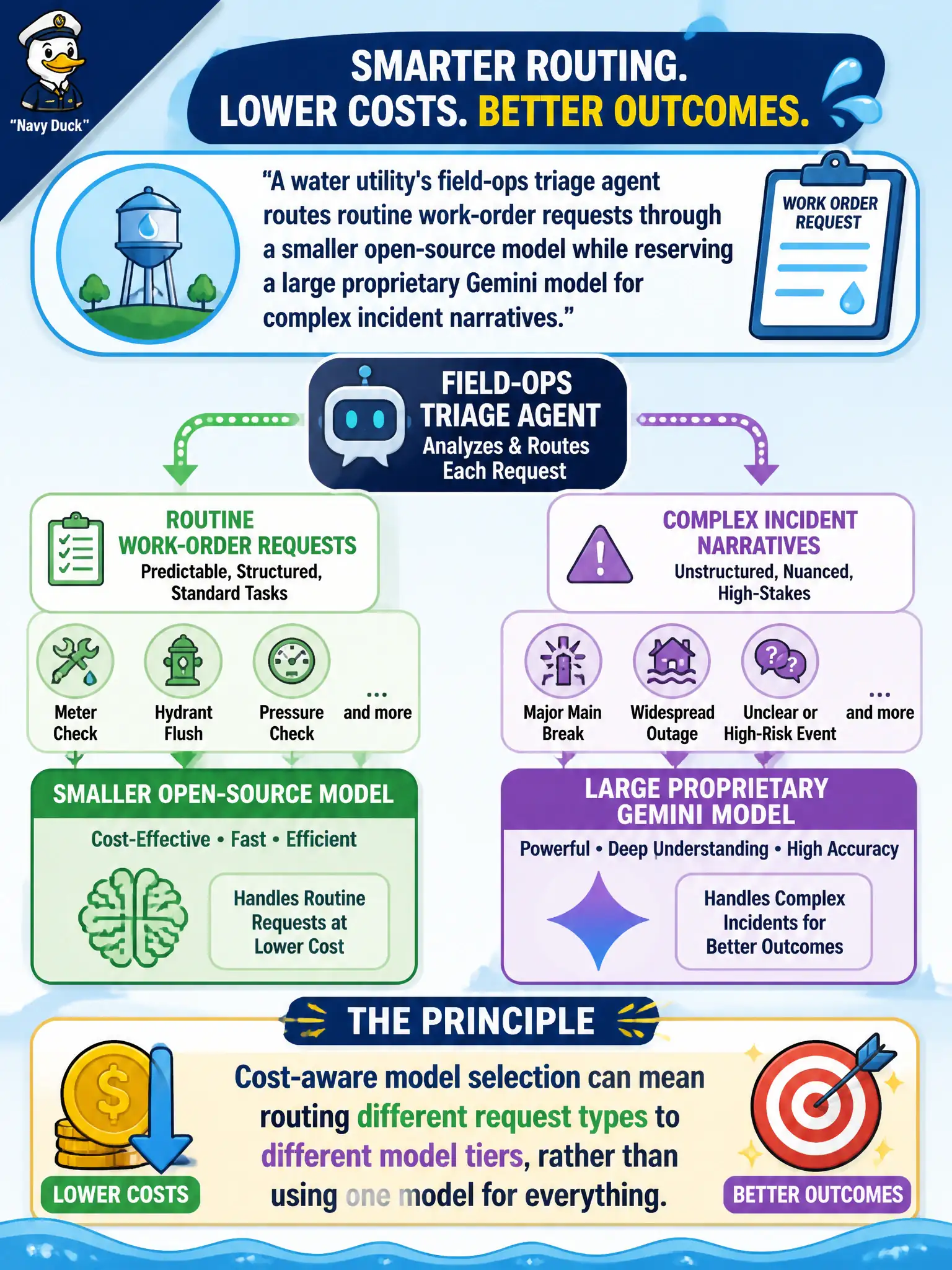
A water utility's field-ops triage agent routes routine work-order requests through a smaller open-source model while reserving a large proprietary Gemini model for complex incident narratives. What principle does this architecture reflect?
Select an answer to reveal the explanation.
Short Explanation
Think of it like a utility dispatch center that sends a technician to reset a breaker but calls in an engineer for a cascading outage — not every job needs the same level of expertise, and paying for the engineer on every routine call would be wasteful. Routing routine work orders to a smaller model and complex narratives to the larger one is that same tiered dispatch, matching the model's cost and capability to what each request actually needs.
Full Explanation
Cost-aware agent architecture doesn't require picking one model for the whole workload; it can mean tiering requests by complexity and routing each tier to the model best suited for it, so routine, well-bounded work orders use a smaller, cheaper open-source model while complex incident narratives that need deeper reasoning go to the larger proprietary model.
Applying a single model uniformly across every request type misses the opportunity this scenario demonstrates, since it forces either overpaying for simple requests or underserving complex ones. Assuming the smaller model should eventually replace the larger one entirely misunderstands the architecture as a stepping stone rather than a durable design, when in fact the two tiers are meant to coexist for genuinely different request profiles. Basing routing purely on volume rather than complexity would misroute a high-volume batch of complex narratives to the cheaper model or a low-volume batch of routine requests to the expensive one, defeating the purpose of tiering.
Scope note: tiered routing depends on a reliable way to classify incoming requests by complexity before dispatch, which is itself a design decision worth testing. Operational check: sample a batch of routed requests and confirm complex incident narratives are actually landing on the larger model rather than slipping through to the smaller one.