
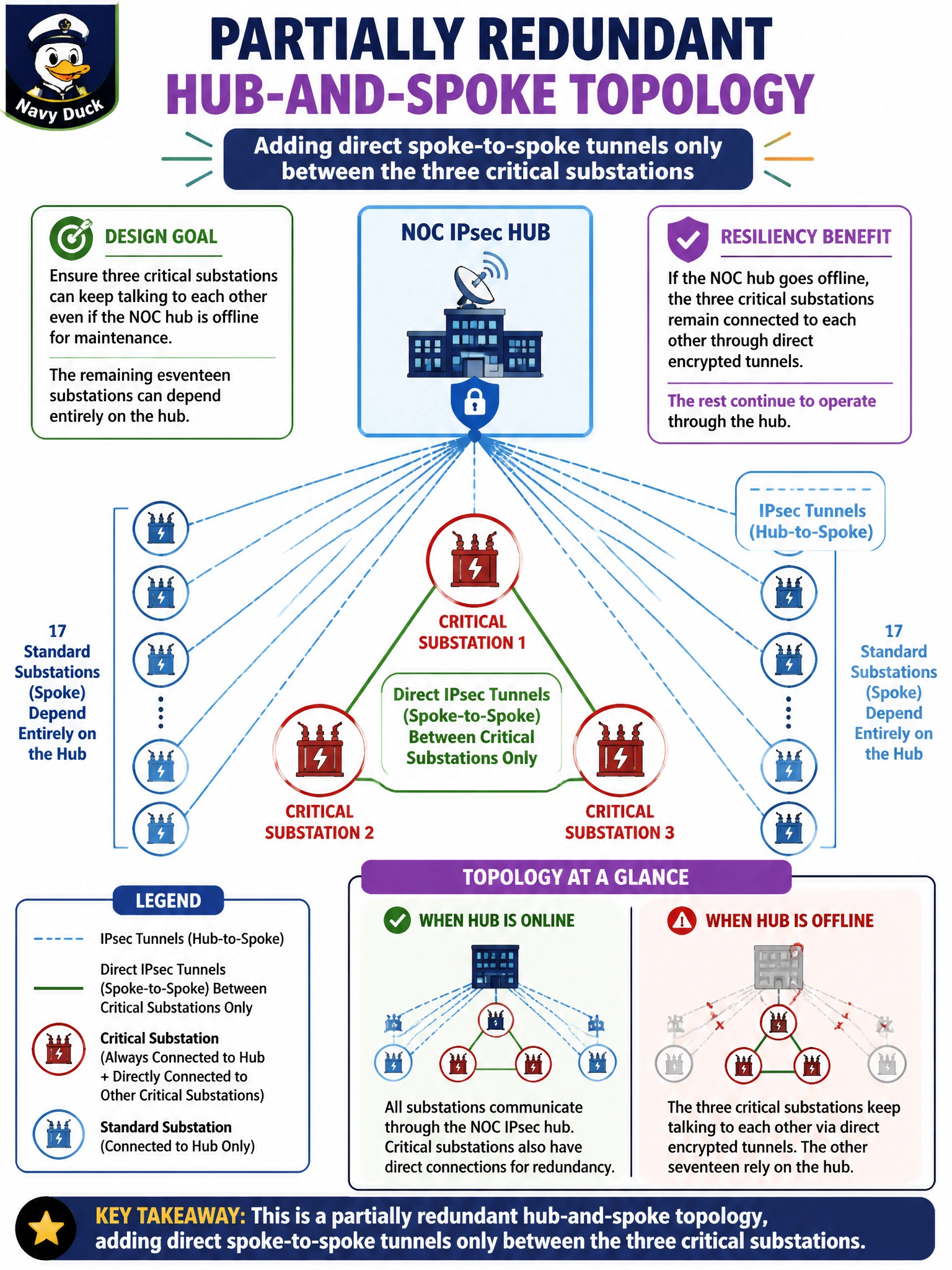
The NOC's IPsec hub connects to twenty substations, and the utility wants three critical substations to keep talking to each other even if the NOC hub temporarily goes offline for maintenance, while the remaining seventeen substations can tolerate depending entirely on the hub. Which topology description matches this design?
Select an answer to reveal the explanation.
Short Explanation
This is the classic middle ground between hub-and-spoke and full mesh: keep the simple hub design for most sites, but add a few direct tunnels between the handful of substations that genuinely can't afford to lose contact if the NOC has a bad day. That's what a partially redundant topology is for.
Full Explanation
A partially redundant IPsec topology keeps the simplicity of hub-and-spoke for most sites while adding a small number of direct spoke-to-spoke tunnels between specific sites that have a genuine requirement to stay connected even if the hub is unavailable — exactly matching a design where three critical substations get direct tunnels to each other while the other seventeen remain purely hub-dependent. Claiming partial redundancy isn't a recognized pattern is simply factually wrong; it is a standard, named trade-off between the operational simplicity of hub-and-spoke and the connectivity resilience of full mesh, chosen precisely to avoid building n(n-1)/2 tunnels across all twenty sites when only three need direct resilience. Dialup phase 1 configuration is about how a peer with a dynamic address authenticates into a static hub; it says nothing about whether spoke-to-spoke connectivity survives a hub outage, so it cannot substitute for actually building direct tunnels between the critical sites. Describing standard hub-and-spoke as unaffected by a hub outage is backwards — in pure hub-and-spoke, the hub is a single point of failure for all inter-spoke traffic, which is exactly the vulnerability the critical substations need direct tunnels to avoid. To validate the design, confirm the three critical substations each show two phase 1 gateways — one to the hub and one to each relevant peer — while the remaining seventeen show only the single hub gateway.