
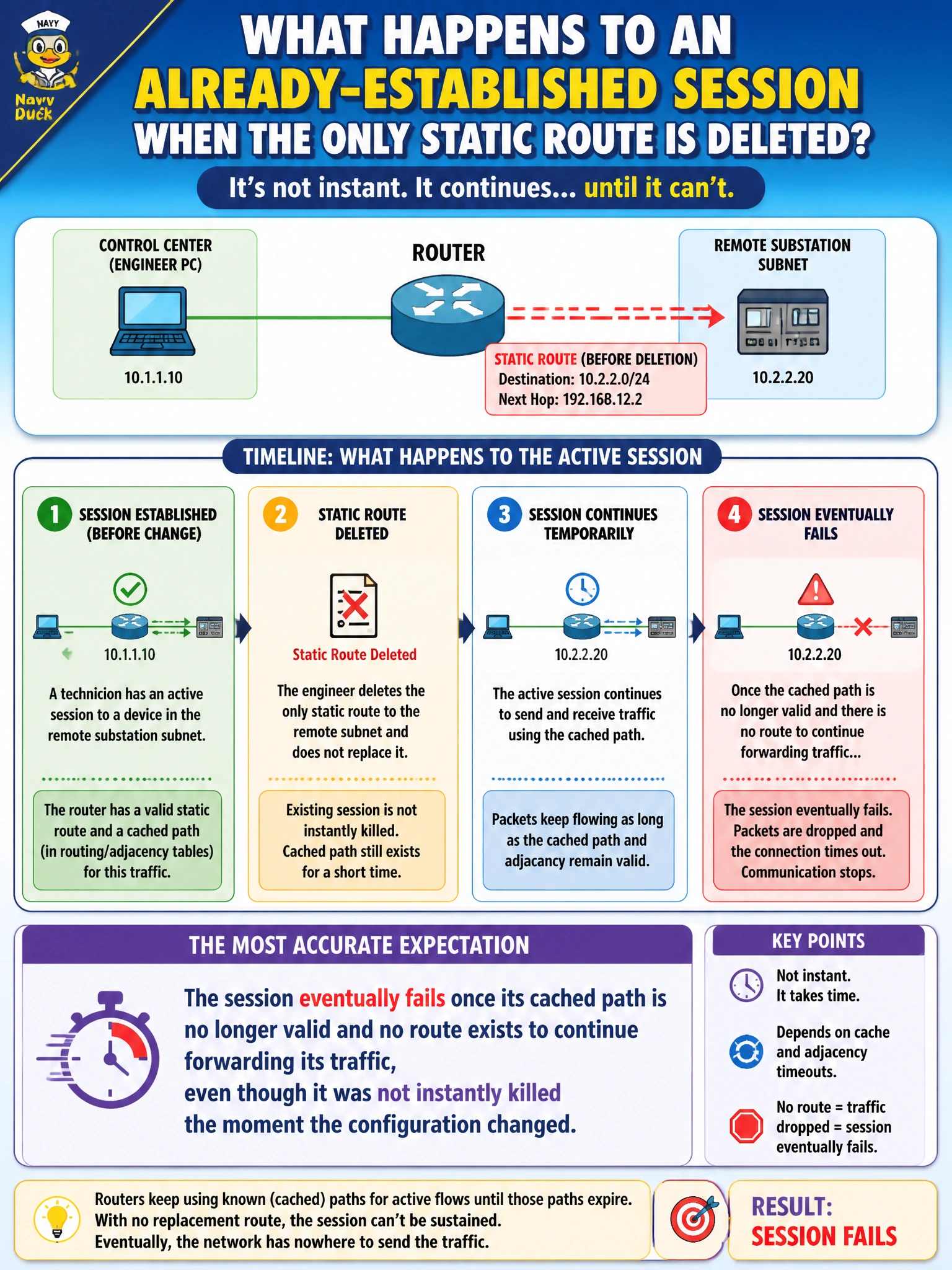
An engineer deletes the only static route to a remote substation subnet entirely — not replacing it with a different route, just removing it — while a technician has an active session to a device in that subnet. What is the most accurate expectation for that already-established session?
Select an answer to reveal the explanation.
Short Explanation
A session running on a path can coast for a little while even after that path's map entry disappears, but it can't keep going forever with no map at all. Sooner or later it hits a wall and the session dies because there is genuinely nowhere left to send its packets.
Full Explanation
While an established session's forwarding decision is cached at session creation and is not re-evaluated packet by packet against every routing table change, that caching does not make a session immune to routing entirely — once the only route to a destination is deleted outright, with nothing left standing in for it, the session's traffic ultimately has no valid path to continue over, and the session fails, whether through interface-level effects, expiration, or the next event that forces a fresh route lookup. This nuance separates a route being changed to a different valid alternative, where the existing session can persist unaffected, from a route being removed with no replacement, which removes the reachability that traffic to that destination depends on. Claiming a session is unaffected forever overstates the caching behavior into something FortiOS does not actually guarantee. The FortiGate does not automatically recreate a route an administrator deliberately deleted; that would defeat the purpose of the deletion. Sessions also do not spontaneously convert themselves into policy-route-governed traffic; policy routes are a distinct, explicitly configured feature, not a fallback a session adopts on its own. A practical check is to delete a test route to an otherwise-idle test destination and confirm that an active session to it eventually stops passing traffic rather than continuing indefinitely.