
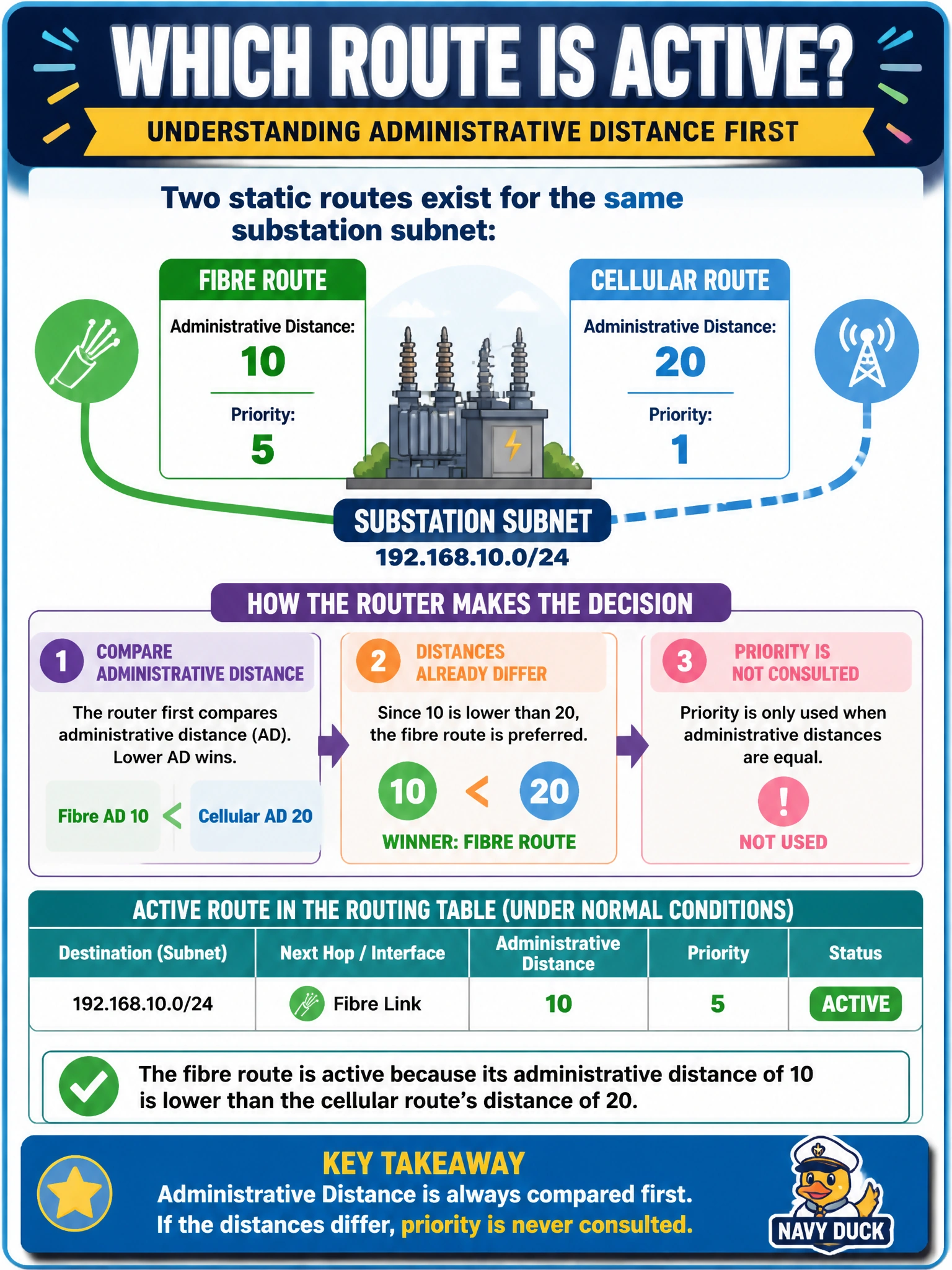
Two static routes exist for the same substation subnet: one via fibre at administrative distance 10 and priority 5, and one via cellular at administrative distance 20 and priority 1. Which route is active in the routing table under normal conditions?
Select an answer to reveal the explanation.
Short Explanation
Distance always gets the first say, and priority only ever gets a turn if distance ends in a tie. Since fibre's distance of 10 already beats cellular's 20, the FortiGate never even needs to look at the priority numbers.
Full Explanation
Administrative distance is the first and higher-priority criterion in route selection: whenever two candidate routes to the same destination have different administrative distances, the route with the lower distance is installed as active, full stop, and the priority field is not evaluated at all in that comparison. Here, fibre's distance of 10 is lower than cellular's distance of 20, so fibre is selected regardless of the fact that cellular happens to carry a lower, seemingly more favorable priority value — priority only matters as a tiebreaker between routes that already share the same distance, which is not the situation here. This is the reverse-order trap this pairing is famous for: assuming priority can win against a distance difference is incorrect. ECMP is likewise not triggered by differing priority values; ECMP requires both distance and priority to match exactly across all candidate routes, and here neither value matches. Configuration recency plays no role in FortiOS route selection logic at all. A useful operational check is to view the routing table and confirm the fibre route shows as selected, then intentionally fail the fibre link and observe that cellular only becomes active once fibre is withdrawn, not before.