
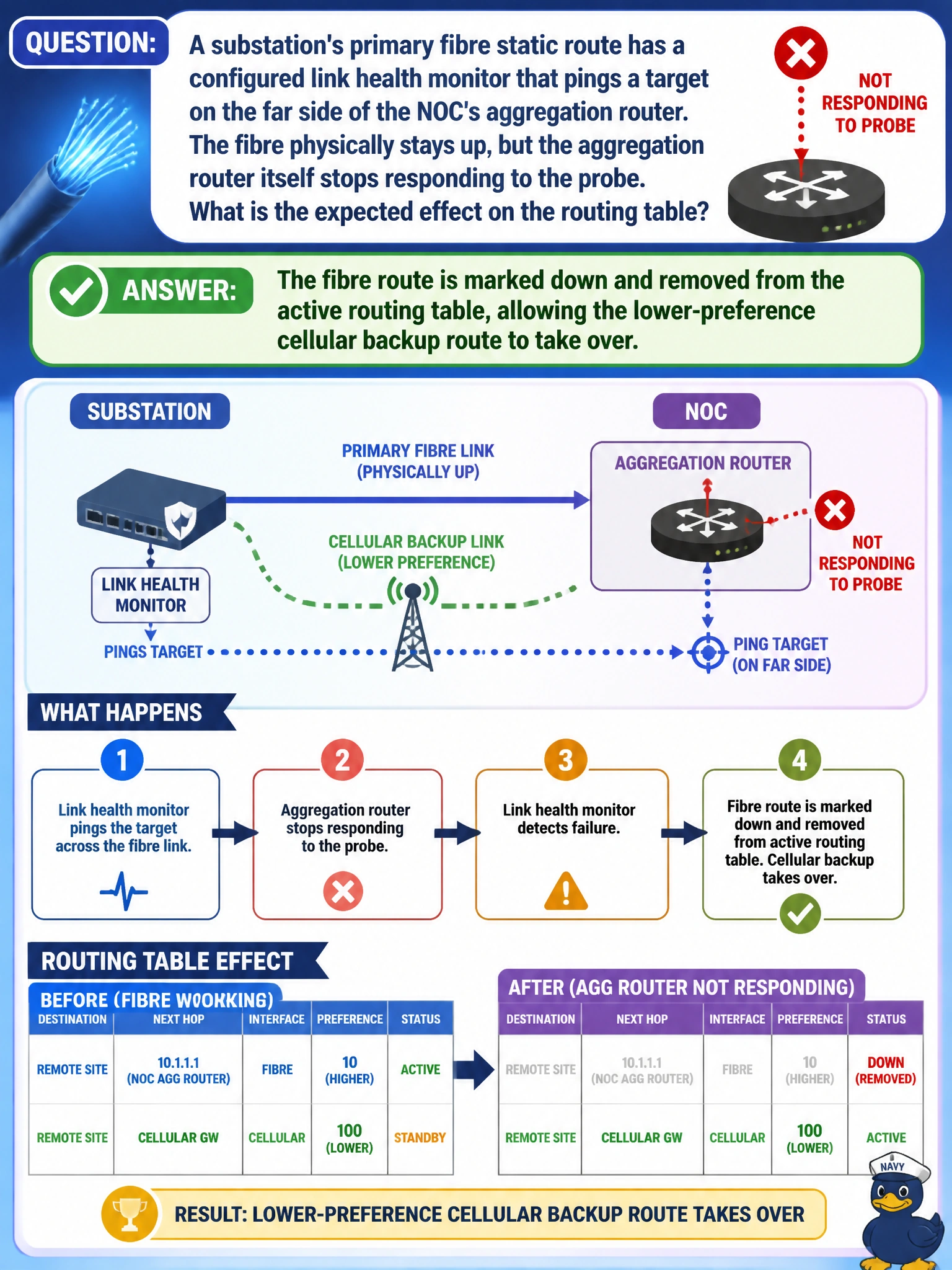
A substation's primary fibre static route has a configured link health monitor that pings a target on the far side of the NOC's aggregation router. The fibre physically stays up, but the aggregation router itself stops responding to the probe. What is the expected effect on the routing table?
Select an answer to reveal the explanation.
Short Explanation
The whole point of pinging past the immediate link is to catch exactly this kind of failure — the cable's fine, but something further down the road stopped answering. When the target stops replying, the FortiGate treats that route as broken and lets the backup take over.
Full Explanation
A link health monitor is deliberately configured to probe a target that may be several hops beyond the immediate next hop, so it can detect reachability failures the physical link state alone would never reveal — exactly the scenario where the fibre stays electrically up but something downstream, like the aggregation router, has stopped responding. When probes fail past the configured threshold, FortiOS marks the associated static route as down and removes it from the active routing table, which allows a properly configured backup route, such as the cellular link at a higher priority value, to become the active path without requiring any manual intervention. The first option describes the opposite of the feature's purpose — checking only the directly connected next hop is exactly the limitation dead gateway detection exists to overcome by probing further. The FortiGate does not renegotiate or reassign gateway IP addresses on its own; addressing is a static configuration, not something the health monitor changes. Firewall policies are also unaffected structurally by a route going down; they remain configured and simply stop matching traffic that no longer has a valid route, rather than being deleted. To confirm the behavior, watch the routing table during a controlled outage of the probe target and verify the fibre route disappears and cellular becomes active.