
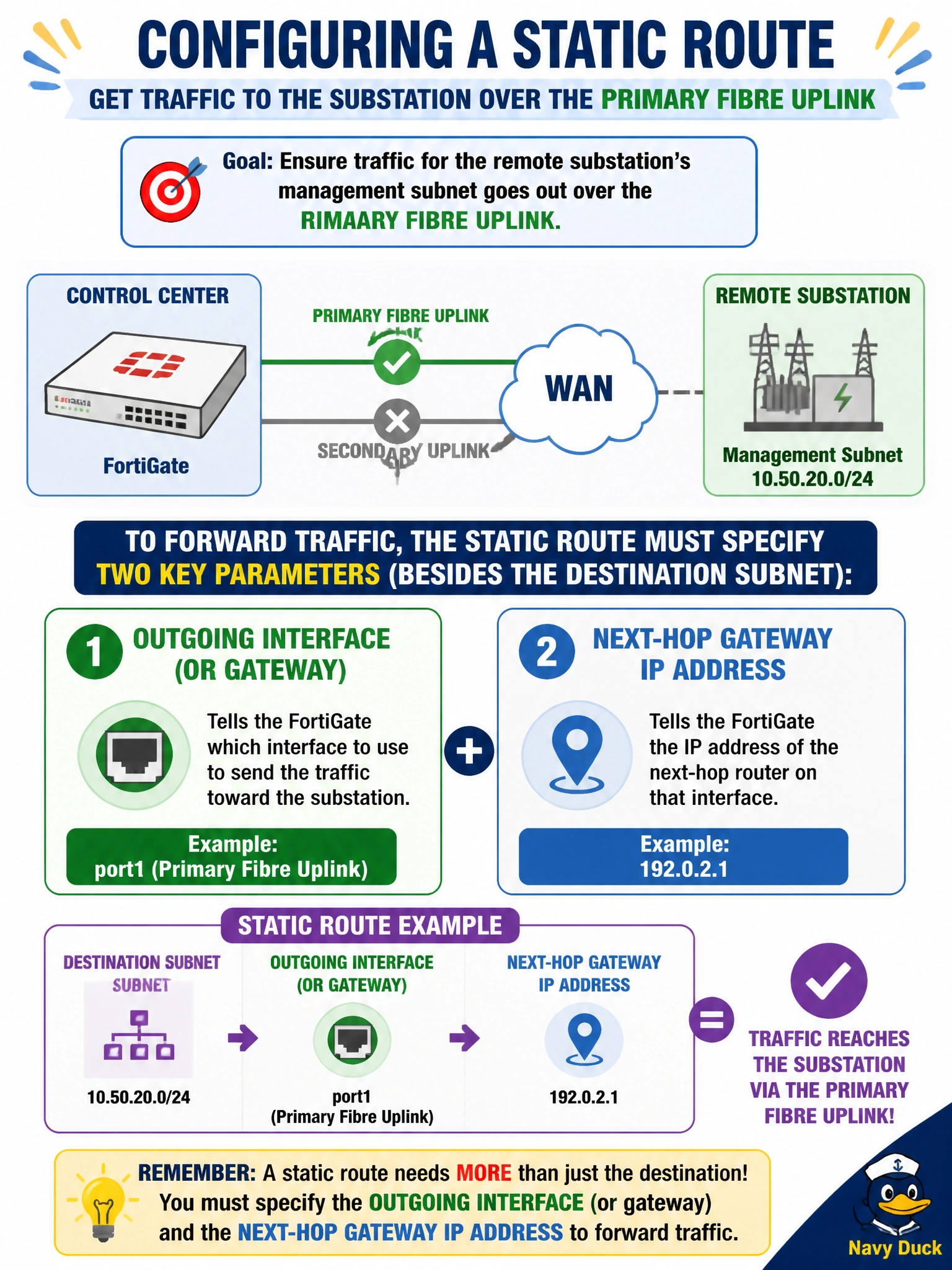
A grid-operations engineer is configuring a new static route on the control-center FortiGate so traffic for a remote substation's management subnet goes out over the primary fibre uplink. Besides the destination subnet, which pair of parameters must the static route specify to actually forward traffic toward that substation?
Select an answer to reveal the explanation.
Short Explanation
Think of a static route as an address label plus a direction: it tells the FortiGate which door (interface) to walk out of and whose hand (gateway) to hand the packet to next. Without both pieces, the FortiGate knows a destination exists but has no way to actually get a packet there.
Full Explanation
A static route's job is to answer two questions for a given destination: which interface should the packet leave through, and who is the next hop that will carry it onward. On the control-center FortiGate, a route to the substation management subnet needs the interface bound to the fibre uplink and the next-hop gateway address on that link (or the interface alone for a point-to-point or directly connected topology). Administrative distance and priority are optional tie-breaking values that only matter once more than one route exists to the same destination — they do not by themselves forward a single packet. A serial number and DNS hostname have nothing to do with layer-3 forwarding decisions, and a firewall policy ID or antivirus profile controls whether traffic is permitted and inspected, not which path it takes to get there; routing and policy lookups are separate stages of packet processing. A useful operational check is to view the routing table after saving the route and confirm the substation subnet shows up with the expected interface and gateway, not just as a configured-but-inactive entry.