
A security engineer is evaluating an IPS signature described as "rate-based" for detecting a flood-style scan attempt against the utility's back-office web application. Which best describes how a rate-based signature differs from a standard signature match?
Select an answer to reveal the explanation.
Short Explanation
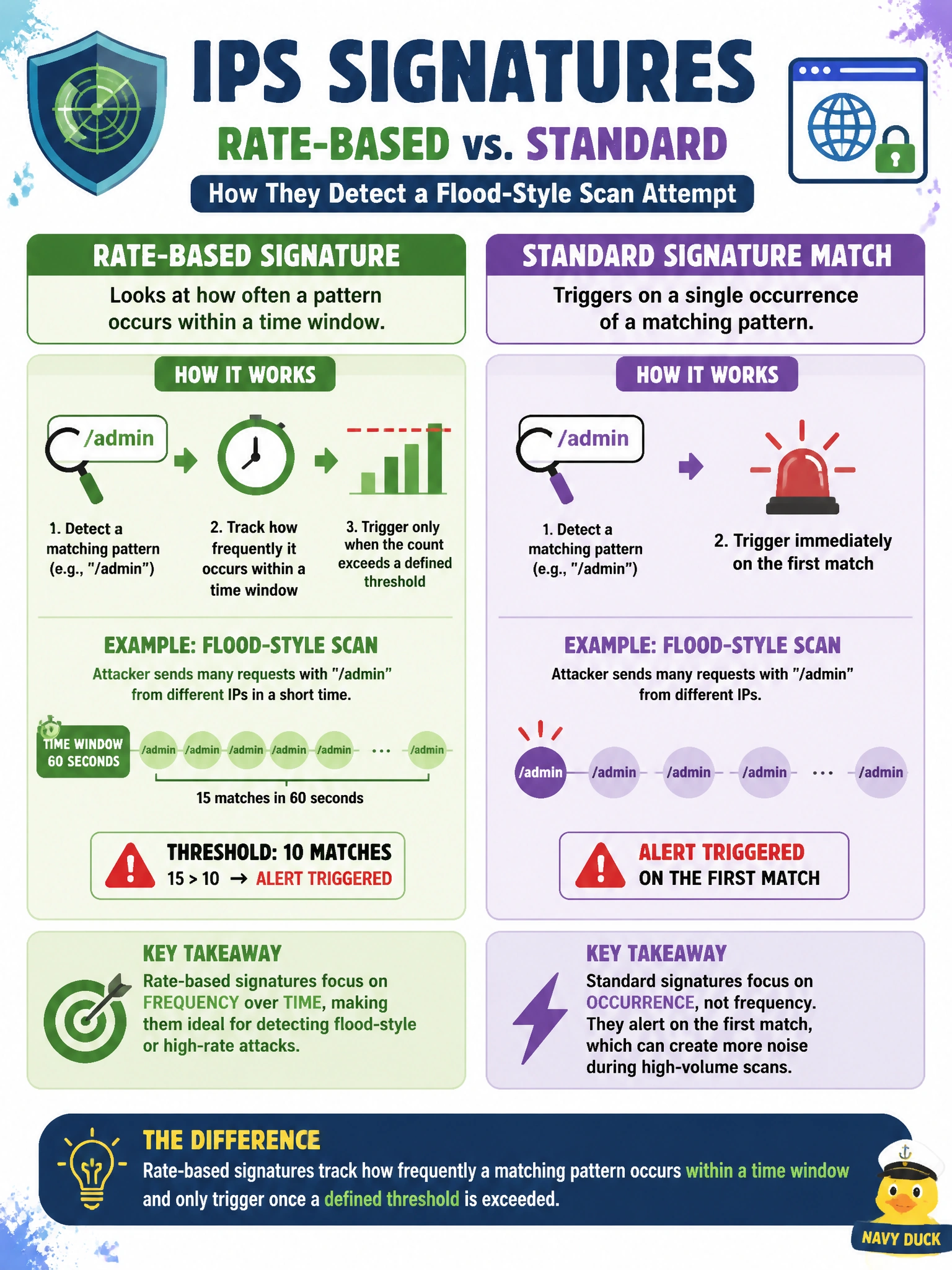
A standard signature is like a tripwire that fires on the first touch. A rate-based one is more like a counter — it lets a few events pass and only sounds the alarm once the pace crosses a line, which is exactly what flood-style behavior looks like.
Full Explanation
Rate-based IPS signatures add a frequency dimension on top of pattern matching: the sensor tracks how many times a specific pattern or event occurs within a defined time window and only takes action once that count crosses a configured threshold. This design targets behaviors that are only malicious in volume — a flood or scan attempt — where any single instance of the pattern would look harmless in isolation. The first wrong option describes an ordinary static signature, which is the opposite of what makes a rate-based signature distinct. The second wrong option wrongly ties rate-based detection to decrypted traffic specifically; rate-based signatures evaluate whatever traffic reaches the sensor and are not defined by inspection mode or decryption status. The third wrong option confuses IPS with application control, a separate profile that identifies software rather than counting event frequency. A caveat for a utility environment: legitimate operational polling can itself be bursty, so a rate-based signature's threshold needs tuning against real traffic patterns to avoid false positives on normal grid-operations chatter. To verify tuning, review the signature's hit count and configured threshold in the IPS log during both normal operation and a controlled test burst.