
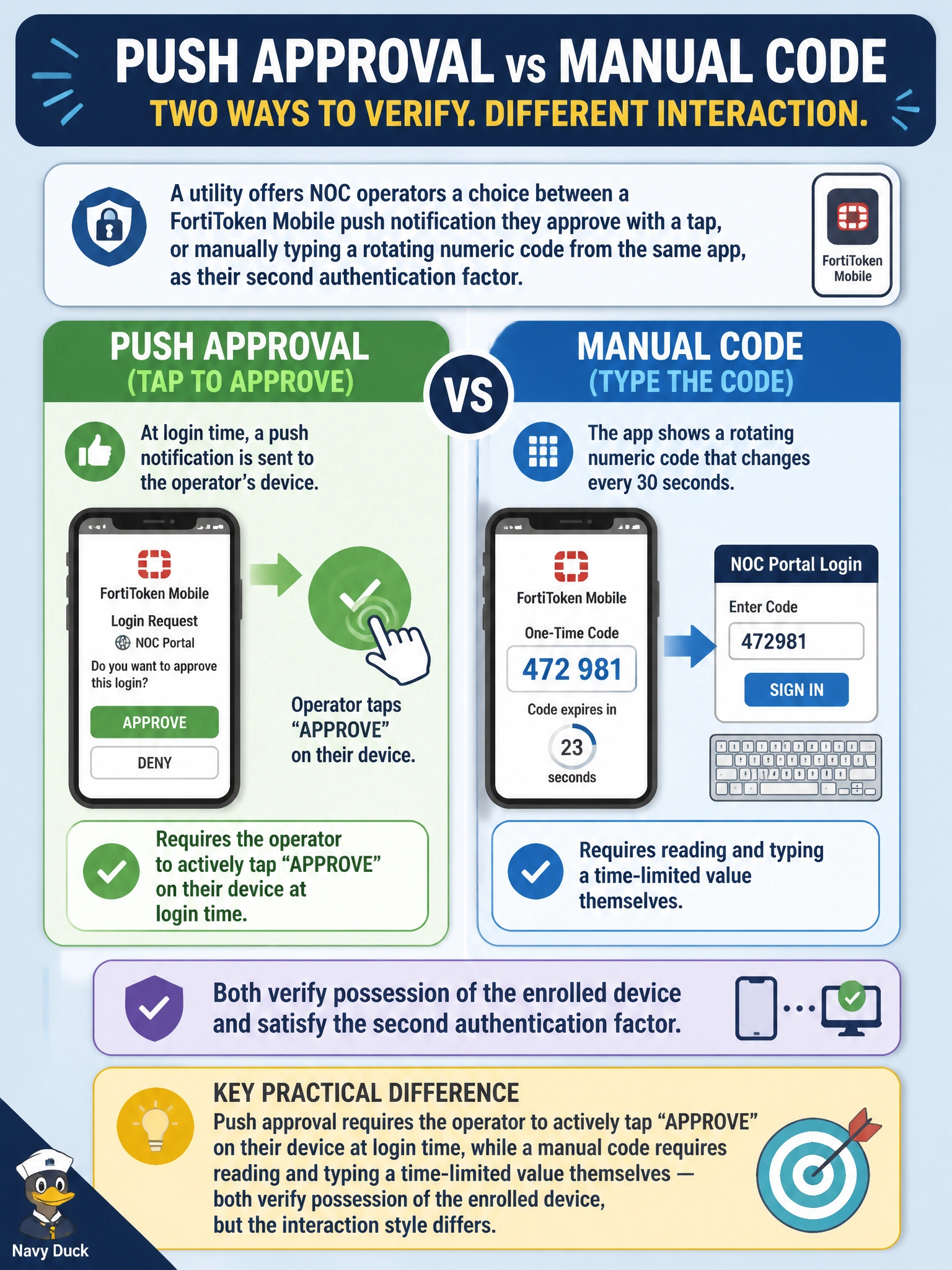
A utility offers NOC operators a choice between a FortiToken Mobile push notification they approve with a tap, or manually typing a rotating numeric code from the same app, as their second authentication factor. What is the key practical difference between these two options?
Select an answer to reveal the explanation.
Short Explanation
Both options are proving the same thing — that the operator actually has their enrolled phone in hand — they just ask for it differently. One's a single tap on a notification; the other means glancing at a rotating number and typing it in before it changes. Same underlying trust, just a different amount of friction for the operator.
Full Explanation
Both push approval and manual code entry serve the same purpose as a second factor: proving possession of the operator's enrolled mobile device. Push approval streamlines this into a single tap on a notification the app generates at login time, while manual entry requires reading a time-limited rotating numeric code from the app and typing it in before it expires — the underlying trust is identical, only the interaction style and effort differ. Describing push notifications as providing no security benefit is incorrect; a push still requires an active, deliberate approval tied to that specific login attempt, a genuine verification step, not a no-op. Manual code entry requires prior enrollment of a token exactly like push does — there is no code-only path that skips enrollment, since the app must be provisioned with the account's token seed to generate valid codes at all. There is no restriction tying push approval exclusively to firewall-policy authentication and manual codes exclusively to VPN, or vice versa; either can generally serve as a second factor across supported contexts. A caveat: push approval carries an 'approval fatigue' risk, where a user might tap approve without scrutiny, while manual entry forces a moment of active attention to the code and the attempt. Confirm by testing both methods against the same account and observing either satisfies the requirement.