
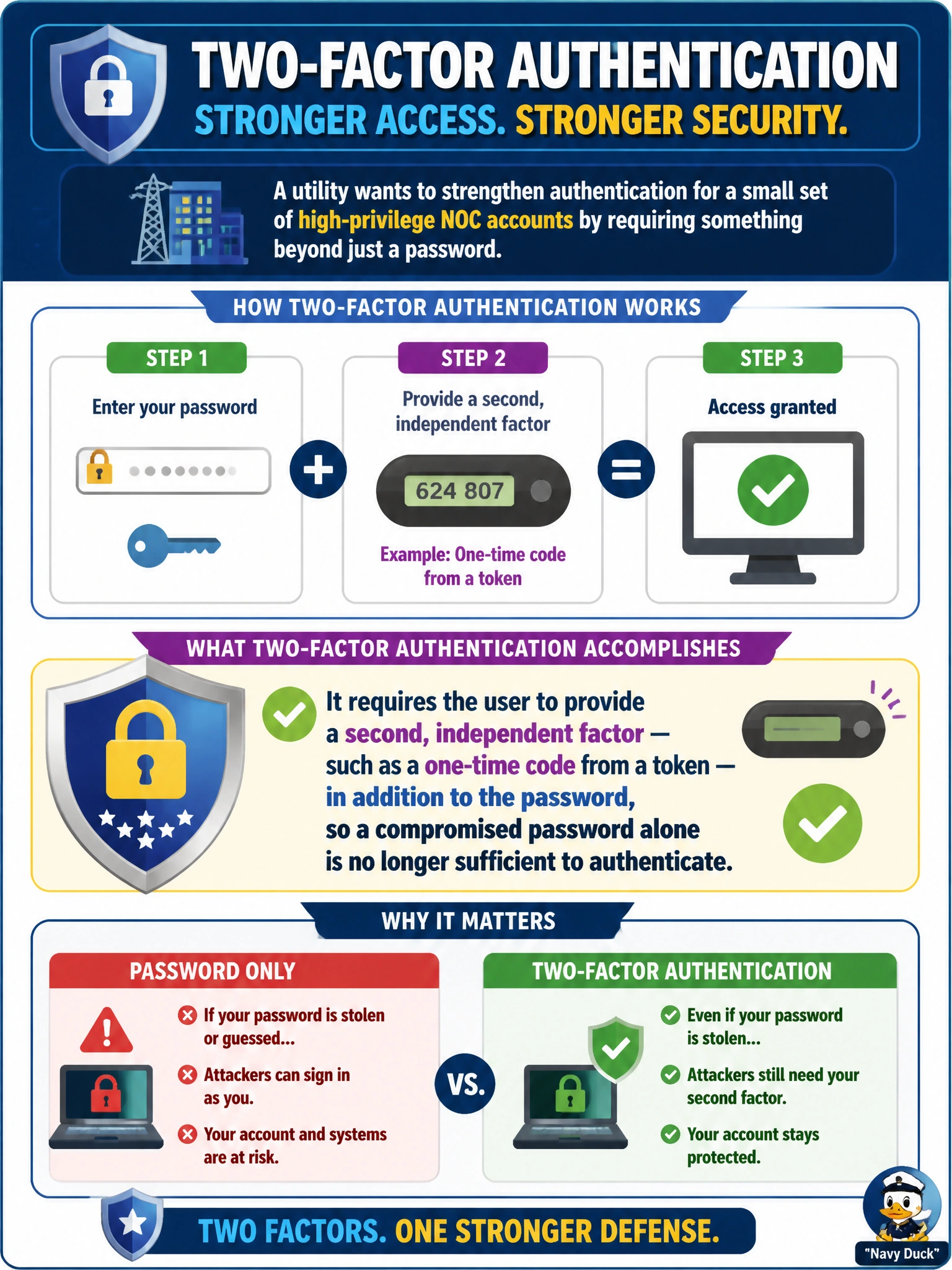
A utility wants to strengthen authentication for a small set of high-privilege NOC accounts by requiring something beyond just a password. What does adding two-factor authentication accomplish?
Select an answer to reveal the explanation.
Short Explanation
Two-factor isn't about typing your password twice or making it longer — it's about proving who you are with two genuinely different kinds of evidence. Something you know, like a password, paired with something you have, like a token that spits out a fresh code every thirty seconds. Steal the password alone and you still don't get in.
Full Explanation
Two-factor authentication requires the user to present two independent categories of proof — typically something they know (a password) and something they have (a physical or soft token generating a time-based one-time code) — so that possession of the password alone is no longer sufficient for an attacker to authenticate as that user. This meaningfully raises the bar for high-privilege NOC accounts, since compromising a password through phishing or reuse no longer grants access without also compromising the second factor. Entering a password twice is a UI confirmation pattern to catch typos, not an additional authentication factor, since both entries prove the same single piece of knowledge. Doubling password complexity strengthens the single knowledge factor but does not add an independent second factor at all — it is still one category of proof, just a harder version of it. Automatically locking an account after failed attempts is a lockout policy addressing brute-force attempts, an entirely different control from verifying identity with two factors. A caveat worth noting: two-factor schemes are only as strong as how the second factor is delivered and stored — a token seed stored insecurely undermines the benefit. To confirm two-factor is actually enforced, attempt a login with a correct password and no second factor and verify access is refused.