
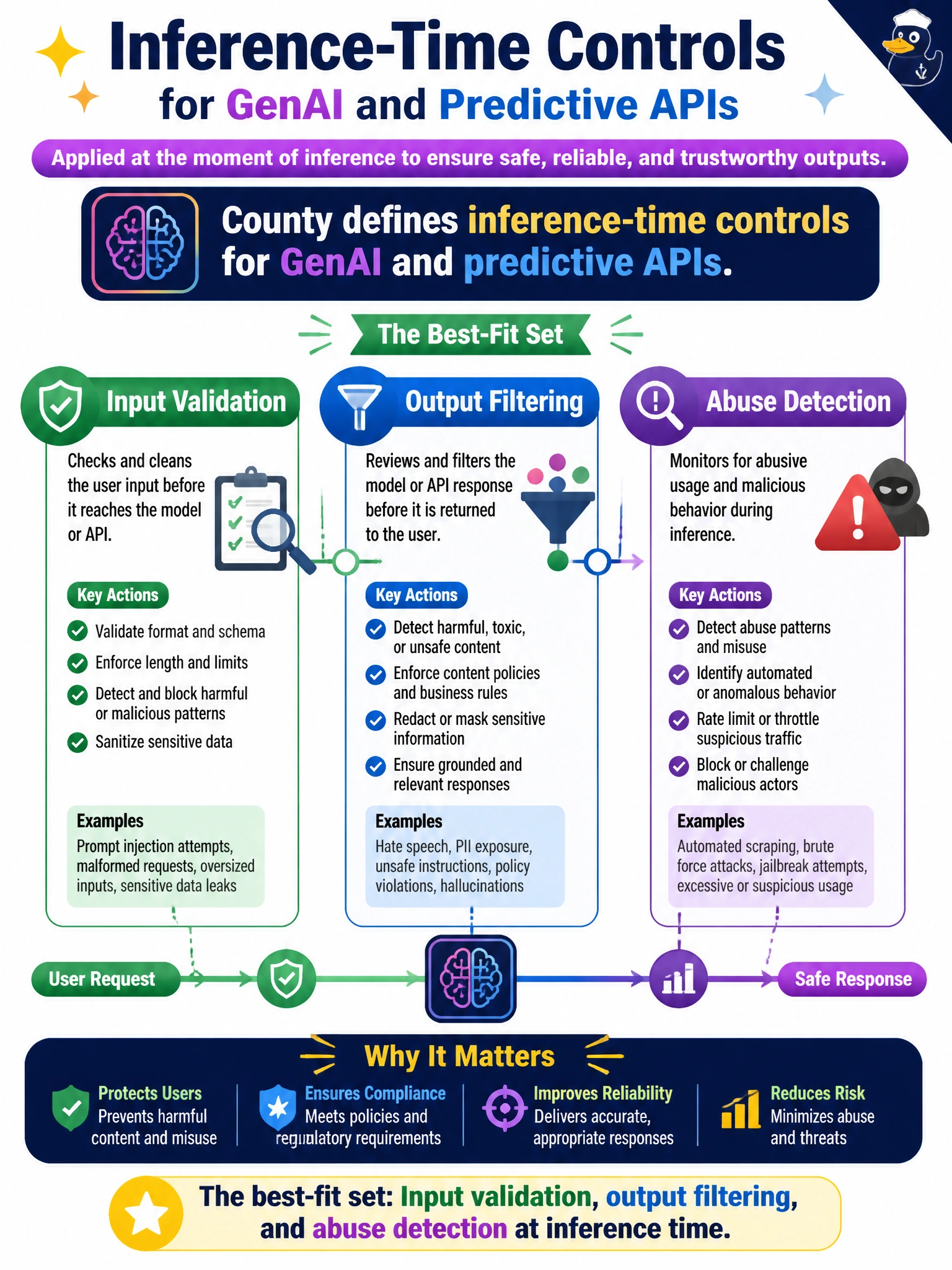
County defines inference-time controls for GenAI and predictive APIs. Which set best fits?
Select an answer to reveal the explanation.
Short Explanation
Inference is where the rubber meets the road. Validate inputs, filter outputs, and watch for abuse—don’t trust every prompt that walks in.
Full Explanation
County inference-time controls for GenAI and predictive APIs should include input validation, output filtering, and abuse detection. Input validation constrains prompts and feature payloads to expected schemas and policy, reducing injection and malformed-request risk. Output filtering blocks or redacts harmful, sensitive, or out-of-policy responses before residents or staff see them. Abuse detection watches for volumetric or behavioral misuse at the moment of inference—where attacks and mistakes actually land. This trio is the runtime counterpart to design-time architecture controls.
Skipping validation because raw prompts are “always trusted” ignores adversarial and accidental inputs on civic interfaces. Disabling output filtering so any harmful response ships unchanged exports model failures directly to the public. Postponing abuse detection until after a public scandal accepts preventable harm and reputational damage as the detection strategy.
Exam caveat: inference-time means controls at request/response time—validation, filtering, and abuse detection—not only training-time dataset work.
Operational check: enforce schema and policy checks on inbound inference, apply output filters aligned to county use-policy, enable abuse analytics with alert routing, and red-team prompts to verify both block paths before expanding GenAI/predictive API exposure.