
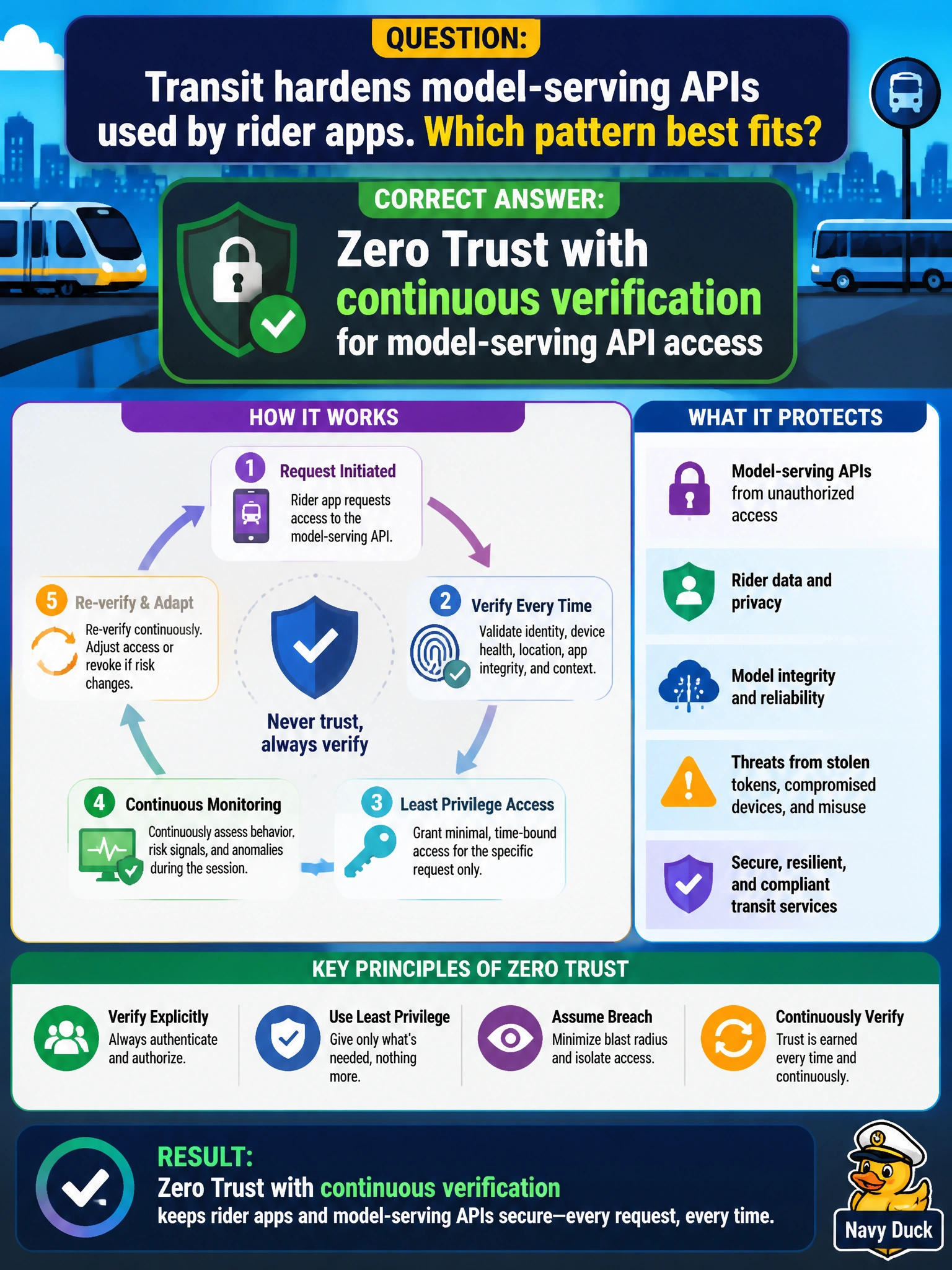
Transit hardens model-serving APIs used by rider apps. Which pattern best fits?
Select an answer to reveal the explanation.
Short Explanation
Rider apps aren’t a free pass forever. Treat model APIs with Zero Trust—verify continuously, don’t assume last year’s handshake still counts.
Full Explanation
Transit model-serving APIs used by rider apps should follow Zero Trust with continuous verification rather than long-lived implicit trust. Every call—mobile client, partner integration, or internal service—must authenticate, authorize to least privilege, and be re-validated based on session risk, device posture, or token lifetime as policy requires. Continuous verification prevents a once-authenticated rider app or stolen token from retaining unbounded access to inference that may expose schedules, location-adjacent data, or operational predictions. Zero Trust also assumes breach: network location alone never equals trust for civic APIs on the internet edge.
Implicit trust for any client that authenticated last year freezes outdated assurance into a standing privilege and ignores credential theft, app compromise, and policy change. Providing no authentication because rider apps are “friendly by default” invites anonymous abuse and scraping of transit AI capacity. Shared static passwords posted in a public developer portal are credentials as press releases—trivial to harvest and reuse against production serving.
Exam caveat: Zero Trust for model APIs emphasizes continuous verification and least privilege, not merely a one-time login at app install. “Friendly” first-party apps still need authN/Z.
Operational check: place serving APIs behind mutual TLS or short-lived tokens, enforce per-client scopes and continuous session checks, rotate credentials, and verify that expired or anomalous clients lose inference access without relying on network location alone.