
Courts IT is preparing to renew a legal-research GenAI contract. What assurance step best fits the vendor lifecycle?
Select an answer to reveal the explanation.
Short Explanation
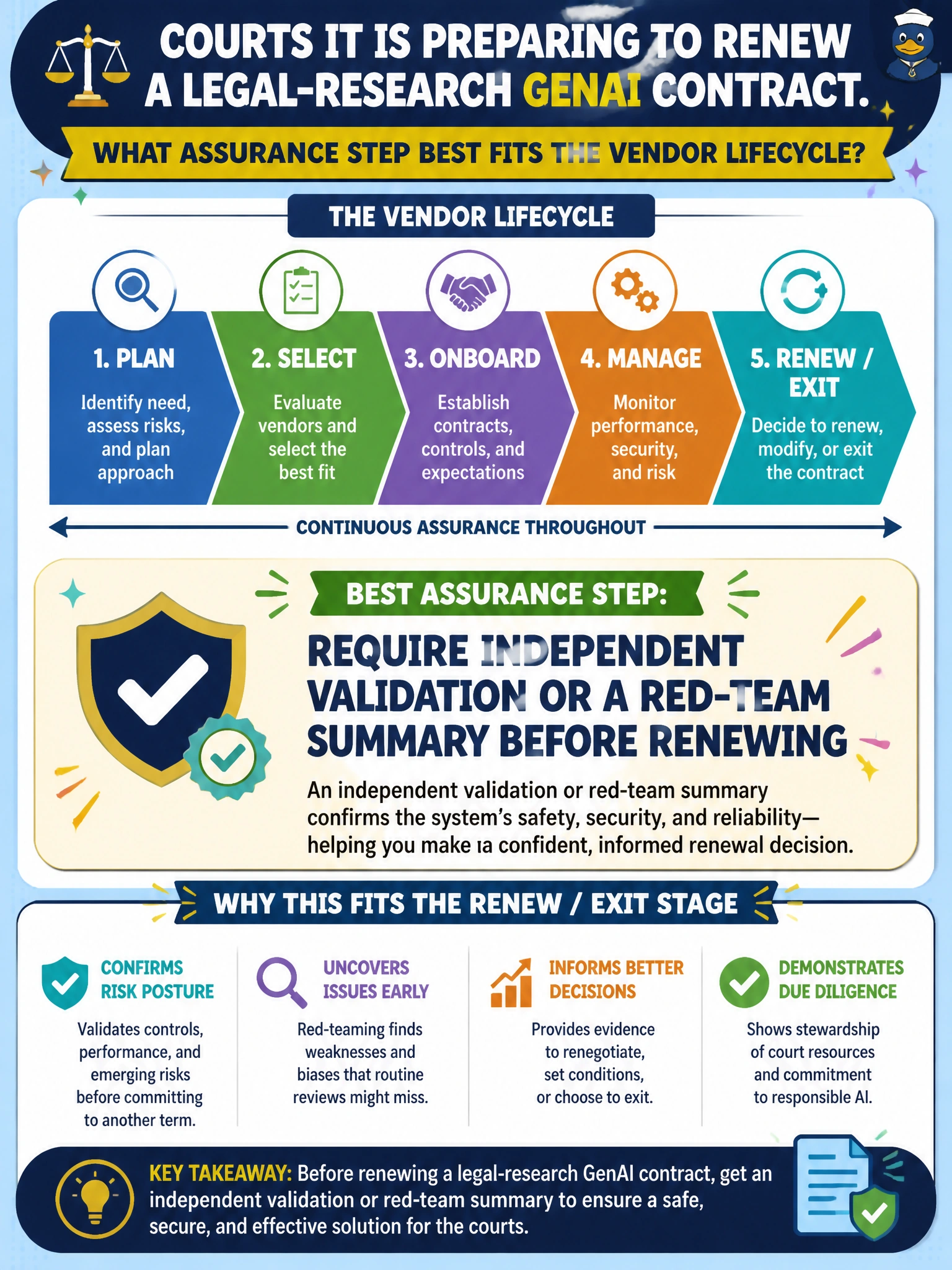
Renewal isn’t a rubber stamp. Independent validation or a red-team summary before you re-up beats a discount-for-silence deal every time.
Full Explanation
Courts IT preparing to renew a legal-research GenAI contract should treat renewal as a gated lifecycle step, not a rubber stamp. Require independent validation or a red-team summary before renewing is correct because high-sensitivity court GenAI can affect legal research quality, confidentiality, and judicial trust; independent validation or red-team evidence tests whether controls and failure modes still hold after a year of use and model change. Municipal courts vendor lifecycle governance uses renewal as leverage to demand fresh assurance.
Renew automatically because the prior year had no formal review fails by concept: absence of review is a governance gap, not evidence of safety. Skip validation if the vendor offers a discount for fast signature fails by concept: price incentives do not substitute for independent assurance on court GenAI. Rely only on the vendor’s self-graded “A+ ethics” sticker fails by concept: self-attested marketing grades are not independent validation or red-team evidence.
Exam caveat: independent validation can be third-party, internal specialist, or contracted red team—what matters is independence from pure sales claims and coverage of relevant AI risks. Renewal can still proceed with conditions if gaps are accepted as residual risk by an authorized owner.
Operational check: before courts GenAI renewal, require an independent validation or red-team summary covering confidentiality, hallucination/harmful output, and access controls; attach evidence to the renewal packet; reject discount-for-skip deals; and withhold signature until assurance meets the court’s bar or residual gaps are formally accepted.