
Fire/EMS wants to scale a call-type assist model across stations. What scaling strategy is most appropriate?
Select an answer to reveal the explanation.
Short Explanation
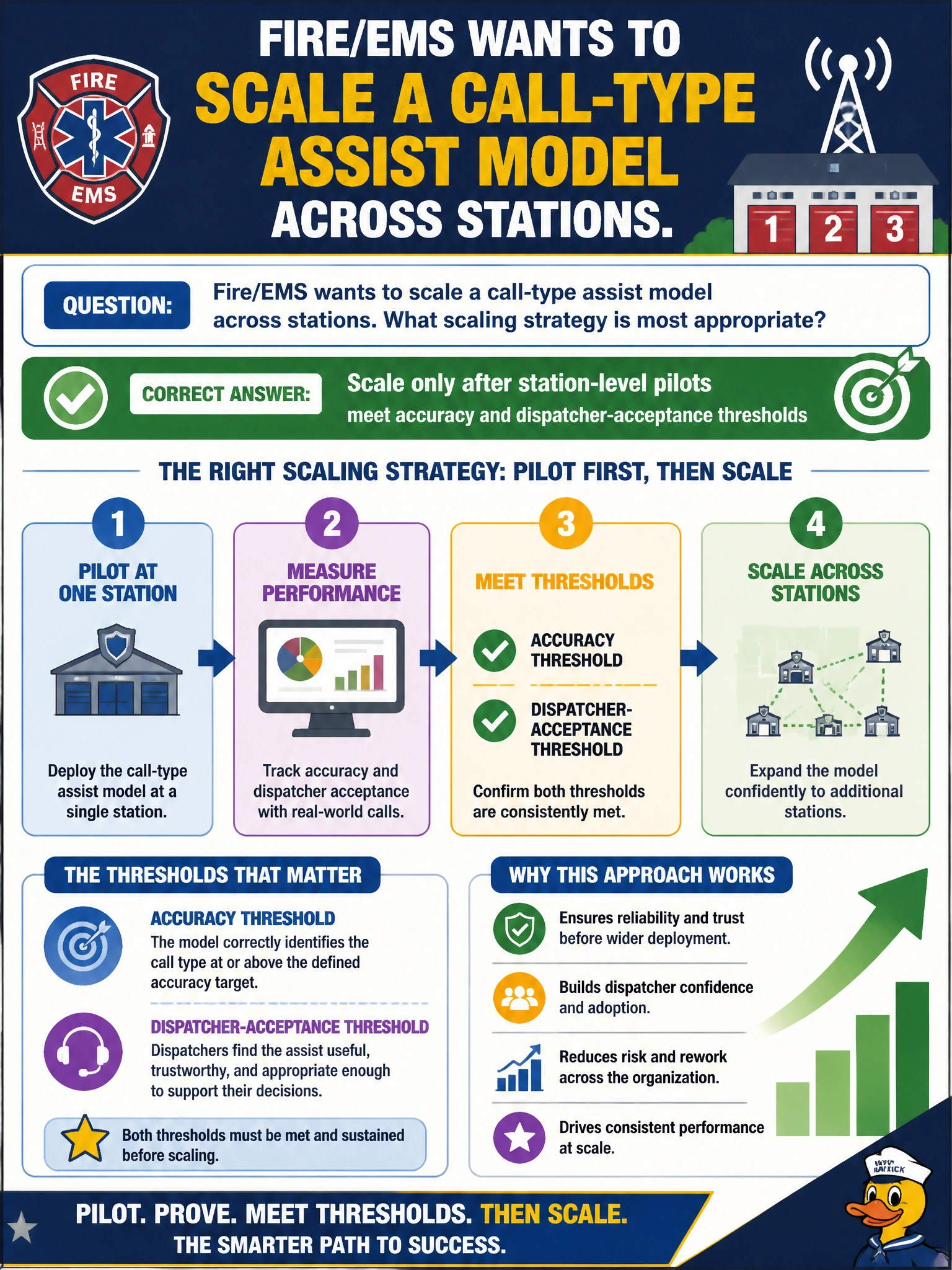
Scaling EMS AI is more “prove it at a few stations” than “spray it everywhere.” Wait until accuracy and dispatcher acceptance clear the bar—then expand.
Full Explanation
The correct answer is scaling the Fire/EMS call-type assist model only after station-level pilots meet accuracy and dispatcher-acceptance thresholds. Scaling strategy in public safety must be evidence-gated: local pilots prove whether call-type suggestions help without harming triage quality, and dispatcher acceptance indicates the tool fits real cognitive workflow. Meeting both thresholds before multi-station rollout reduces the chance of spreading a misleading assist into higher call volume.
Scaling immediately to all stations regardless of pilot results fails by concept because it ignores empirical evidence and safety culture. Scaling based solely on vendor slide-deck accuracy claims fails because marketing claims are not local validation under the city’s call mix. Disabling dispatcher feedback once scaling begins fails because continuous feedback is how drift, edge cases, and usability regressions are caught after expansion.
Exam caveat: scale-after-threshold items pair technical metrics with human acceptance in operational settings. Operational check: define accuracy and acceptance thresholds in the pilot plan, collect dispatcher feedback continuously, and authorize multi-station scale only via a written go decision after thresholds are met.