
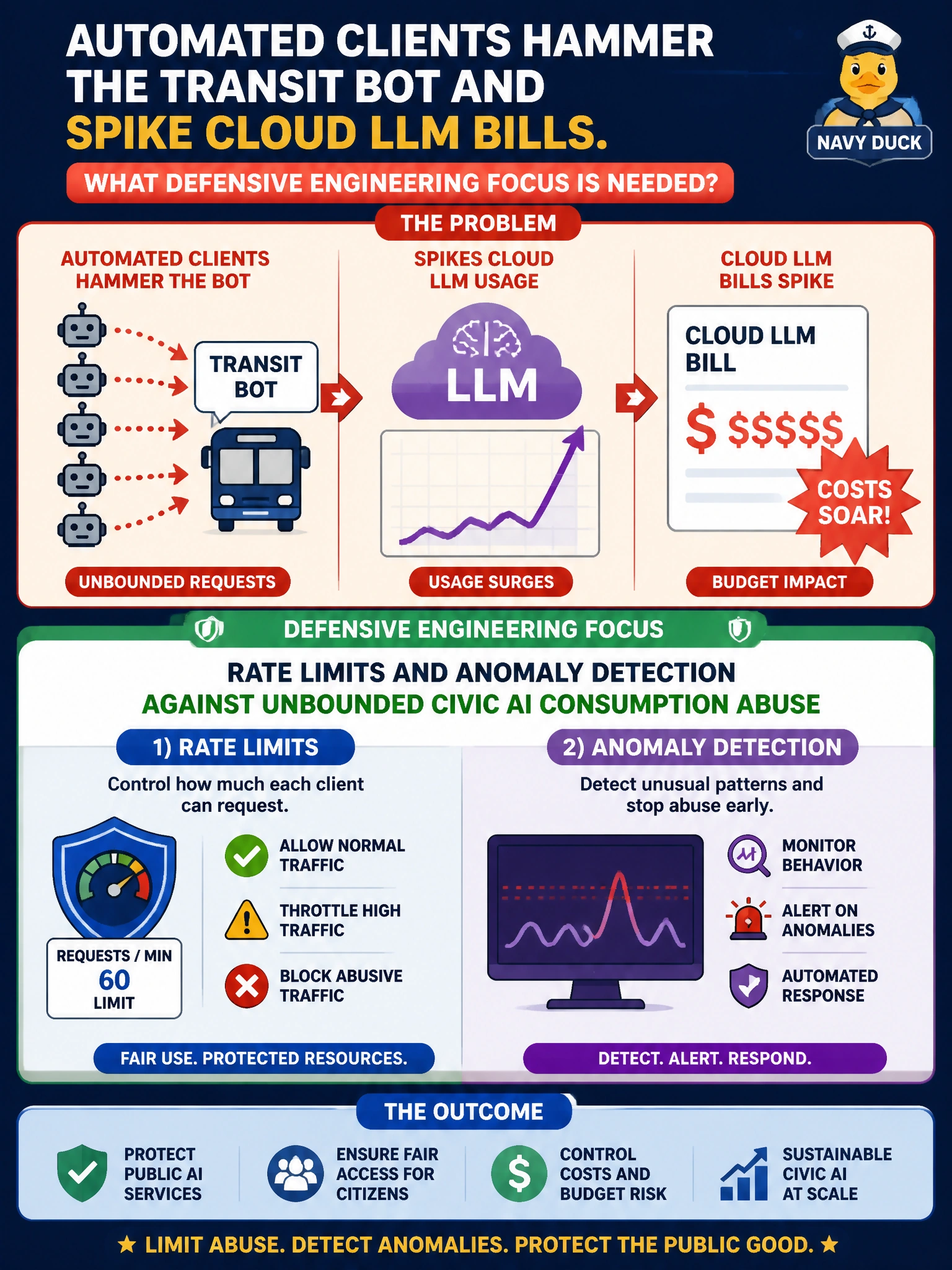
Automated clients hammer the transit bot and spike cloud LLM bills. What defensive engineering focus is needed?
Select an answer to reveal the explanation.
Short Explanation
When bots burn the city’s token budget, that’s denial-of-wallet—rate-limit and watch for weird spend spikes. Glitter maps don’t cap API spend.
Full Explanation
Automated clients hammering the transit bot and spiking cloud LLM bills call for defensive engineering focused on rate limits and anomaly detection against unbounded civic AI consumption abuse—sometimes framed as denial-of-wallet or resource exhaustion. Public or semi-public municipal LLM endpoints without quotas invite scripted floods that degrade service for riders and burn budget without classic 'crash the server' symptoms. Rate limits, API keys/quotas per client class, burst controls, and anomaly detection on token spend and request graphs mitigate that abuse while preserving legitimate rider traffic. Consumption controls are therefore first-class defenses for civic generative endpoints, not optional FinOps afterthoughts. Glitter overlays on transit maps, rainbow turnstile LED modes, and spa music on platform speakers fail conceptually: decorative branding does not cap request rates or detect spend anomalies. Amenities do not constrain LLM consumption. Exam caveat: pure 'scale the GPU cluster' answers address capacity, not abuse; the stem’s bill spike from automated clients points to rate limiting and anomaly detection. Operational check: enforce per-IP and per-key rate limits on the transit bot gateway, alert on token-cost anomalies, and verify load tests that simulated bots are throttled before budgets are exhausted.