
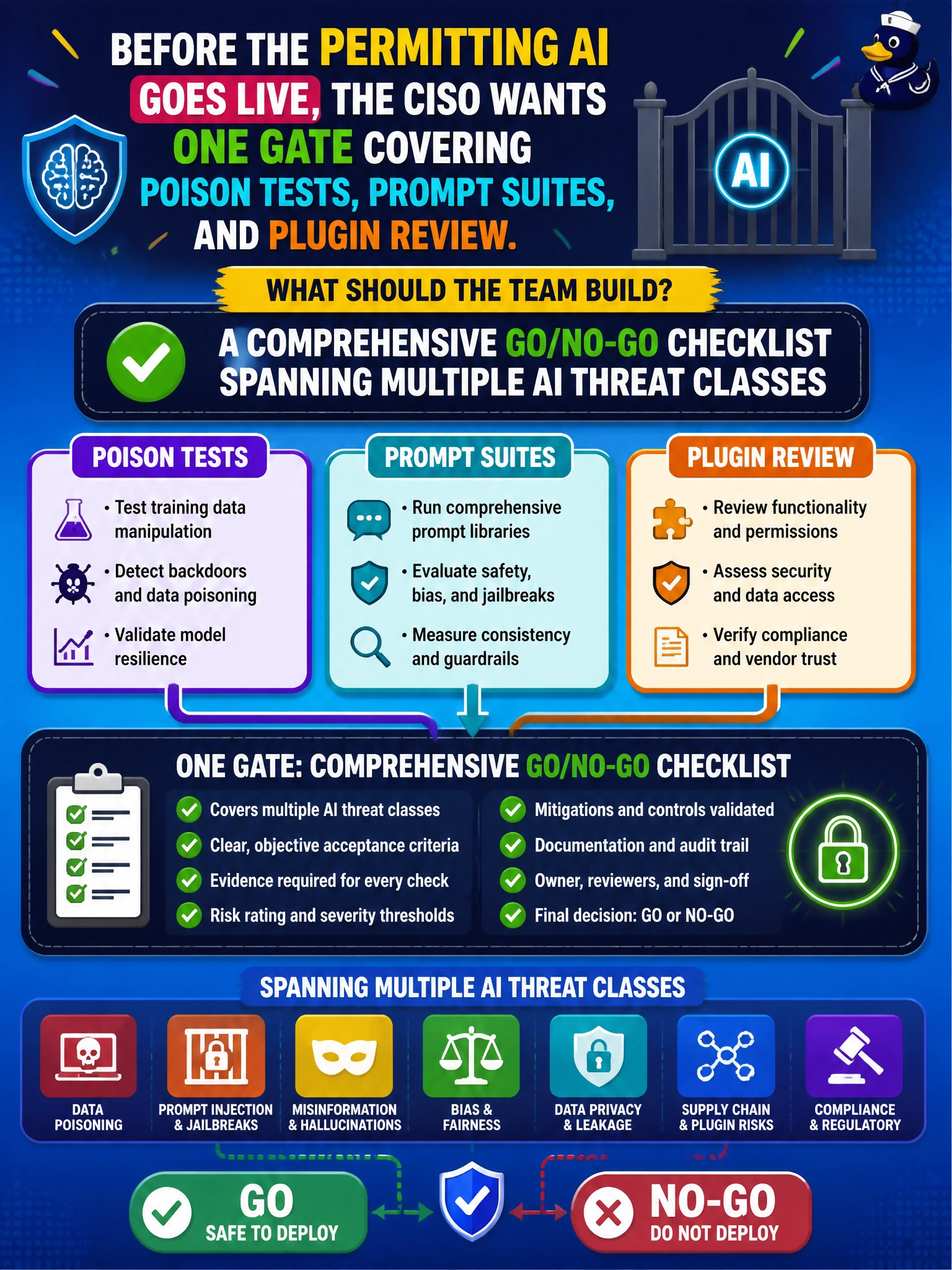
Before the permitting AI goes live, the CISO wants one gate covering poison tests, prompt suites, and plugin review. What should the team build?
Select an answer to reveal the explanation.
Short Explanation
One skinny checklist that only covers one threat class isn't a launch gate—you want poison, prompts, and plugins on the same sheet. Acing one class alone, or just writing it down, isn't a comprehensive gate.
Full Explanation
Before the permitting AI goes live, the CISO’s demand for one gate covering poison tests, prompt suites, and plugin review is satisfied by a comprehensive go/no-go checklist that spans multiple AI threat classes rather than a single functional demo. Poison tests probe whether corrupted or adversarial documents in training or RAG corpora can skew permit guidance; prompt suites exercise jailbreaks, instruction override, and social-engineering of the assistant; plugin or tool review examines authn/z, least privilege, and dangerous side effects when the copilot calls case systems. Packaging those classes into one leadership-visible gate makes coverage explicit and prevents ‘green’ launches based only on happy-path transcripts. Municipal go-live for generative AI that touches permitting must therefore show evidence artifacts per threat class—pass/fail criteria, owners, dates, and residual exceptions—so council and risk committees can see breadth of assurance, not just polish. A staged model card update recording poison metrics and evaluation scores documents one threat class's results after the fact, but a model-card entry is a record, not an enforced go/no-go gate spanning poison, prompts, and plugins the way the CISO asked for. A pre-deployment red-team summary focused on prompt injection findings covers only the prompt-suite class in detail and leaves poison and plugin risks out of the single gate entirely, which is exactly the single-class blind spot the CISO wants closed. A plugin approval workflow verifying tool permissions and data scopes is a real control for the plugin class alone, but by itself it says nothing about poison tests or prompt suites, so it still isn't the comprehensive gate spanning all three classes. The gate has to span all three threat classes together, not substitute thoroughness in one for coverage of the others. Exam caveat: watch for answers that document or enforce just one threat class alone—a model-card entry, a red-team summary, or a plugin workflow—when the stem explicitly requires one gate spanning poison, prompts, and plugins together. Operational check: attach the multi-class checklist to the change ticket for production cutover, require signed evidence for each section, and refuse go-live if any critical class lacks completed testing or documented residual-risk acceptance.