
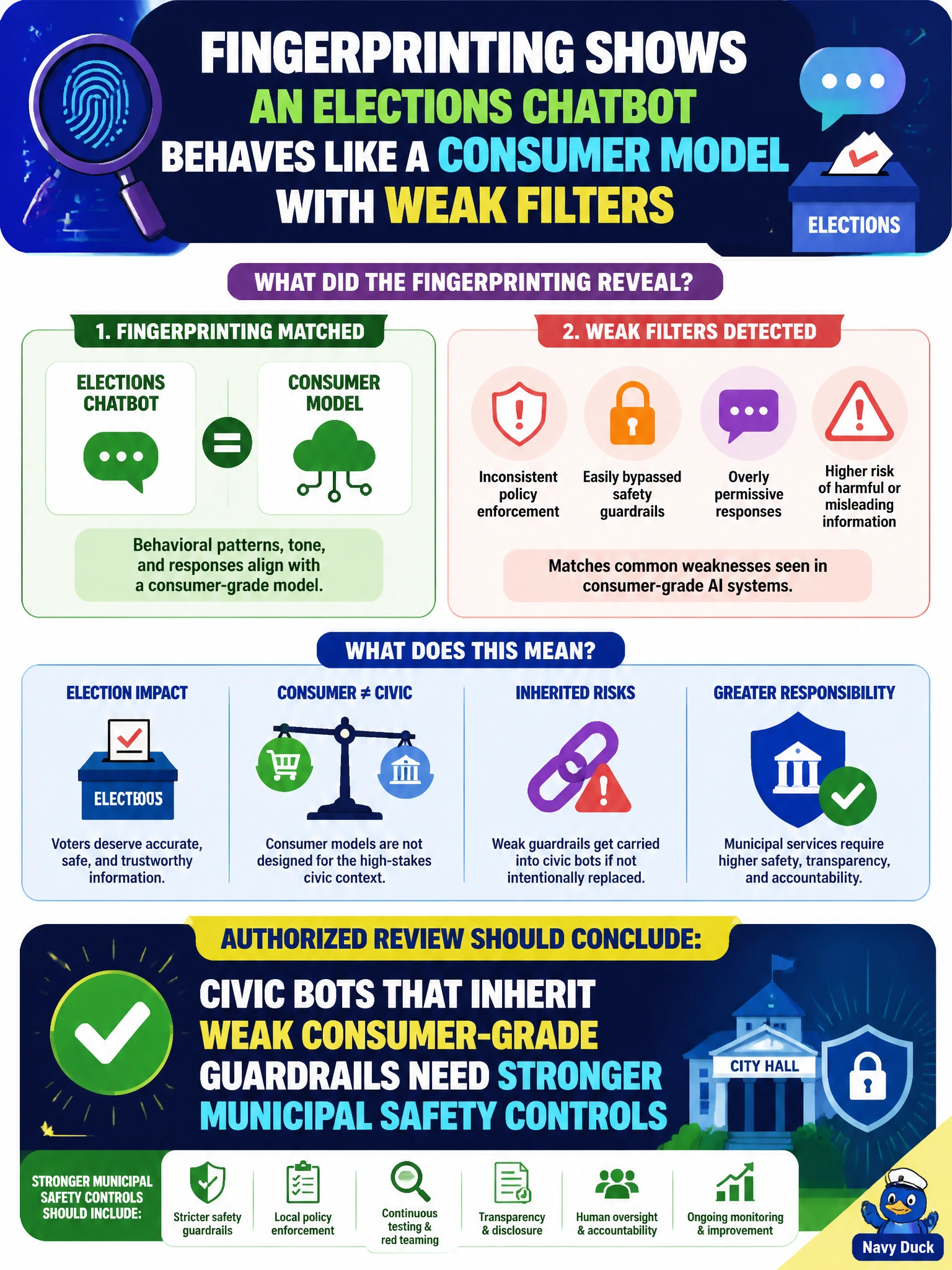
Fingerprinting shows an elections chatbot behaves like a consumer model with weak filters. What should the authorized review conclude?
Select an answer to reveal the explanation.
Short Explanation
If it acts like a casual chat app on election topics, that is a red flag—city bots need tougher rails than consumer toys.
Full Explanation
If fingerprinting shows an elections chatbot behaves like a consumer model with weak filters, the authorized review should conclude that civic bots that inherit weak consumer-grade guardrails need stronger municipal safety controls. Election topics are high-stakes; consumer defaults often prioritize engagement over rigorous refusal, citation discipline, and jurisdiction-specific policy—unacceptable for official voting guidance from a city system.
Applying standard consumer content filters to the elections chatbot for voter information requests simply reinstates the same weak, engagement-first guardrails that caused the problem—it replicates consumer-grade filtering instead of imposing the stronger municipal safety controls the fingerprinting gap requires. Tuning chatbot system prompts to reduce refusal errors flagged by model fingerprinting is a superficial tweak that risks making the bot even more permissive; it does not add the civic-grade refusal, citation, and jurisdiction-specific controls the review should require. Logging the fingerprint similarity in routine monitoring dashboards for election operations is passive observation that leaves the guardrail gap unaddressed—the finding is clear and demands stronger municipal controls, not just a dashboard entry. The review's job is to recognize the gap and require stronger civic-grade safety controls, not to route around it or wave it off.
Exam caveat: fingerprint-like behavior is a risk indicator, not a legal finding of vendor fraud. Confirm with targeted T&E and require municipal overlays—filters, grounded answers, human escalation—regardless of base model branding or marketing claims.
Operational check: impose heightened elections-topic T&E, enforce stronger refusal and grounding controls, and withhold public release until go/no-go safety gates pass for voting-related prompts and known weak-filter failure modes.