
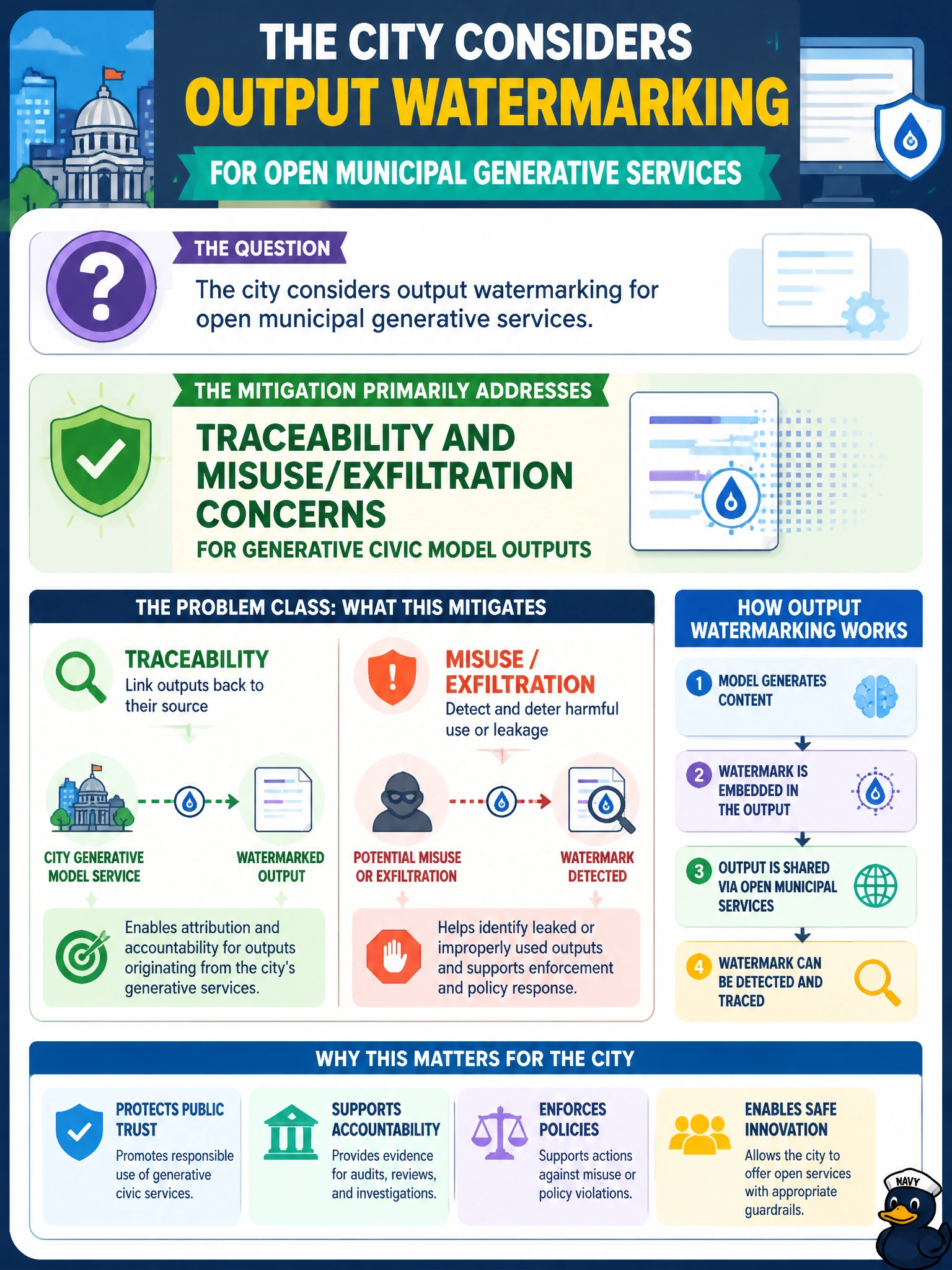
The city considers output watermarking for open municipal generative services. What problem class is that mitigation primarily addressing?
Select an answer to reveal the explanation.
Short Explanation
Watermarks are like invisible city stamps on generated text—helpful when you need to spot misuse later.
Full Explanation
Output watermarking for open municipal generative services primarily addresses traceability and misuse or exfiltration concerns for generative civic model outputs. Watermarks or similar provenance marks help later identify content that originated from city generative systems, supporting investigation of misuse, policy violations, or unauthorized redistribution of synthetic civic content across public channels.
Improving factual accuracy and reducing hallucinations treats watermarking as a quality-control fix, which isn't why a city would adopt it; watermarks don't make generated content more truthful or reliable. Screening inputs and filtering disallowed requests happens before generation, whereas watermarking only tags output after it's produced; a watermark does not stop prohibited prompts or block harmful requests at the door. Managing access control and authentication is a separate gatekeeping layer; watermarking labels output provenance but does not verify who can use the service or prevent unauthorized users from reaching the model. The actual problem watermarking targets is knowing where generated text came from after the fact, for tracing misuse or leaked output, not improving factual accuracy or screening inputs.
Exam caveat: watermarking aids detection and attribution; it is not a complete anti-extraction or anti-abuse control by itself, and robustness varies by scheme and attacker effort. Pair watermarks with quotas, access control, monitoring, and acceptable-use enforcement.
Operational check: define which municipal generative endpoints emit watermarks, document detection tooling for investigators, and test that marks survive common transformations used in misuse scenarios without breaking legitimate accessibility or records requirements.