
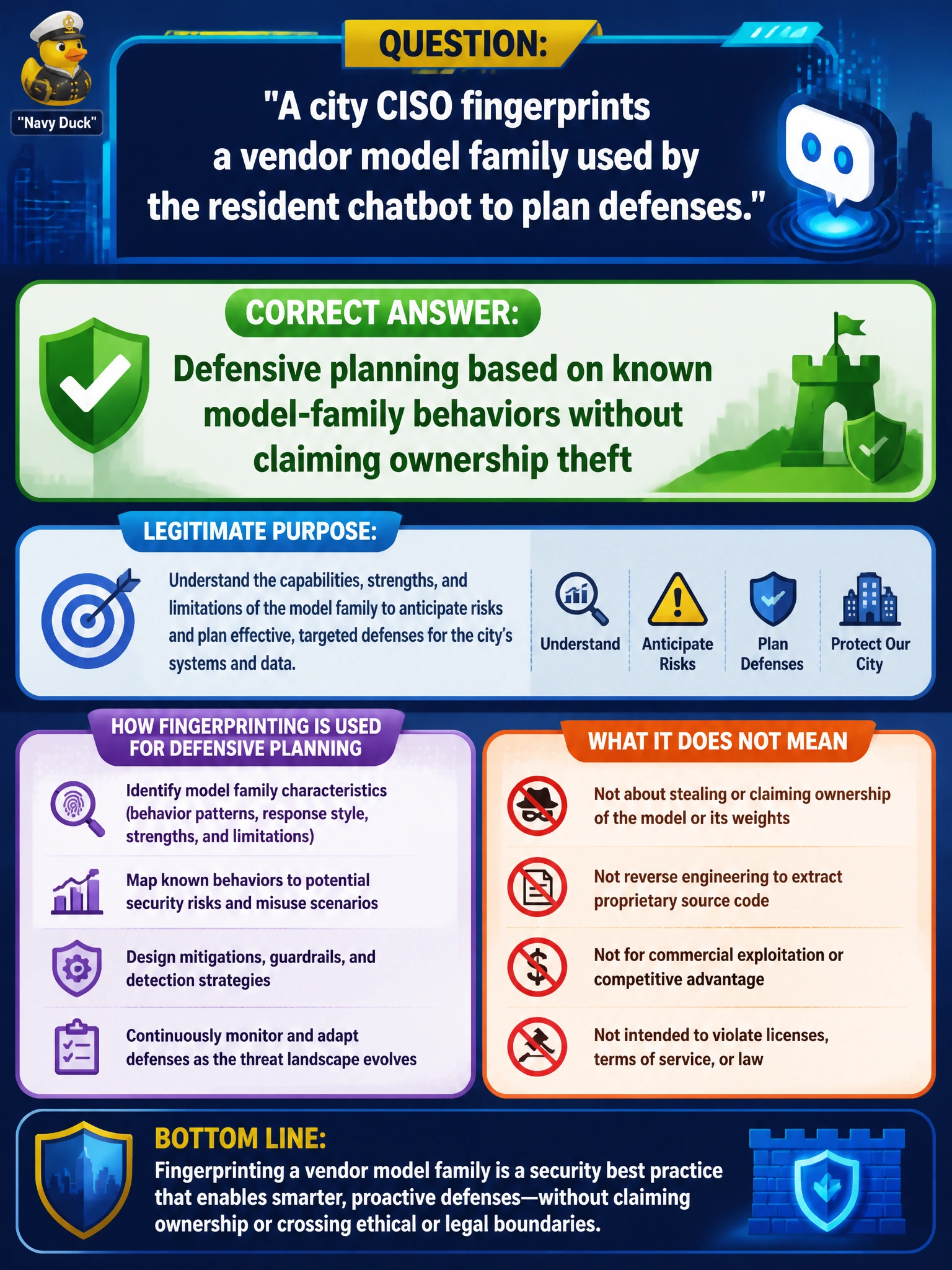
A city CISO fingerprints a vendor model family used by the resident chatbot to plan defenses. What is the legitimate purpose of that fingerprinting?
Select an answer to reveal the explanation.
Short Explanation
Fingerprinting is like checking which lock brand is on the door so you buy the right defenses—not stealing the whole house.
Full Explanation
When a city CISO fingerprints a vendor model family used by the resident chatbot, the legitimate purpose is defensive planning based on known model-family behaviors without claiming ownership theft. Fingerprinting helps infer likely capabilities, default guardrails, documented weaknesses, and suitable hardening patterns so municipal defenders can prioritize controls, monitoring, and T&E suites appropriate to that family.
Publishing known model fingerprints in public threat bulletins would hand attackers a roadmap to the chatbot's weaknesses instead of protecting it—defensive fingerprinting stays internal to planning, not public disclosure. Using a model fingerprint to attribute chatbot evasion attempts to a specific threat actor overreaches what family-level fingerprinting can establish; it reveals likely model behaviors, not the identity of the attacker behind an evasion attempt. Treating a matched fingerprint as proof of model theft overstates what behavioral fingerprinting can establish; shared behavior patterns across a model family are expected and don't themselves prove misappropriation. The legitimate use stays narrow: know what you're defending against without overreaching into accusation or disclosure.
Exam caveat: defensive fingerprinting supports hardening and risk communication; it is not authorization to clone, redistribute, or misappropriate vendor models. Results should be treated as hypotheses confirmed by documentation and testing, not as absolute attribution.
Operational check: record fingerprint findings in the chatbot’s threat model and map them to specific municipal controls (rate limits, content filters, logging, red-team suites) with owners and review dates.