
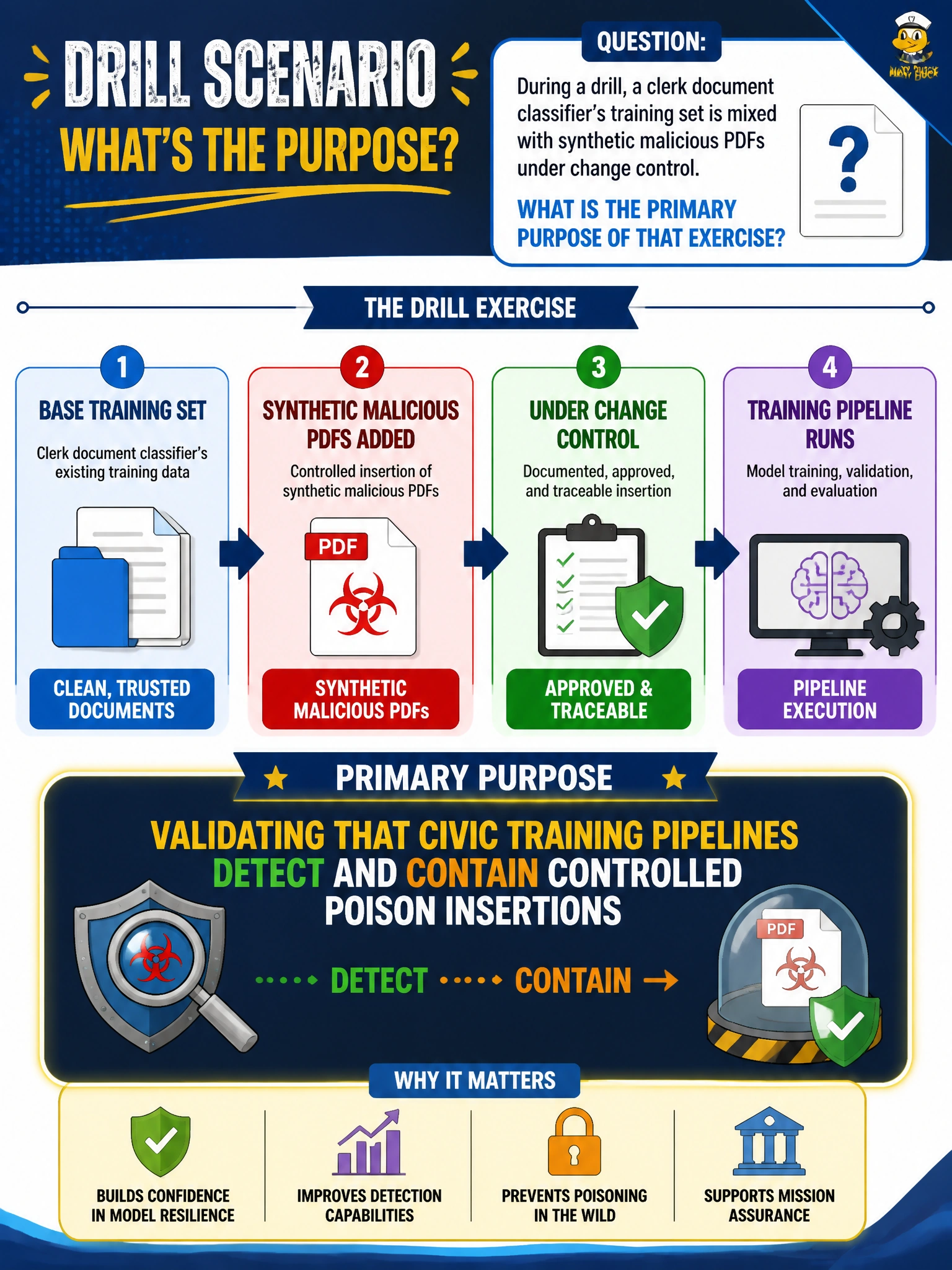
During a drill, a clerk document classifier’s training set is mixed with synthetic malicious PDFs under change control. What is the primary purpose of that exercise?
Select an answer to reveal the explanation.
Short Explanation
A controlled poison drill is a fire drill for the training pipe—see if detectors catch the planted junk.
Full Explanation
During a drill that mixes a clerk document classifier's training set with synthetic malicious PDFs under change control, the primary purpose is validating that civic training pipelines detect and contain controlled poison insertions. Authorized poison drills are fire drills for MLOps: known-bad artifacts are inserted deliberately so detection, quarantine, alerting, and rollback can be measured. They are evaluation activities, not production sabotage, and should leave an audit trail of authorization, blast radius, and cleanup.
Measuring baseline classifier accuracy on clean archival filings is benchmarking, not poison detection, and does not validate whether malicious insertions are caught or contained. Verifying that records retention schedules archive training samples after mandated holding periods is records-management compliance, not a training-pipeline sensor exercise for poison insertions. Confirming that OCR preprocessing normalizes scanned intake forms for text extraction is about document processing quality, not detecting or containing controlled poison insertions. These options fail because they substitute adjacent operational or compliance tasks for the controlled security exercise objective.
Exam caveat: controlled insertion requires formal authorization, scoped environments, and guaranteed removal; accidentally leaving synthetic malice in production training is itself an incident. Success criteria should be pre-declared (time-to-detect, whether training jobs blocked, whether artifacts were quarantined). Distinguish drills from undisclosed red-team dumps without change control.
Operational check: execute the PDF poison drill in staging with tickets filed; confirm detectors fire, training fails closed or isolates the batch, and responders follow the civic playbook. After cleanup, verify digests match the known-good corpus and that production never trained on the synthetic set. Capture metrics for the next maturity review of municipal document-classifier MLOps.