
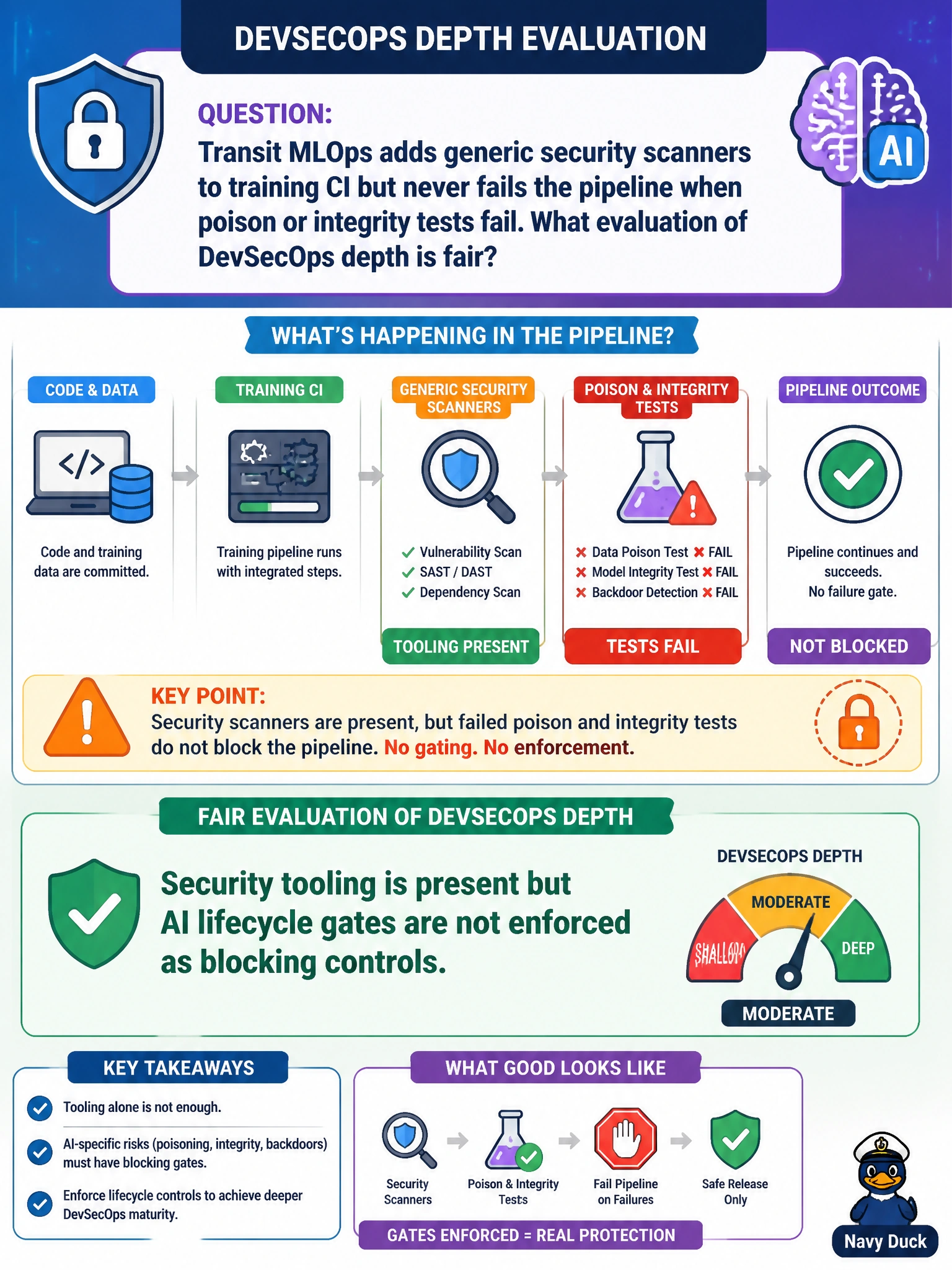
Transit MLOps adds generic security scanners to training CI but never fails the pipeline when poison or integrity tests fail. What evaluation of DevSecOps depth is fair?
Select an answer to reveal the explanation.
Short Explanation
Scanners that never stop a bad run are décor. Blocking poison tests are the real brakes.
Full Explanation
When transit MLOps adds generic security scanners to training CI but never fails the pipeline when poison or integrity tests fail, a fair evaluation is that security tooling is present but AI lifecycle gates are not enforced as blocking controls. Scanners without fail-closed policy create a false sense of DevSecOps maturity: findings can be ignored while poisoned or unverified datasets still train production models. Depth requires that integrity and poison evaluations are mandatory gates with owners and severity rules—not optional dashboards.
Generic SAST coverage in CI finds code-level vulnerabilities like injection or unsafe deserialization; it was never designed to detect a poisoned training dataset, so claiming it satisfies training data poisoning and integrity requirements overstates what a code scanner checks. Storing scanner output in CI logs creates a record of what ran, but a log entry is not an enforced policy—writing results to a log does not block promotion of a dataset that failed its provenance check. Clean infrastructure scan results show the build environment is healthy, but that says nothing about whether the training data in that run was authentic, so it cannot validate model artifact lineage for release. These options fail because they treat adjacent controls as if they substituted for AI-specific gates that actually block a bad run.
Exam caveat: generic SAST and container scans remain useful for civic ML repos, but they do not substitute for dataset integrity and poison tests. Exam answers often hinge on whether controls are blocking versus merely present or merely logged.
Operational check: configure the training pipeline so checksum mismatches, failed poison canaries, or missing dataset signatures exit non-zero and prevent artifact publication. Page on-call when gates fail and require documented waiver with expiry. Audit recent transit training jobs for any that shipped despite open integrity findings—if any did, DevSecOps depth is still insufficient.