
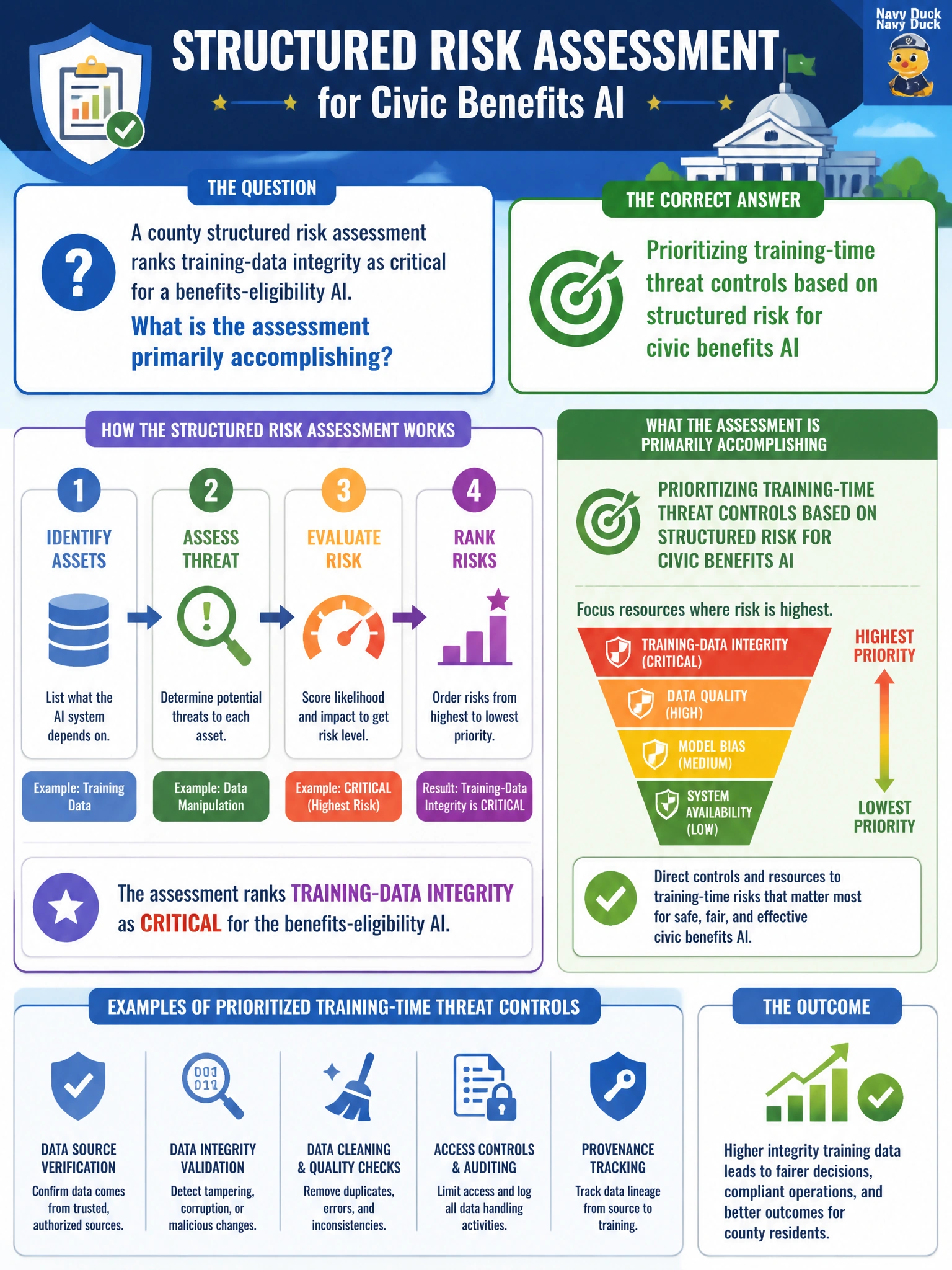
A county structured risk assessment ranks training-data integrity as critical for a benefits-eligibility AI. What is the assessment primarily accomplishing?
Select an answer to reveal the explanation.
Short Explanation
Calling training integrity critical just means you put the strongest locks on the data that trains the model. It's about prioritizing training-time threat controls, not post-deployment drift monitoring or applicant-group fairness metrics.
Full Explanation
A county structured risk assessment that ranks training-data integrity as critical for a benefits-eligibility AI is primarily prioritizing training-time threat controls based on structured risk for civic benefits AI. Risk ranking drives where limited municipal security effort goes: if poisoned or tampered labels could wrongly grant or deny benefits, provenance, dual review, poison testing, and access control on training data become first-order controls. The assessment's accomplishment is prioritization and resource direction—not marketing of benefits materials.
Mapping certified training dataset lineage for audit traceability is a documentation and audit task, not the act of prioritizing training-time threat controls based on structured risk. Maintaining active post-deployment monitoring for model drift happens after deployment and doesn't address the training-data integrity prioritization at issue. Validating targeted eligibility decision fairness metrics across applicant groups is a program-oversight activity, not the governance decision about where limited municipal security effort goes. Each option mistakes a partial or administrative step for the actual outcome of structured, risk-based prioritization.
Exam caveat: calling a risk 'critical' does not mean other AI risks (model theft, prompt injection, serving abuse) are irrelevant—it means training integrity deserves elevated controls for this system. Structured assessment should remain evidence-based and revisit rankings when architecture or data sources change. Also separate inherent risk (impact of wrong eligibility decisions) from control effectiveness.
Operational check: translate the critical rating into a control set with owners—dataset signing, annotator dual control, poison/canary tests in CI, and blocked promotion on integrity failure. Verify the next benefits-model release cannot skip those gates. Re-score residual risk after controls are evidenced so the county's register reflects actual civic AI posture.