
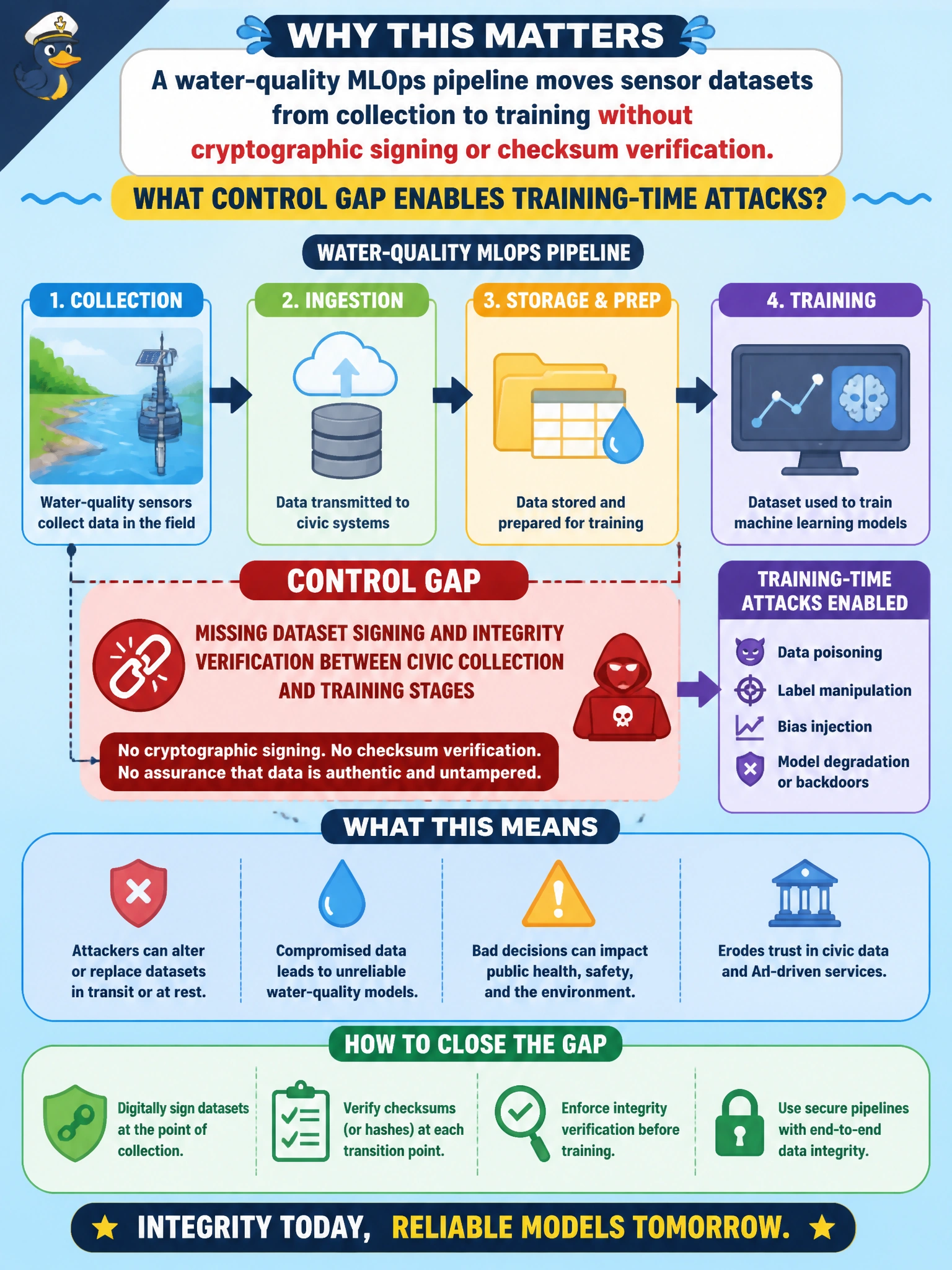
A water-quality MLOps pipeline moves sensor datasets from collection to training without cryptographic signing or checksum verification. What control gap enables training-time attacks?
Select an answer to reveal the explanation.
Short Explanation
Unsigned datasets moving from collection to training are like unlabeled water samples. Anyone could swap the jug and you'd never know.
Full Explanation
A water-quality MLOps pipeline that moves sensor datasets from collection to training without cryptographic signing or checksum verification has a control gap of missing dataset signing and integrity verification between civic collection and training stages. Without integrity binding, an attacker—or silent corruption—can alter readings between the plant or lab systems and the training bucket, teaching the model false water-quality patterns. Lifecycle controls should hash or sign datasets at collection, verify at each handoff, and refuse training on mismatched digests. That gap is what enables many training-time attacks against municipal environmental ML.
Incomplete model version tracking across retraining cycles in the central experiment registry is a reproducibility and governance concern—knowing which trained artifact is which—not a check on whether the sensor data that fed training was authentic before it ever arrived. Gaps in encrypted transport for live sensor telemetry streams to the municipal operations dashboard would expose data in transit to a dashboard, a confidentiality issue downstream of training, not the missing signing or checksum step between collection and the training stage itself. Limited production drift monitoring for deployed water-quality models in field operations is a post-deployment observability gap that catches degraded accuracy after the fact, not the upstream integrity control that stops tampered data from reaching the trainer in the first place. Distractors fail by pointing at version tracking, transport encryption, or drift monitoring—real MLOps concerns, but none of them establish that the training dataset itself is authentic and unaltered.
Exam caveat: signing and checksums detect unauthorized change; they do not by themselves prove sensors were accurate at the source. Pair integrity verification with access control, dual review for sensitive corpora, and monitoring for statistical outliers. Missing integrity between stages is a classic MLOps finding distinct from version-registry, transport, or drift-monitoring gaps.
Operational check: generate a digest at collection export, store it in a write-once audit log, and require the training job to verify the digest before fit begins. Alert on mismatch and quarantine the dataset. Tabletop a swapped-file scenario for water-quality ML to confirm the pipeline fails closed rather than silently training on tampered civic sensor data.