
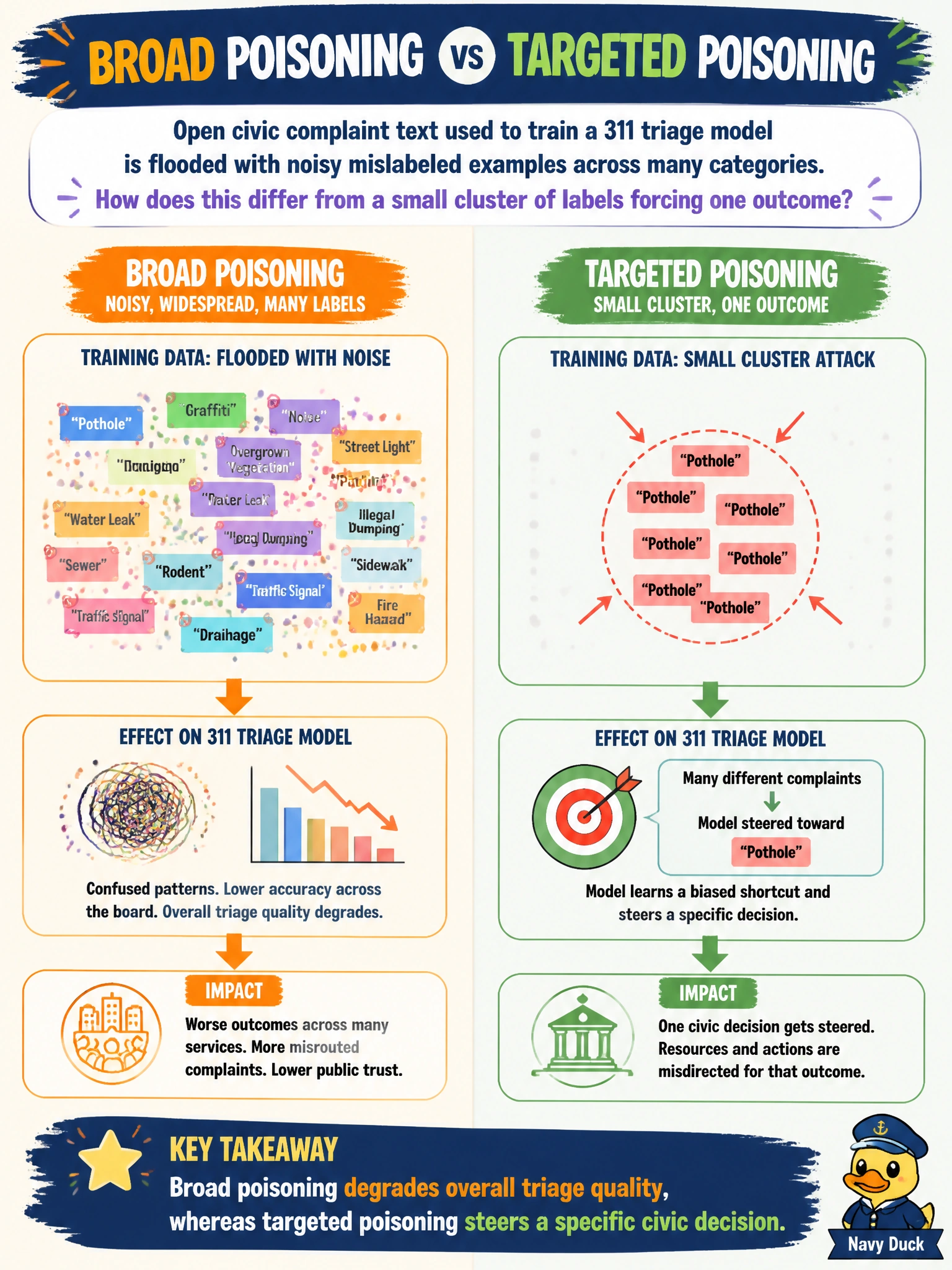
Open civic complaint text used to train a 311 triage model is flooded with noisy mislabeled examples across many categories. How does this differ from a small cluster of labels forcing one outcome?
Select an answer to reveal the explanation.
Short Explanation
Broad poison is like dumping sand in every gear; targeted poison bends one lever. Know which mess you face.
Full Explanation
Open civic complaint text flooded with noisy mislabeled examples across many categories is broad poisoning that degrades overall 311 triage quality, whereas a small cluster forcing one outcome is targeted poisoning that steers a specific civic decision. Broad corruption raises error rates across classes, confuses routing, and erodes resident trust in triage generally. Targeted corruption keeps most behavior looking normal while bending one lever (for example, always escalate or always close a chosen category). Recognizing which pattern is present determines monitoring signals, forensic scope, and remediation: global data cleansing versus hunting a purposeful label pocket.
Claiming broad label noise improves triage robustness through regularization while targeted clusters merely test edge-case handling mistakes diffuse poisoning for a benefit and an attack for a feature; broad noise degrades overall triage quality, and targeted clusters deliberately steer one civic decision. Saying broad mislabeling is just reporting variation over time and clustered labels merely reveal geographic service gaps misses that broad corruption is poisoning that raises error rates across classes, while a tight cluster is targeted steering of one outcome. Arguing that broad poisoning exploits inference phrasing variations while targeted poisoning merely adjusts confidence thresholds for one category misdescribes both: broad poisoning degrades overall triage quality across many categories, and targeted poisoning forces a specific civic decision. These distractors fail because they collapse or ignore the conceptual difference between diffuse quality destruction and steered decisions.
Exam caveat: both patterns are training-time integrity attacks, but exam stems often ask you to contrast impact. Broad is not merely a louder version of targeted; the threat models and defenses differ. Also, legitimate concept drift or policy changes can look like quality loss—pair statistical detection with provenance review before declaring poisoning.
Operational check: plot per-class label entropy and disagreement rates over time for the 311 training corpus. Diffuse spikes across many categories with diverse annotators suggest broad poisoning or systemic labeling failure; a tight cohort driving one disposition suggests targeted steering. Scope cleanup and dual-control review accordingly, then re-evaluate triage F1 on a clean municipal gold set before promoting the model.