
Before new agent plugins reach production, a county CISO requires an inventory of models, tools, and dependencies similar to a software bill of materials. What practice is being instituted?
Select an answer to reveal the explanation.
Short Explanation
An AIBOM is a packing list for AI parts—know every model, tool, and plugin before it goes live.
Full Explanation
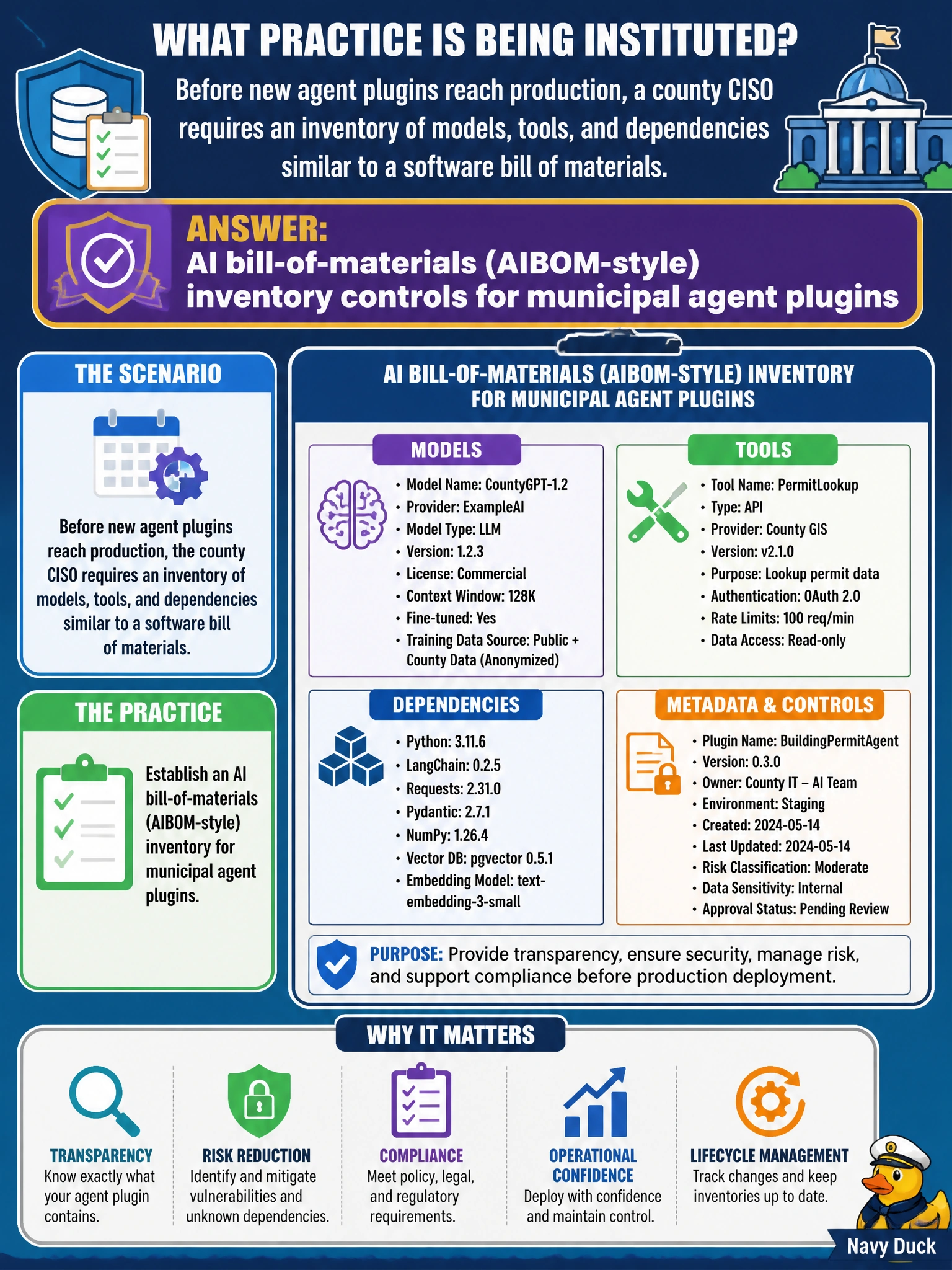
Requiring an inventory of models, tools, and dependencies before new agent plugins reach production is instituting AI bill-of-materials (AIBOM-style) inventory controls for municipal agent plugins. An AIBOM gives the county visibility into which foundation models, tool connectors, libraries, and data sources a plugin uses so allow-listing, vulnerability tracking, license review, and incident scoping are possible. Without that inventory, a municipal agent can quietly introduce unapproved tools or vulnerable dependencies into citizen-facing workflows. The CISO's gate is therefore a lifecycle governance control analogous to SBOM practice, adapted to AI components.
Centralized runtime tool permission monitoring dashboards observe permissions during execution but do not create the pre-production inventory of models, tools, and dependencies required by the CISO. Pre-release red-team prompt injection testing evaluates resilience to adversarial prompts but does not inventory the components a plugin depends on before it reaches production. Versioned prompt template change tracking records revisions to prompts but does not enumerate the models, tools, libraries, and data sources that make up the plugin's supply chain. These options address runtime permissions, adversarial testing, or template versioning, but none establishes the required pre-production inventory of AI components.
Exam caveat: an AIBOM inventory is a visibility and control foundation—it does not by itself prove a plugin is safe. It must be paired with review gates, signing, and runtime monitoring. Also distinguish AIBOM (models, tools, AI deps) from a classic SBOM of only OS packages; municipal agent plugins need both layers when containers and AI tooling ship together.
Operational check: before promotion, require a completed inventory listing model identifiers/versions, tool endpoints, third-party SDKs, and data stores touched by the plugin; reject promotion if any component lacks an owner or is outside the municipal allow-list. Store the AIBOM with the change record so a later incident can answer which plugins used a compromised model or library. Spot-check that the declared inventory matches what the plugin actually loads in staging.