
When mission-mapping prompt-test priority across city bots, which systems should rank highest?
Select an answer to reveal the explanation.
Short Explanation
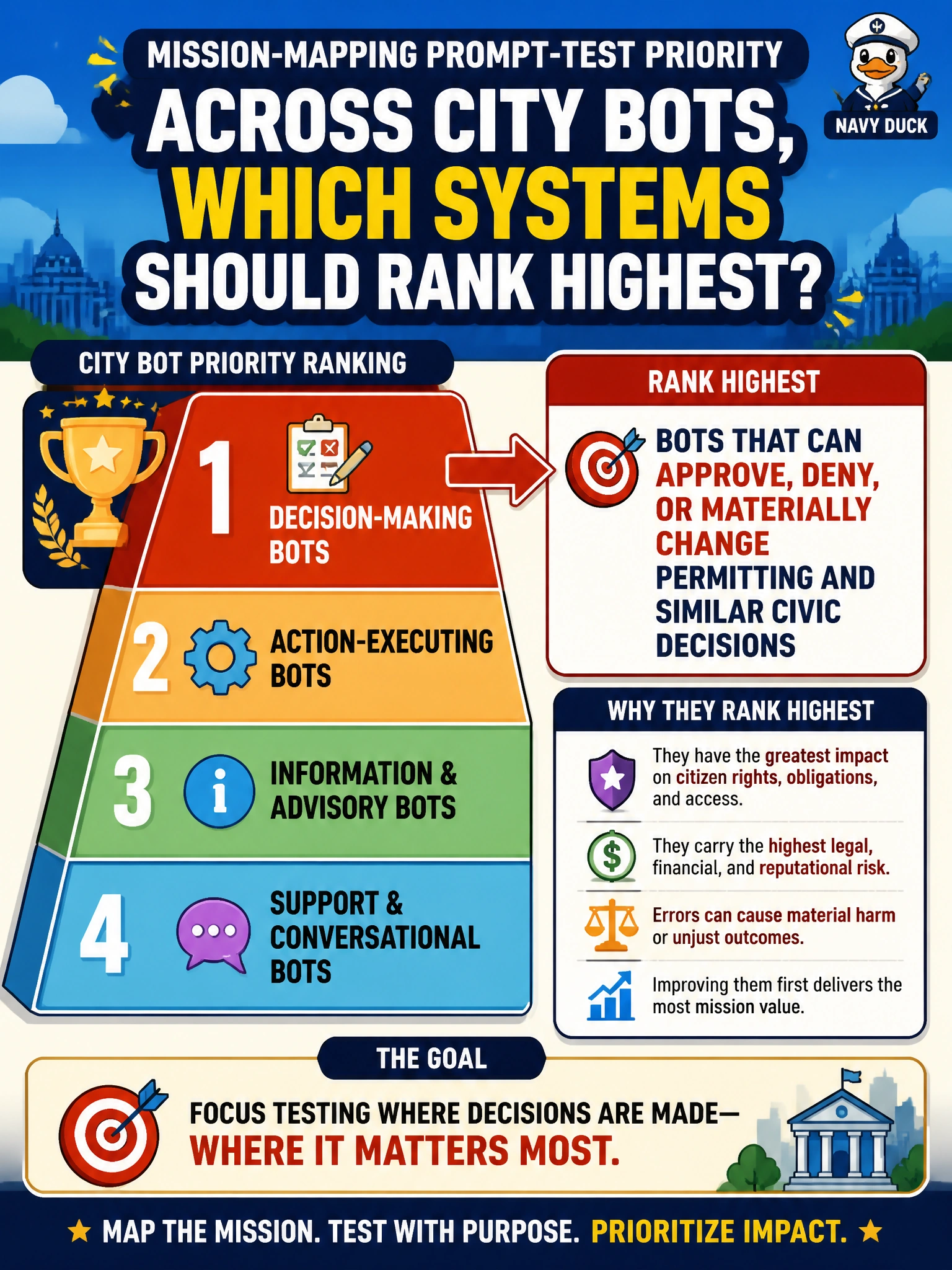
Put the heat on bots that can say yes or no to a permit—not the one that just displays decorative weather. Mission-mapping means prompt tests follow civic decision power.
Full Explanation
Mission-mapping prompt-test priority across city bots ranks highest those systems whose outputs can approve, deny, or materially change permitting and similar civic decisions. Decision power concentrates impact: a compromised or injectable permitting assistant can alter fees, timelines, eligibility narratives, or routing in ways that affect residents and city liability. Correct prioritization follows civic authority and consequence, not novelty of the chatbot interface. A system that could be exploited to flood emergency dispatch with fabricated requests is a serious risk, but the question asks which bots should rank highest for mission-mapping by decision authority, not which has the scariest isolated failure mode—dispatch-flooding risk still has to be weighed against actual decision-making power. Estimating average daily paper-form volume at the 311 center is an operations metric, not a prioritization criterion for prompt-testing effort. Decorative weather-only kiosks lack generative decision influence and are poor top-tier targets for prompt-exploitation T&E. Exam caveat: lower-priority systems may still need baseline testing, but mission-mapping explicitly sequences effort toward decision-critical municipal AI first. Operational check: inventory bots by ability to change case state, trigger workflows, or advise binding outcomes; score impact and exposure; schedule deep prompt tests for permitting and analogous decision agents before expanding to informational FAQ assistants.