
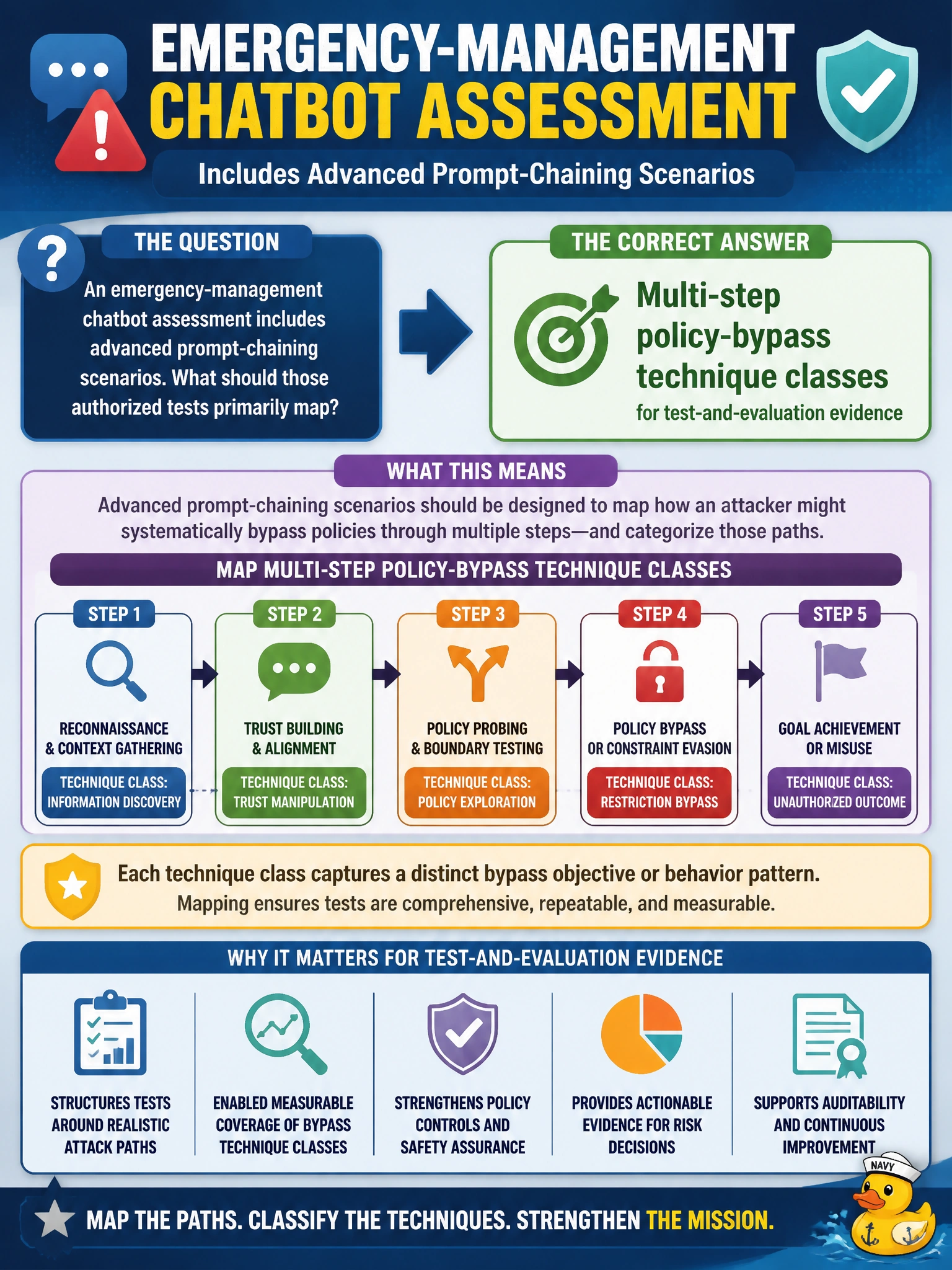
An emergency-management chatbot assessment includes advanced prompt-chaining scenarios. What should those authorized tests primarily map?
Select an answer to reveal the explanation.
Short Explanation
Chaining prompts is like testing a sequence of doors—not one kick, but a path. In an authorized emergency-bot T&E, you're mapping multi-step bypass classes for evidence, not just checking whether output filters block disallowed content in single-turn prompts.
Full Explanation
Advanced prompt-chaining scenarios in an authorized emergency-management chatbot assessment primarily map multi-step policy-bypass technique classes for test-and-evaluation evidence. Chaining explores whether sequential adversarial turns can erode constraints that a single prompt cannot, producing durable evidence about session-level policy resilience. That mapping informs control design (re-anchoring instructions, turn limits, escalation detectors) for civic emergency assistants without turning the engagement into an unrelated event-planning exercise. Whether error messages reveal system architecture is a specific information-disclosure bug, narrower than the general class of multi-step policy-bypass techniques the chaining scenario is built to map. Whether careful questioning can leak internal routing or escalation policies is one possible outcome of a successful chain, but it describes an effect rather than the technique-mapping objective the test authorizes. Testing whether output filters block disallowed content in single-turn test prompts is a single-turn filter check unrelated to whether sequential adversarial turns erode policy constraints across a chain. Exam caveat: authorized T&E documents technique classes and success conditions at a professional level; it does not publish step-by-step jailbreak payloads for uncontrolled reuse. Operational check: define chain stages and expected policy checkpoints, measure whether constraints reset or weaken across turns, retain evidence in a controlled findings store, and brief emergency managers on residual bypass classes that could affect guidance integrity during incidents.