
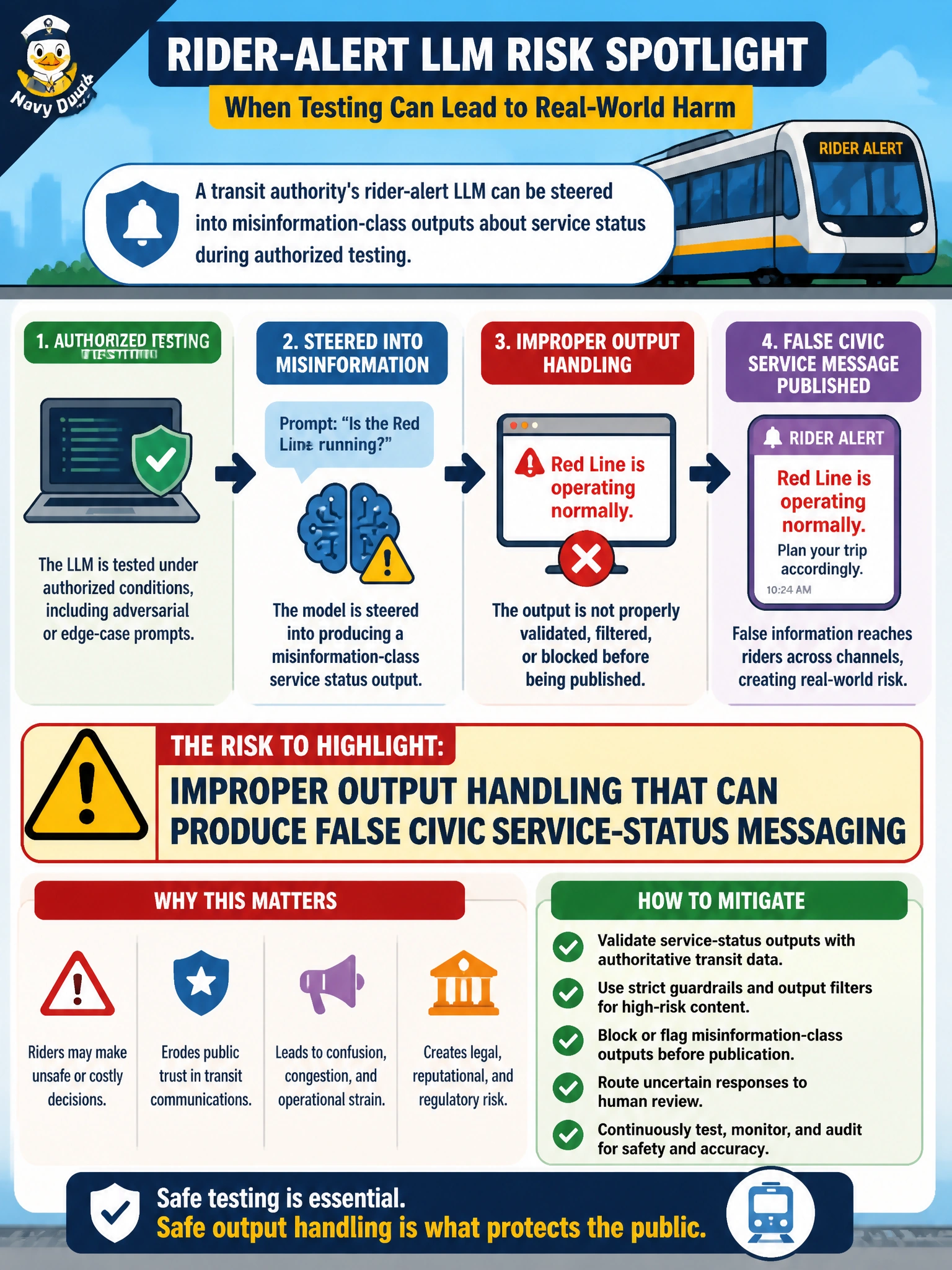
A transit authority's rider-alert LLM can be steered into misinformation-class outputs about service status during authorized testing. What risk should the assessment highlight?
Select an answer to reveal the explanation.
Short Explanation
If a rider bot can be nudged into saying the wrong line is running, that's not an automated-dispatch or system-prompt leakage problem—it's bad output handling that can spread false service news. High token consumption from complex timetable queries is a latency issue, not why the bot's status claims are wrong. Call the risk, then harden the alert path.
Full Explanation
A transit authority rider-alert LLM that can be steered into false service-status claims during authorized testing demonstrates improper output handling with direct civic impact: riders may receive misinformation about delays, closures, or line status. The assessment should highlight that generative outputs affecting public safety messaging lack sufficient validation, grounding, or policy enforcement before they are treated as operational truth. Correct risk framing prioritizes integrity controls on service-status channels over unrelated amenities. Excessive agency enabling automated dispatch of unverified service alerts to riders is a deployment concern, but it doesn't address whether the model's output can be steered into false service-status claims in the first place. System prompt leakage revealing internal routing logic for service disruption handling is about confidentiality, a different risk surface than the content integrity of what it says about service status. High token consumption from complex timetable queries increasing inference latency during peak hours describes a performance issue, not why the model's generated status claims can be factually wrong. Exam caveat: highlighting misinformation risk is not the same as claiming the model was 'hacked' in a classic network sense; COASP-aligned write-ups tie the failure to output handling, grounding, and release controls. Operational check: require status answers to cite authoritative feeds or allow-listed APIs, block free-form status claims when retrieval fails, run adversarial steering tests before release, and route critical alerts through human or rule-based confirmation for transit operations.