
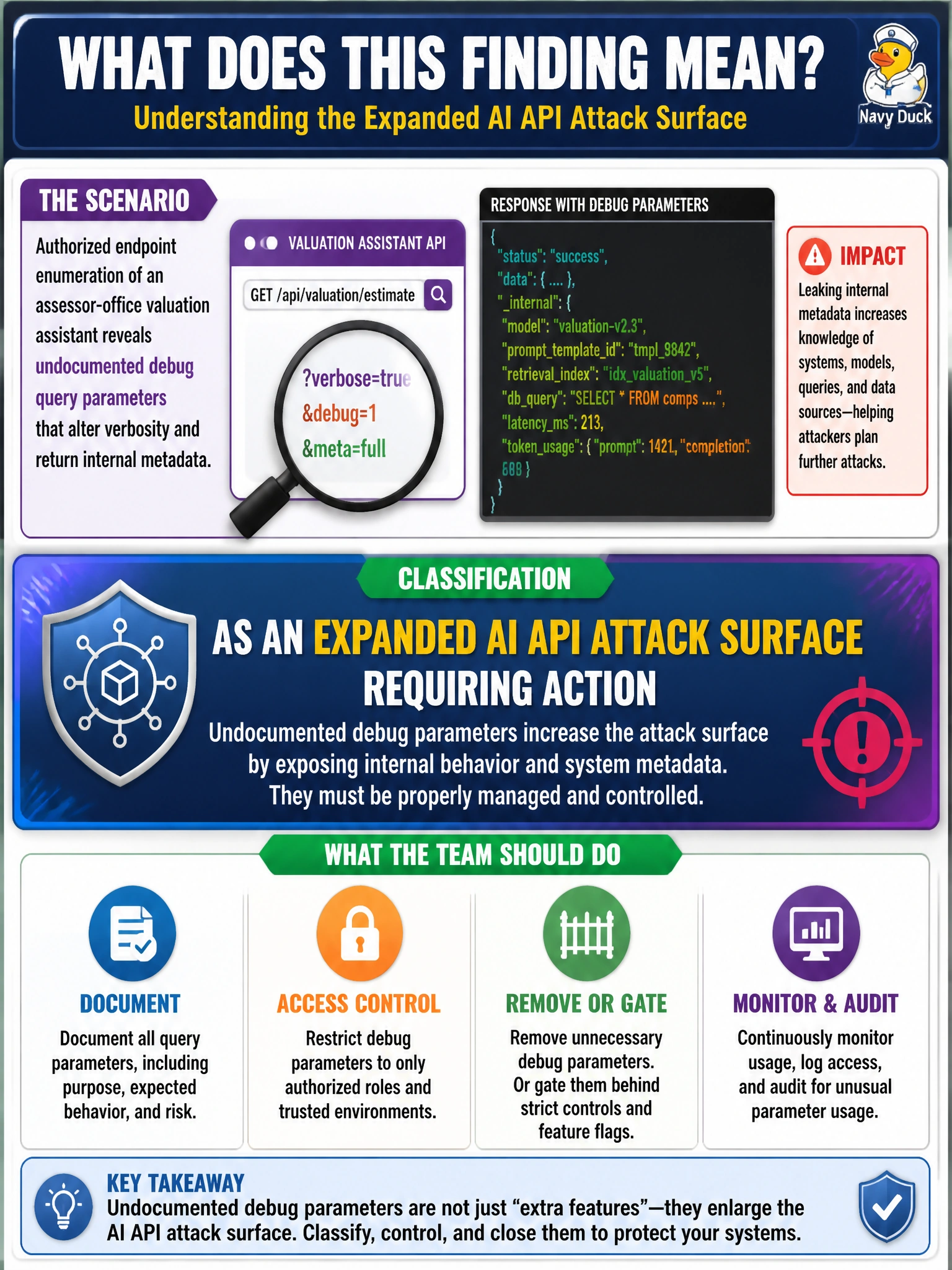
Authorized endpoint enumeration of an assessor-office valuation assistant reveals undocumented debug query parameters that alter verbosity and return internal metadata. How should the team classify this?
Select an answer to reveal the explanation.
Short Explanation
Undocumented debug knobs on a civic AI API are like a side door labeled 'janitor' that still opens the vault hallway. You should flag them for locking and inventory, but don't treat them as a prompt-injection problem requiring hardened system instructions and filtered parcel queries.
Full Explanation
Authorized endpoint enumeration of an assessor-office valuation assistant that reveals undocumented debug query parameters altering verbosity and returning internal metadata should be classified as an expanded AI API attack surface. Debug and diagnostic knobs often bypass intended user-facing constraints, leak stack traces, prompt fragments, or internal identifiers, and widen probing options for anyone who learns the parameter names. Civic red teams should document the parameters, recommend access control or removal in production, and verify that non-production-only flags cannot be invoked on live assessor endpoints. Treating it as a prompt injection vulnerability requiring hardened system instructions and filtered valuation outputs for untrusted incoming external parcel queries fails conceptually: undocumented debug parameters are an API configuration and access-control finding, not untrusted user input subverting model behavior through crafted prompts. Classifying it as a model reliability concern requiring temperature tuning and output verbosity limits to stabilize assessor valuation explanations fails because exposed debug parameters are an attack-surface and least-privilege problem, not a sampling instability that temperature adjustments would correct. Calling it an observability improvement requiring centralized logging of verbose metadata to support daily assessor troubleshooting workflows fails because the issue is undocumented debug parameters leaking internal metadata on a live enumerated endpoint, which should be gated or removed rather than centralized as a logging feature. Exam caveat: Undocumented parameters, verbose errors, and debug modes are classic API/AI surface expansion signals. Choose documentation, gating, and least-privilege hardening—not prompt-injection hardening, temperature tuning, or treating verbose debug leakage as an observability logging improvement. Operational check: reproduce the parameter effect under RoE; capture evidence of metadata leakage; open a ticket to remove or authenticate debug paths in production; and re-test that public assessor queries no longer accept the undocumented flags or return internal metadata.