
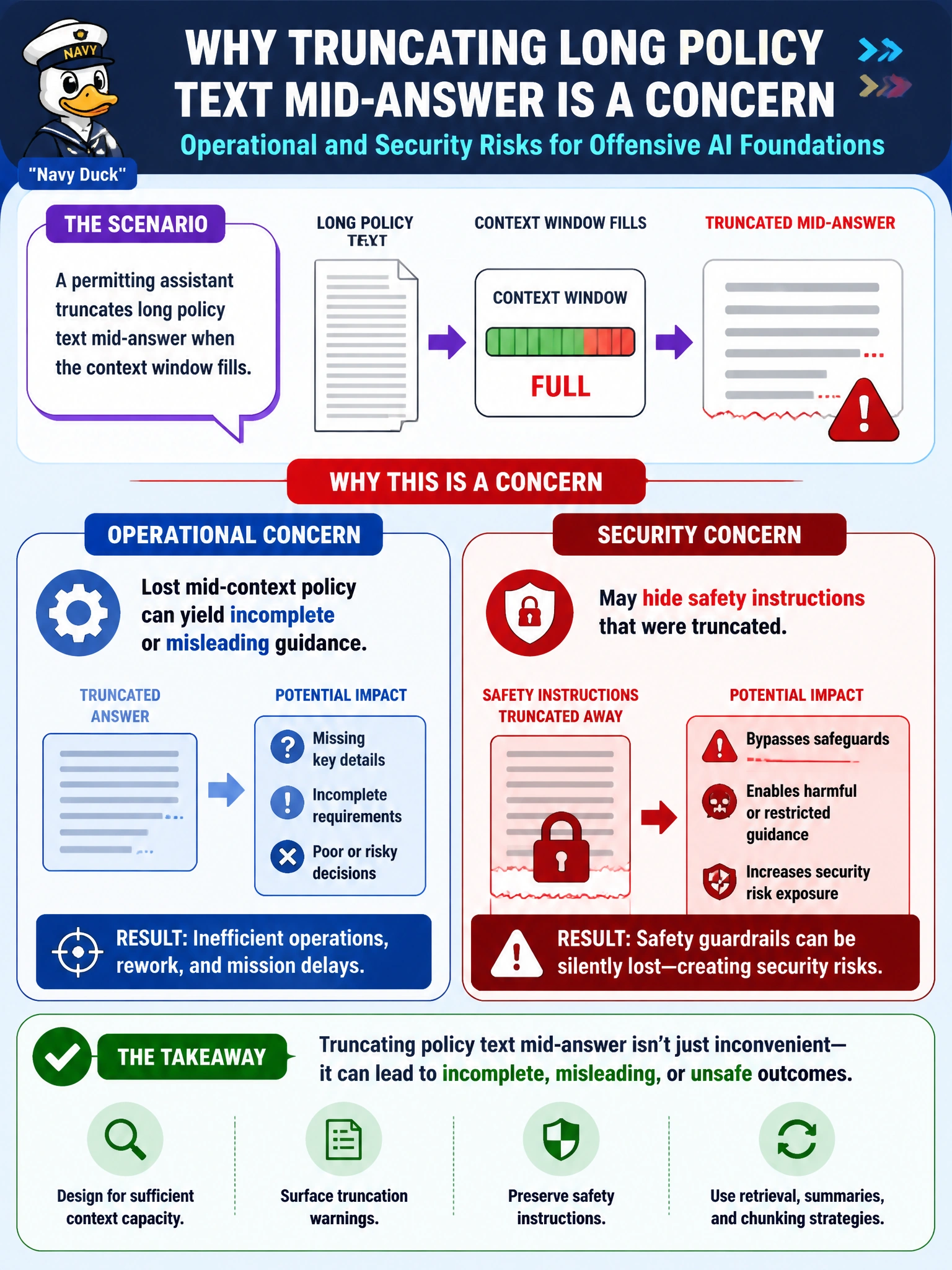
A permitting assistant truncates long policy text mid-answer when the context window fills. Why is this an operational and security concern for offensive AI foundations?
Select an answer to reveal the explanation.
Short Explanation
When the context window fills, it’s like a clerk’s desk so piled up that the safety memo slides onto the floor. The answer may sound confident while the critical policy paragraph never made it into the conversation.
Full Explanation
Finite context windows force truncation or omission when a permitting assistant’s prompts, policies, or retrieved documents exceed capacity. Lost mid-context policy can yield incomplete or misleading legal guidance and may drop system or safety instructions that defenders rely on. Offensive AI assessments should probe length and ordering behaviors and document operational risk when critical civic content falls out of context—confident tone does not prove complete policy coverage.
Claiming that logging truncated exchanges for quality review creates an audit trail supporting later permit decision analysis is wrong; the audit trail does not prevent truncation or restore lost safety instructions, and the operational harm is the missing context itself. Saying that summarizing earlier policy turns into condensed memory preserves enforcement intent while freeing tokens is wrong; summarization can discard nuance and safety-critical detail, and it does not stop the assistant from truncating mid-answer when the window fills. Asserting that querying lengthy policy files through retrieval lookup keeps detailed rules available outside the tight token window is false; retrieval does not prevent the assistant from truncating its own mid-answer output when context capacity is exceeded.
Exam caveat: context overflow is an operational and security concern for guidance integrity—not an audit-trail logging practice, not a summarization shortcut, and not eliminated by retrieval lookup. Operational check: measure max policy/RAG payload sizes for the permitting assistant; test long-document behavior; ensure critical safety/system instructions are retained (e.g., pinned, summarized, or retrieved in priority order); alert when truncation rates rise.