
A 311 agent uses RAG over knowledge articles. Which statement best explains why embeddings and retrieval are security-relevant architecture pieces?
Select an answer to reveal the explanation.
Short Explanation
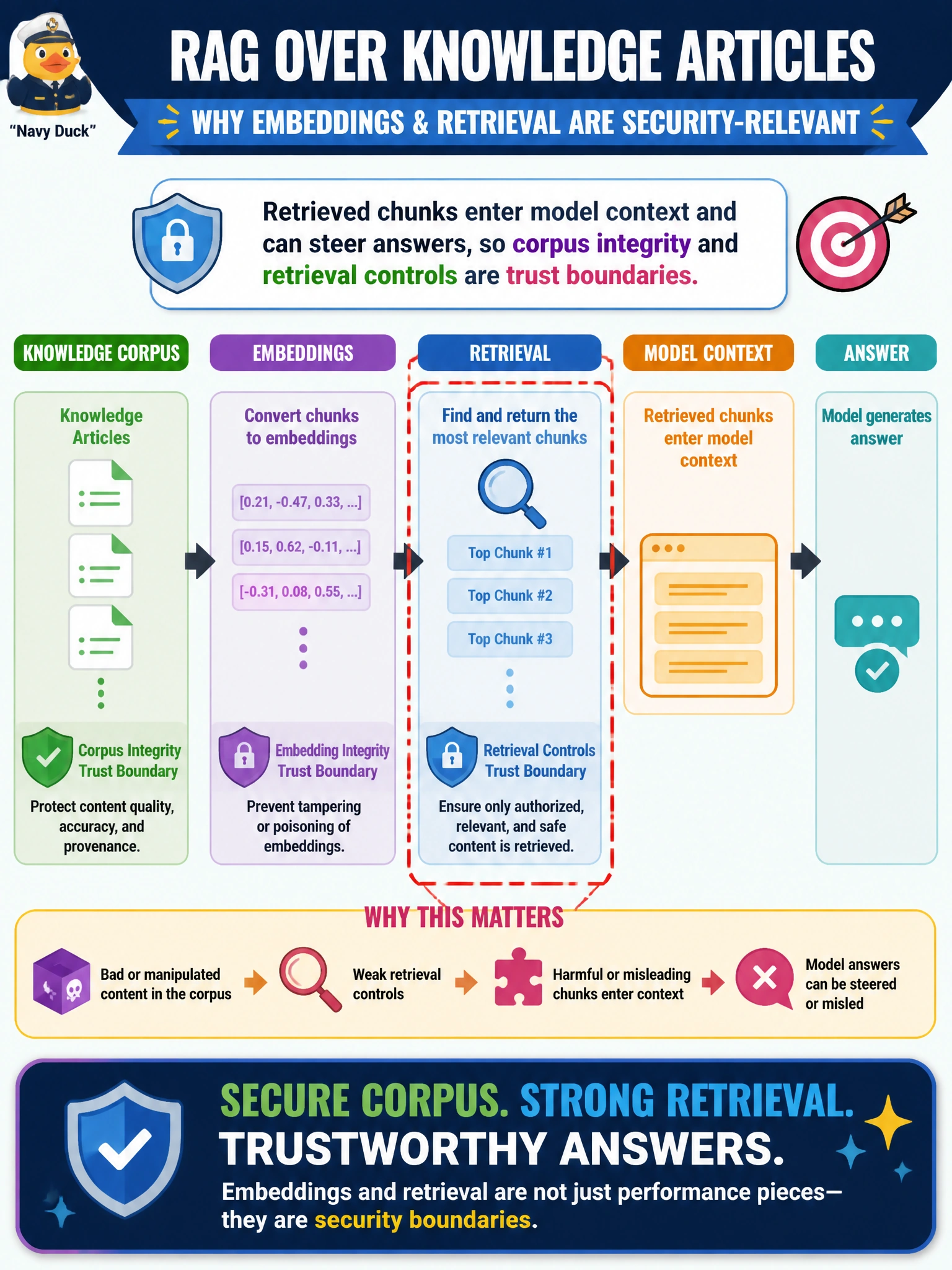
RAG is the bot’s open-book test—whatever pages get stuffed into context can change the answer. If someone slips a bad article onto the shelf, the 311 agent may quote it like gospel.
Full Explanation
In a 311 RAG architecture, embeddings and retrieval select knowledge chunks that are concatenated into model context and therefore steer answers and any downstream tool decisions. Corpus integrity, access control on indexes, and retrieval filtering are trust boundaries for municipal service guidance. Offensive assessments examine poisoning, over-retrieval of sensitive articles, and weak filters rather than assuming the generator alone defines risk for resident-facing replies.
Touting dense embeddings as mainly a relevance and citation-accuracy tuning problem misses the security point: the vectors determine which chunks enter model context, so chunking and retrieval are trust boundaries, not just quality knobs. Citing encryption at rest and audit logging in a managed vector database does not make retrieval safe by itself; those are compliance controls, while the security-relevant issue is that retrieved chunks enter model context and require access control and filtering as trust boundaries. Putting authorization checks after generation to reduce index overhead is backwards; index access control is a trust boundary that must apply before chunks reach the model, not after the answer is generated.
Exam caveat: retrieved chunks are trust boundaries; relevance tuning or encryption alone does not secure retrieval, and authorization must precede generation, not follow it. Operational check: inventory 311 knowledge sources and index ACLs; test retrieval of planted or sensitive articles under authorization; verify filtering and monitoring of what enters context before go-live expansions.