
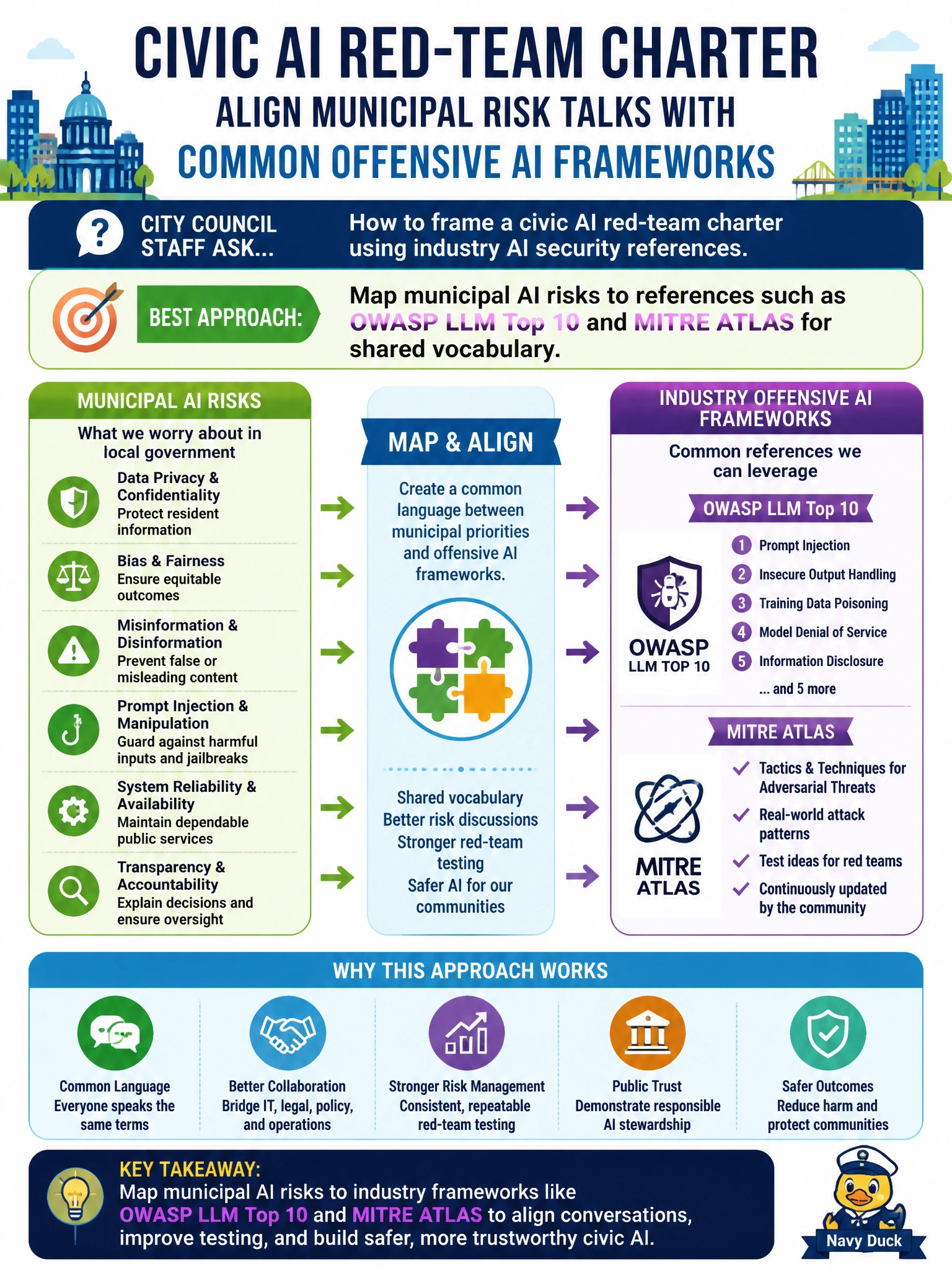
City council staff ask how to frame a civic AI red-team charter using industry AI security references. Which approach best aligns municipal risk talks with common offensive AI frameworks?
Select an answer to reveal the explanation.
Short Explanation
Frameworks are the shared street map—OWASP LLM Top 10 and MITRE ATLAS give council, SOC, and vendors the same intersection names. Without that map, every briefing becomes a different dialect of “bad AI stuff.”
Full Explanation
Municipal AI red-team charters gain clarity when city council, SOC, and vendors share vocabulary from recognized AI attack and threat frameworks such as OWASP LLM Top 10 and MITRE ATLAS. Mapping civic scenarios—prompt injection, supply-chain plugins, model theft narratives—to those taxonomies improves severity labeling, finding communication, and defensive prioritization. Framework use does not replace city policy; it supplies a common language for authorized offensive testing and risk talks. Aligning municipal AI risk tracking with CVSS base scores adapted from the existing municipal vulnerability management workflow scores general IT flaws but does not provide an AI-specific attack taxonomy for offensive LLM testing. Structuring municipal AI red-team findings around NIST AI Risk Management Framework governance functions for quarterly council reporting addresses governance and reporting, not the offensive AI attack vocabulary needed for red-team charter alignment. Using MITRE ATT&CK enterprise matrices to categorize municipal LLM prompt injection and training data leakage techniques during charter testing borrows traditional enterprise IT adversary tactics rather than AI-specific threat frameworks built for LLM risks. Exam caveat: map municipal AI risks to AI-oriented frameworks for shared vocabulary; CVSS-only scoring, NIST RMF governance-only reporting, or ATT&CK enterprise-only categorization does not substitute. Operational check: attach OWASP LLM Top 10 / ATLAS-style mappings to the red-team charter and finding template; brief council staff with those labels; reject reports that cannot map civic AI issues to a recognized taxonomy or city policy equivalent.