
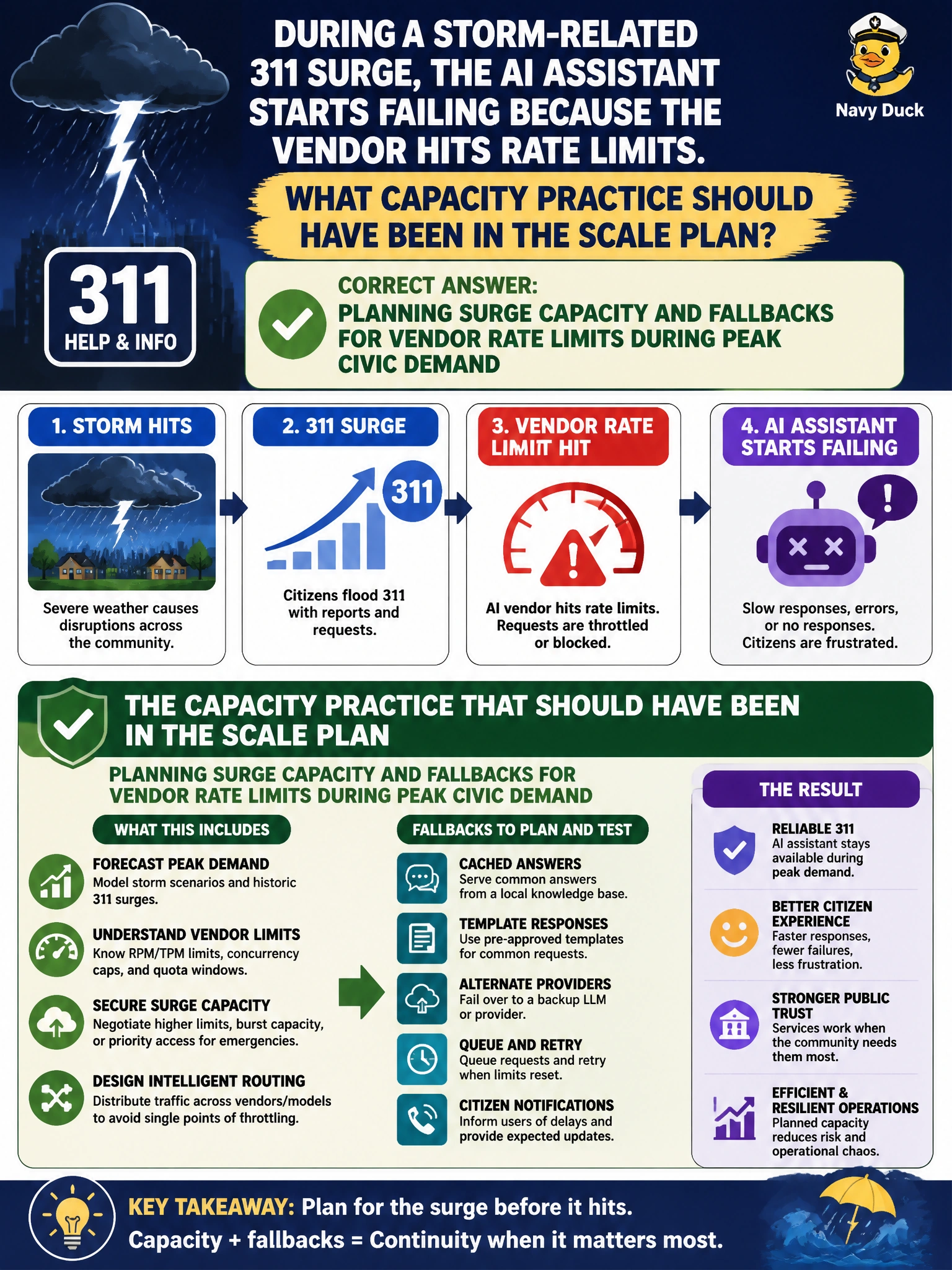
During a storm-related 311 surge, the AI assistant starts failing because the vendor hits rate limits. What capacity practice should have been in the scale plan?
Select an answer to reveal the explanation.
Short Explanation
Storms don’t RSVP to your vendor’s rate-limit table. Scale plans need surge capacity and a fallback path so the assistant doesn’t ghost residents when 311 spikes.
Full Explanation
Scaled civic AI must be sized and contracted for surge demand, including vendor throughput and rate limits during emergencies. During a storm-related 311 surge, assistant failures caused by vendor rate limits reveal a missing capacity practice: planning surge capacity and fallbacks for peak civic demand, not only fair-weather baselines. Municipal incident periods concentrate queries about shelters, road closures, and safety; AI that vanishes exactly when residents need it most fails the mission even if average monthly load looked fine. Assuming fair-weather traffic patterns cover emergency surge conditions understates peak load and is a classic capacity-planning error. Disabling 311 entirely during storms so AI capacity is never tested abandons core emergency communications rather than hardening them. Relying on a single unpaid free-tier key for citywide production load is procurement and architecture negligence for critical services. Exam caveat: items contrast steady-state demos with emergency load; choose surge planning and human/process fallbacks as the scale-risk control. Operational check: model storm/event peak QPS, negotiate burst capacity and SLAs with the vendor, implement graceful degradation and cached critical FAQs, define clerk/IVR fallbacks when AI throttles, and run load tests that simulate emergency spikes before declaring citywide readiness.