
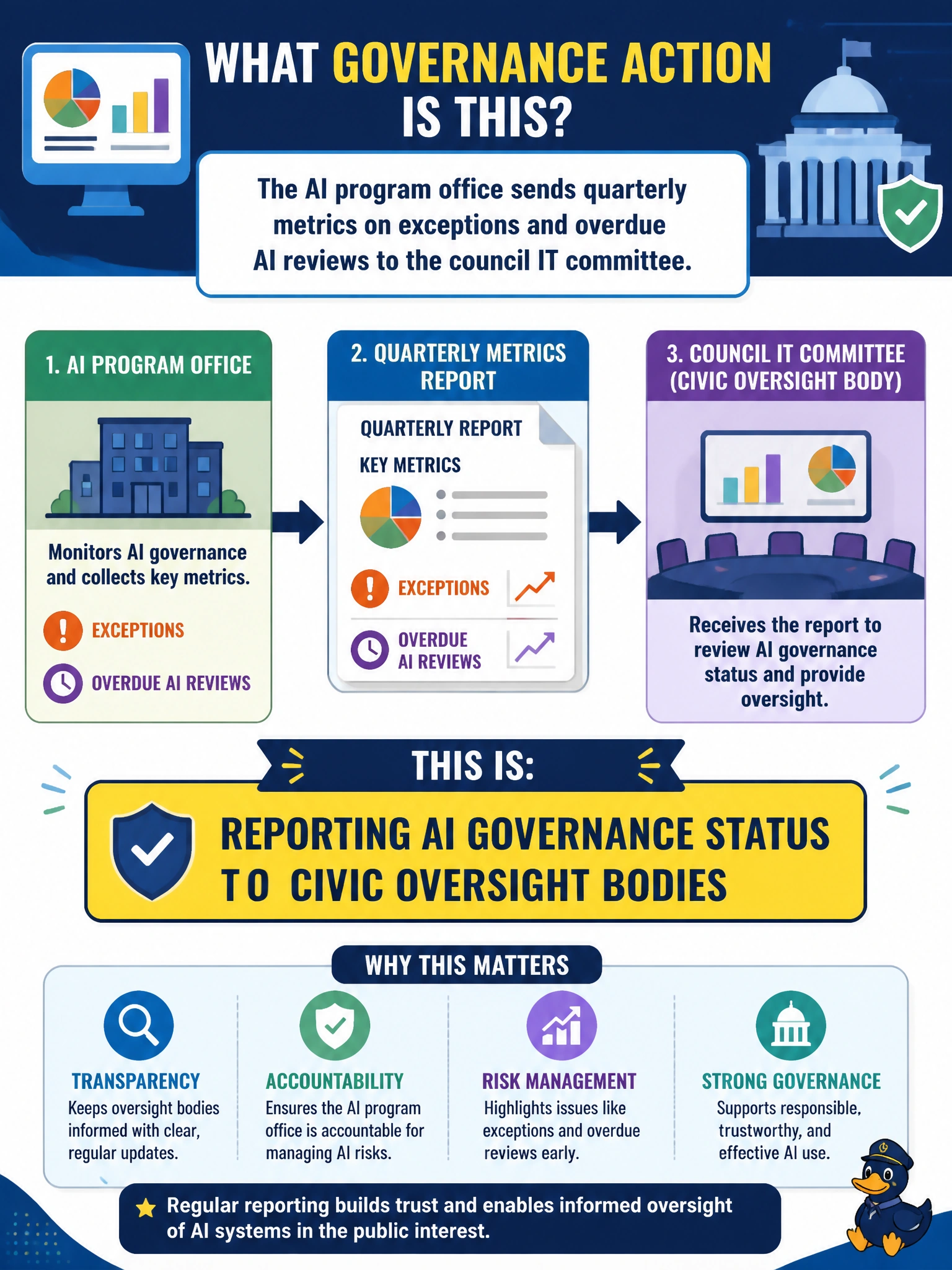
The AI program office sends quarterly metrics on exceptions and overdue AI reviews to the council IT committee. What governance action is this?
Select an answer to reveal the explanation.
Short Explanation
You help civic oversight bodies govern by giving them a clear, quarterly view of exceptions and overdue AI reviews. That accountability matters: GPU utilization alone and vendor briefings without city metrics cannot replace the city’s own governance status.
Full Explanation
Reporting AI governance status to civic oversight bodies is the right action when the AI program office sends quarterly metrics on exceptions and overdue AI reviews to the council IT committee. Oversight bodies cannot govern what they never see: exceptions and overdue reviews indicate control failures, backlog risk, and uneven departmental compliance. A plain, recurring scorecard creates accountability, helps prioritize remediation, and documents that the city is managing AI as an enterprise civic risk rather than as silent departmental experiments. Hiding overdue reviews until after the next election fails because political timing is not a control objective and conceals material governance debt from the body charged with oversight. Tracking GPU utilization alone fails because infrastructure telemetry is not a proxy for policy exceptions, review currency, or resident-impact risk. Asking vendors to brief council without city metrics fails because vendor briefings do not substitute for city-owned exception and overdue-review metrics. Exam caveat: reporting must be accurate and actionable; a dashboard that omits exceptions undermines trust as much as silence. Practical check: define a quarterly pack with open exceptions, overdue reviews by age and owner, and remediation status; send it on a fixed cadence to the designated oversight body, escalate items past SLA, and verify that decisions and follow-ups are recorded in city minutes or governance logs.