
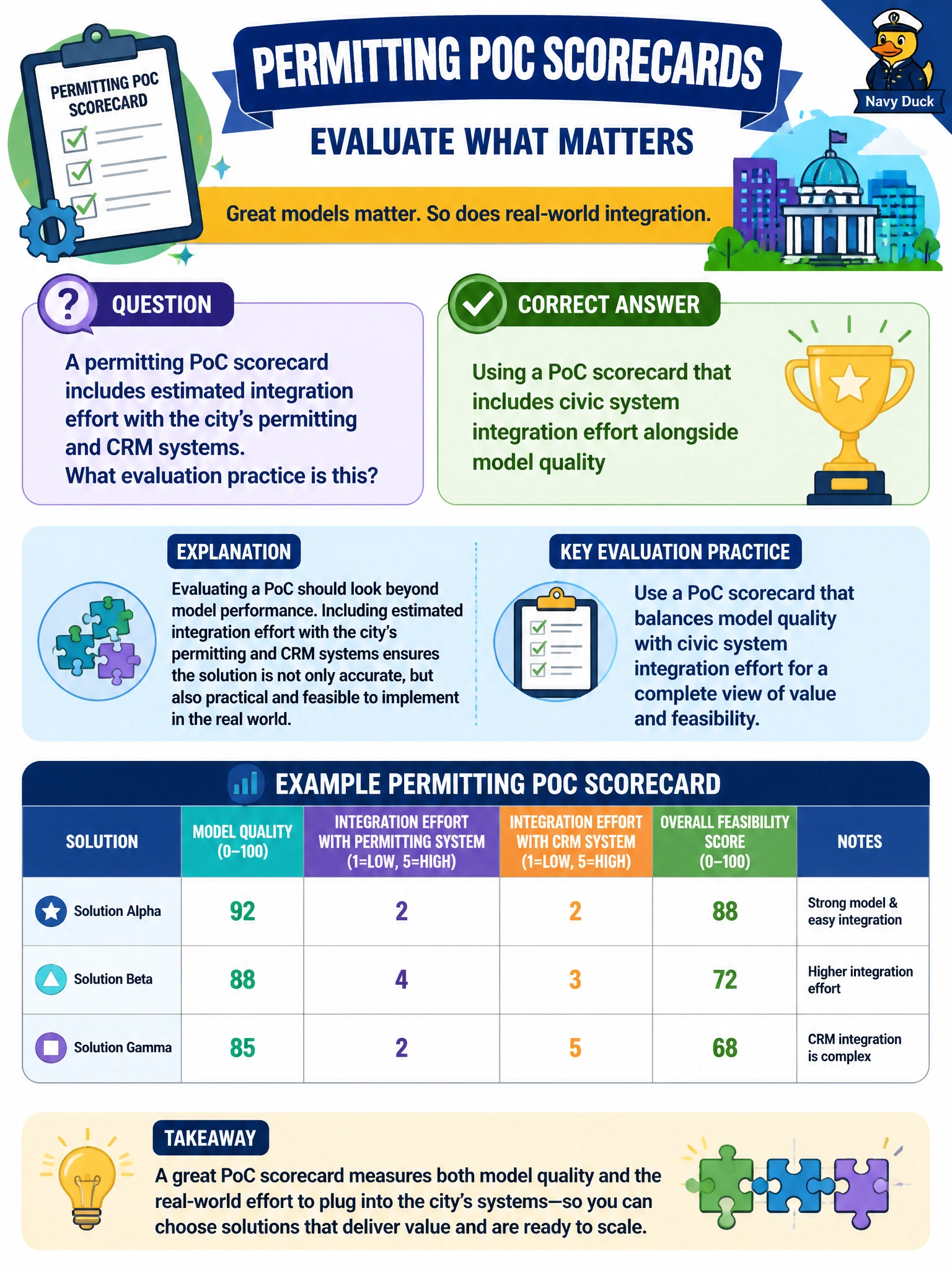
A permitting PoC scorecard includes estimated integration effort with the city’s permitting and CRM systems. What evaluation practice is this?
Select an answer to reveal the explanation.
Short Explanation
A chatbot that can’t talk to permitting is just a clever sticky note. Put integration effort on the PoC scorecard so the city scores the whole job, not just the pretty answers.
Full Explanation
Using a PoC scorecard that includes civic system integration effort alongside model quality is the correct evaluation practice for a permitting PoC. Model cleverness does not equal deployability; connecting to permitting and CRM systems of record often dominates timeline, cost, and risk. Including estimated integration effort forces an honest total-cost and feasibility picture before the city scales a chatbot that cannot reach live case data through governed interfaces. The practice works because municipal AI value usually depends on systems-of-record connectivity, not isolated chat wit.
Scoring only chat wittyness and ignoring system integration work fails by concept: conversational style is not a proxy for enterprise integration feasibility. Declaring integration free because the vendor showed a slide deck fails by concept—slides are not working adapters, identity mappings, or API contracts. Buying the tool first and discovering integration gaps during production cutover fails by sequencing: late discovery of permitting/CRM integration cost routinely blows budgets and delays resident-facing value.
Exam caveat: including integration effort on the scorecard does not require finishing every integration in the PoC; it requires estimating and weighing that work before commitment. Keep permitting/CRM civic framing. Operational check: add integration effort (APIs, SSO, write-back, environments) as a scored PoC criterion; involve permitting and CRM owners in estimates; compare vendors on integration realism, not only answer quality; and treat underestimated integration as a red flag for production readiness.