
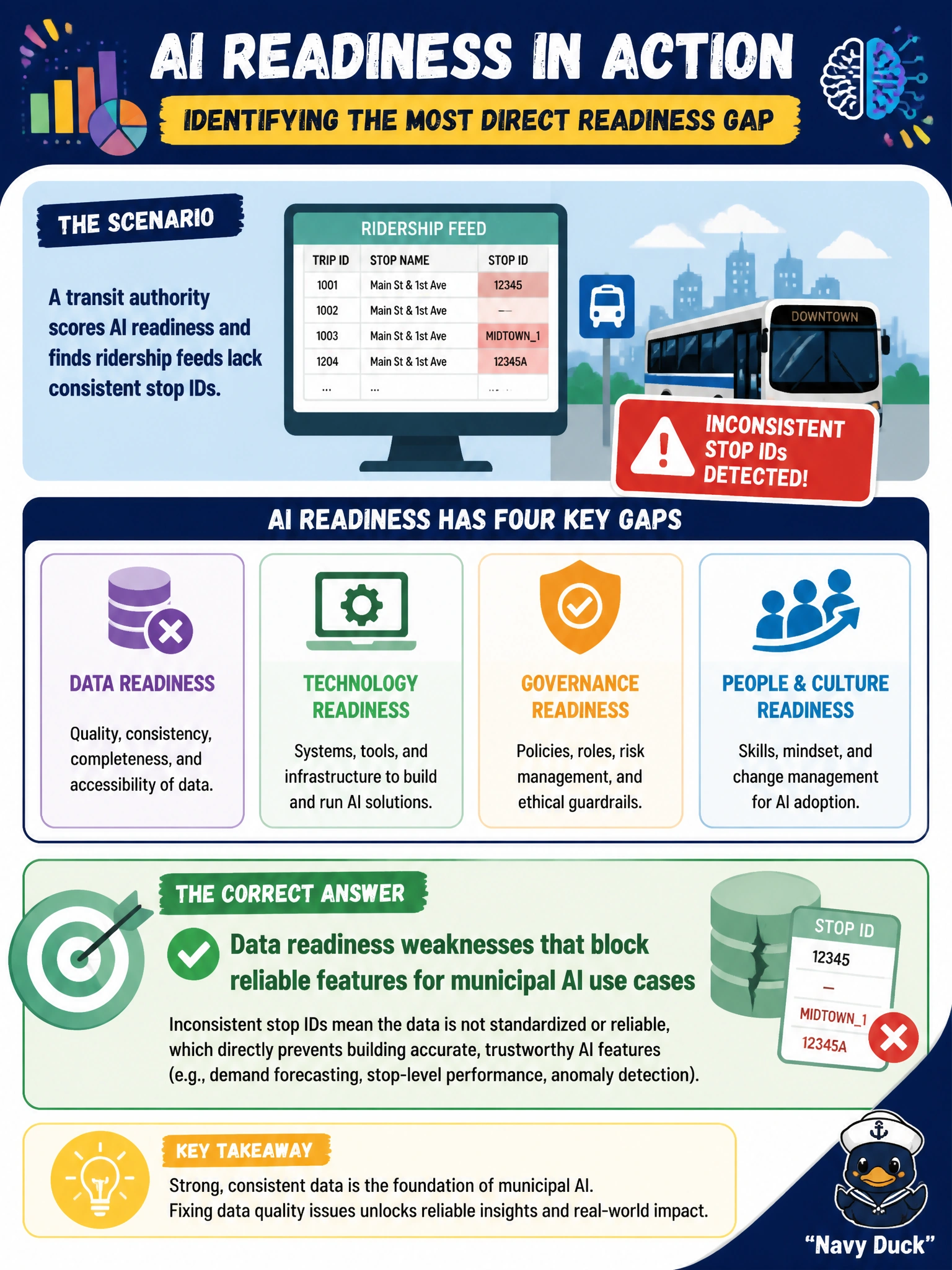
A transit authority scores AI readiness and finds ridership feeds lack consistent stop IDs. Which readiness gap is most directly indicated?
Select an answer to reveal the explanation.
Short Explanation
Models hate messy stop IDs the way mail hates half-written addresses. If every feed invents its own stop codes, data readiness is the broken leg—fix identity before you buy a fancier predictor.
Full Explanation
A transit authority that scores AI readiness and finds ridership feeds lack consistent stop IDs is identifying a data readiness weakness that blocks reliable features for municipal AI use cases. Stable identifiers are the join keys of civic data; without them, predictions mis-attribute events, personalization breaks, and rider-facing products point to the wrong place. Identifier hygiene is a readiness gate that must precede ambitious modeling. Excess executive sponsorship for AI is not what the finding indicates, and more sponsorship cannot repair broken keys by itself. Over-documented data dictionaries with perfect keys contradicts the inconsistent-ID evidence in the stem. Too many GPUs allocated to non-transit departments is an unrelated compute-allocation narrative that does not create canonical stop identity. Exam caveat: inconsistent keys equal a data readiness failure; compute abundance or sponsorship theater cannot substitute. Operational check: establish a canonical stop-ID registry, reconcile GTFS, AVL, and ridership feeds to it, add automated consistency tests in DataOps pipelines, block model promotion until identifier quality meets agreed thresholds, and report data-readiness status alongside model metrics to transit leadership.