
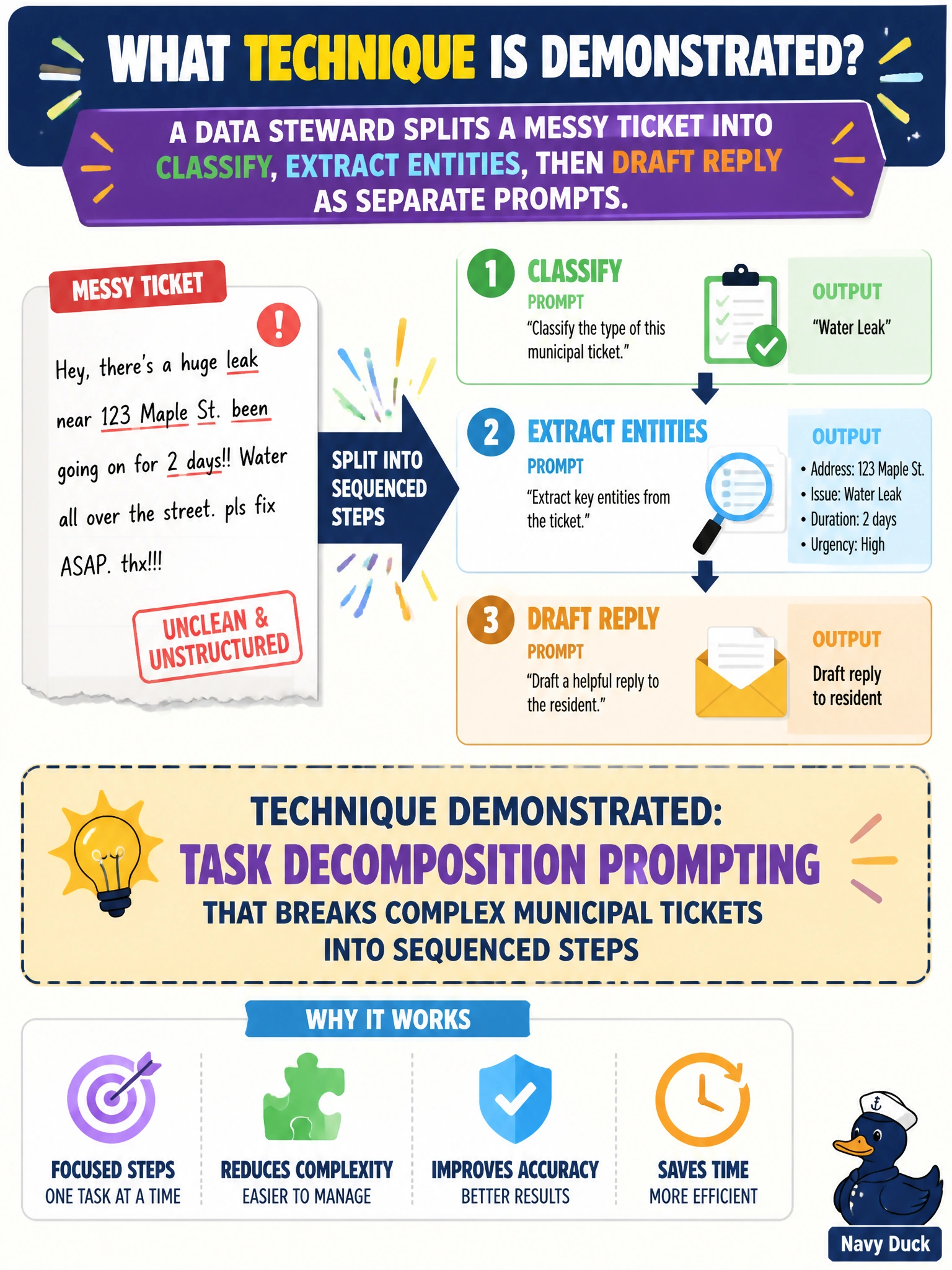
A data steward splits a messy ticket into classify, extract entities, then draft reply as separate prompts. What technique is demonstrated?
Select an answer to reveal the explanation.
Short Explanation
Classify, pull the entities, then draft—three smaller asks beat one messy dump, and that's task decomposition. You're giving the model bounded jobs instead of one chaotic ask. Boundaries like that keep it focused on municipal tickets.
Full Explanation
Complex municipal tickets become manageable when decomposed. Splitting a messy ticket into classify, extract entities, then draft reply as separate prompts demonstrates task decomposition: each prompt has a bounded job and cleaner inputs for the next stage. Classification sets topic and routing; entity extraction pulls addresses, request types, and deadlines; the reply draft then uses structured facts instead of a chaotic narrative dump.
Chain-of-thought prompting that partitions the complex ticket into reasoning processes fails to match what's shown: chain-of-thought elicits intermediate reasoning steps inside a single response to one prompt, while the steward is running three separate prompts across three stages. Multi-agent orchestration that distributes the municipal ticket tasks to separate nodes fails because nothing in the scenario shows separate autonomous agents or nodes collaborating; the steward is sequencing three prompts in one workflow, not distributing work across agents. ReAct prompting framework that segments the municipal ticket into reasoning and actions fails because the scenario shows no interleaved reasoning traces with tool uses and observations; it shows three sequenced prompts for classify, extract, then draft, not a reason-plus-act loop.
Exam caveat: decomposition order matters. A wrong classification early poisons later extraction and drafting; staff should validate stage outputs, not only the final reply.
Operational check: define stage prompts with explicit outputs (class label; entity JSON; reply draft); gate each stage on a quick human or rules check; only then send the resident-facing reply through 311 quality review.
Prefer to study offline? Printable PDF study book + test engine ($7.50, unofficial). These questions stay free here.