
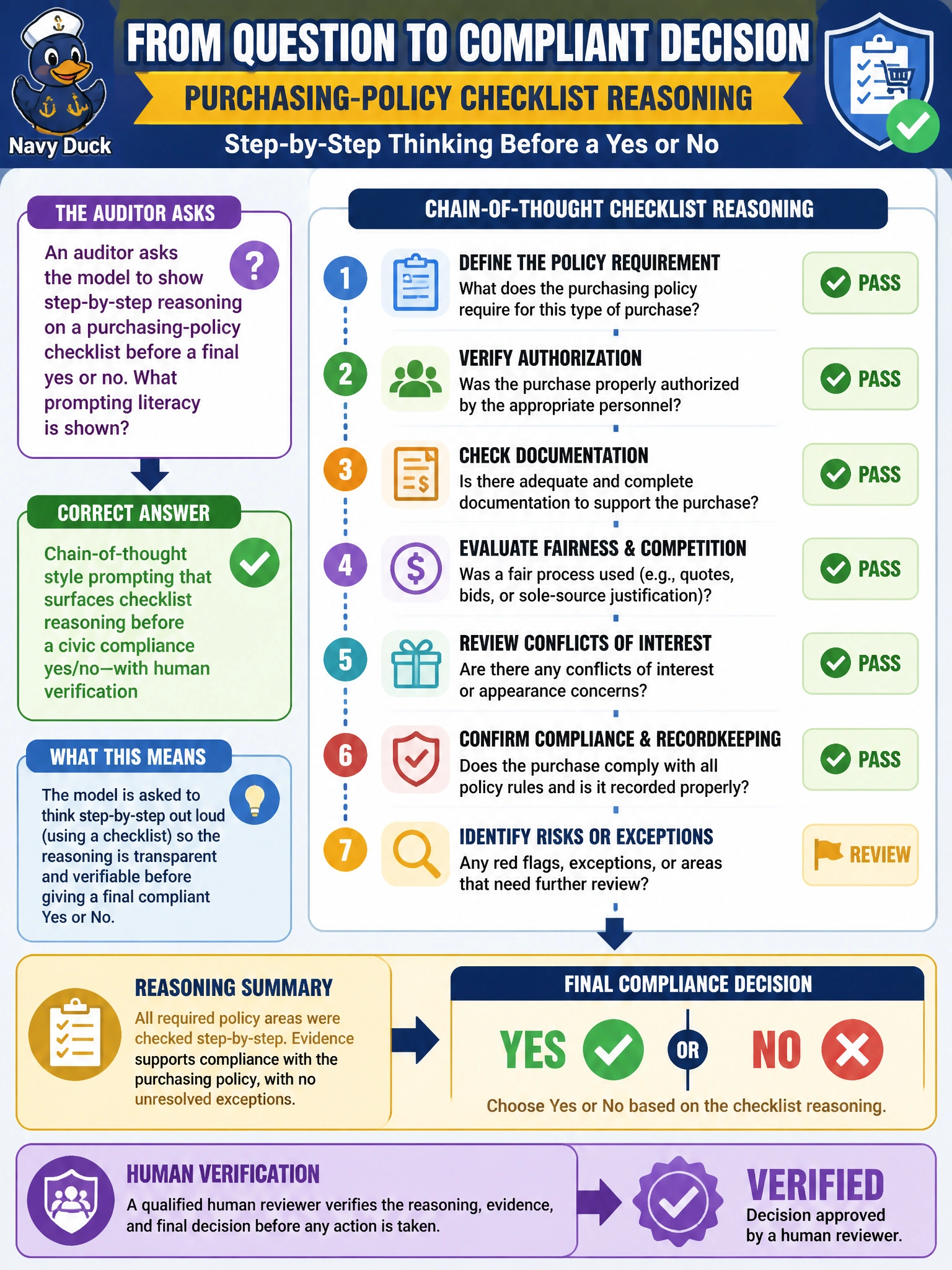
An auditor asks the model to show step-by-step reasoning on a purchasing-policy checklist before a final yes or no. What prompting literacy is shown?
Select an answer to reveal the explanation.
Short Explanation
You make the model show its homework on the purchasing checklist before yes or no. That’s chain-of-thought style prompting for careful reviews, but humans still sign the audit.
Full Explanation
Auditors need visible reasoning before a compliance yes or no. Asking the model to show step-by-step checklist reasoning on purchasing policy before a final answer demonstrates chain-of-thought style prompting that surfaces intermediate checks—with the expectation of human verification. Visible steps let staff see whether thresholds, competitive bidding rules, or documentation requirements were actually considered rather than receiving an unexplained binary.
Few-shot prompting that grounds checklist reasoning in examples before a civic compliance yes/no—with human verification fails because the prompt supplies no examples to learn from; it requires the model to surface step-by-step checklist reasoning from the policy itself before a final yes/no rather than imitating example rulings. Persona prompting framing checklist reasoning as auditor voice before a civic compliance yes/no—with human verification fails because adopting an auditor voice only frames stylistic perspective and does not itself require the model to show intermediate checklist checks before the final compliance answer. Instruction prompting requesting concise step-by-step checklist reasoning before a civic compliance yes/no—with human verification fails because it points to generic instruction-following for concise step-by-step format rather than the specific chain-of-thought literacy of surfacing intermediate checklist checks to make the compliance yes/no inspectable, even though human verification remains expected.
Exam caveat: step-by-step text can be fluent and still wrong. Chain-of-thought increases inspectability; it is not proof of correctness. Humans must verify each cited checklist item against policy and the purchase file.
Operational check: require enumerated checklist steps in the prompt output; map each step to a policy clause ID; withhold final yes/no acceptance until a named auditor confirms the chain against source documents.
Prefer to study offline? Printable PDF study book + test engine ($7.50, unofficial). These questions stay free here.