
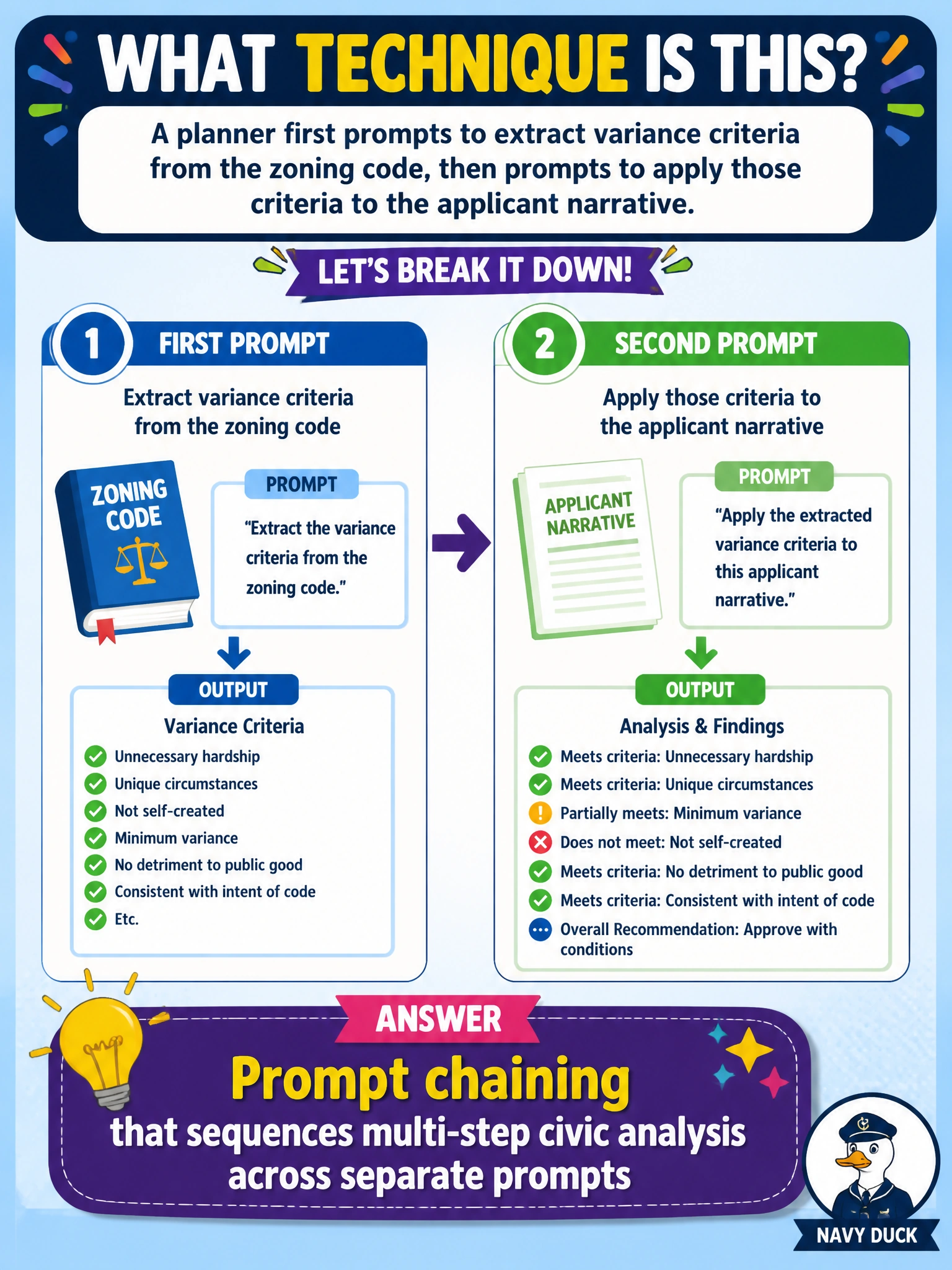
A planner first prompts to extract variance criteria from the zoning code, then prompts to apply those criteria to the applicant narrative. What technique is this?
Select an answer to reveal the explanation.
Short Explanation
Break it up: pull the rules, then apply them. That chain of prompts keeps zoning analysis orderly. Processing extraction and review concurrently won’t work; you can’t apply criteria to a narrative until you’ve pulled them from the code.
Full Explanation
Multi-step civic analysis is clearer when prompts are sequenced. Extracting variance criteria from the zoning code first, then applying those criteria to the applicant narrative, is prompt chaining: each step produces an intermediate artifact that conditions the next. Separating rule extraction from fact application reduces mixing of statute language with advocacy narrative and makes planner review of each stage feasible.
Prompt routing that directs variance queries to specialized civic models fails because the scenario sequences extraction then application with dependency, not a dispatch decision among specialized models; there is no routing to separate experts here. Parallel prompting that processes code extraction and narrative review concurrently fails because the narrative cannot be evaluated against criteria that have not yet been extracted; the steps must be sequenced so the code output conditions the narrative review. Few-shot prompting that applies sample variance rulings to guide decisions fails because the scenario describes a chain from code extraction to narrative application, not the use of sample rulings as examples; few-shot prompting does not create the checked intermediate criteria that this technique requires.
Exam caveat: chaining improves process discipline; it does not guarantee correct legal interpretation. Extracted criteria can still be incomplete or misapplied; a planner must verify both stages against the adopted code.
Operational check: store extracted criteria as a checked intermediate; require the application prompt to cite those criteria line-by-line against the narrative; keep a human planner sign-off before any variance recommendation leaves the planning office.
Prefer to study offline? Printable PDF study book + test engine ($7.50, unofficial). These questions stay free here.