
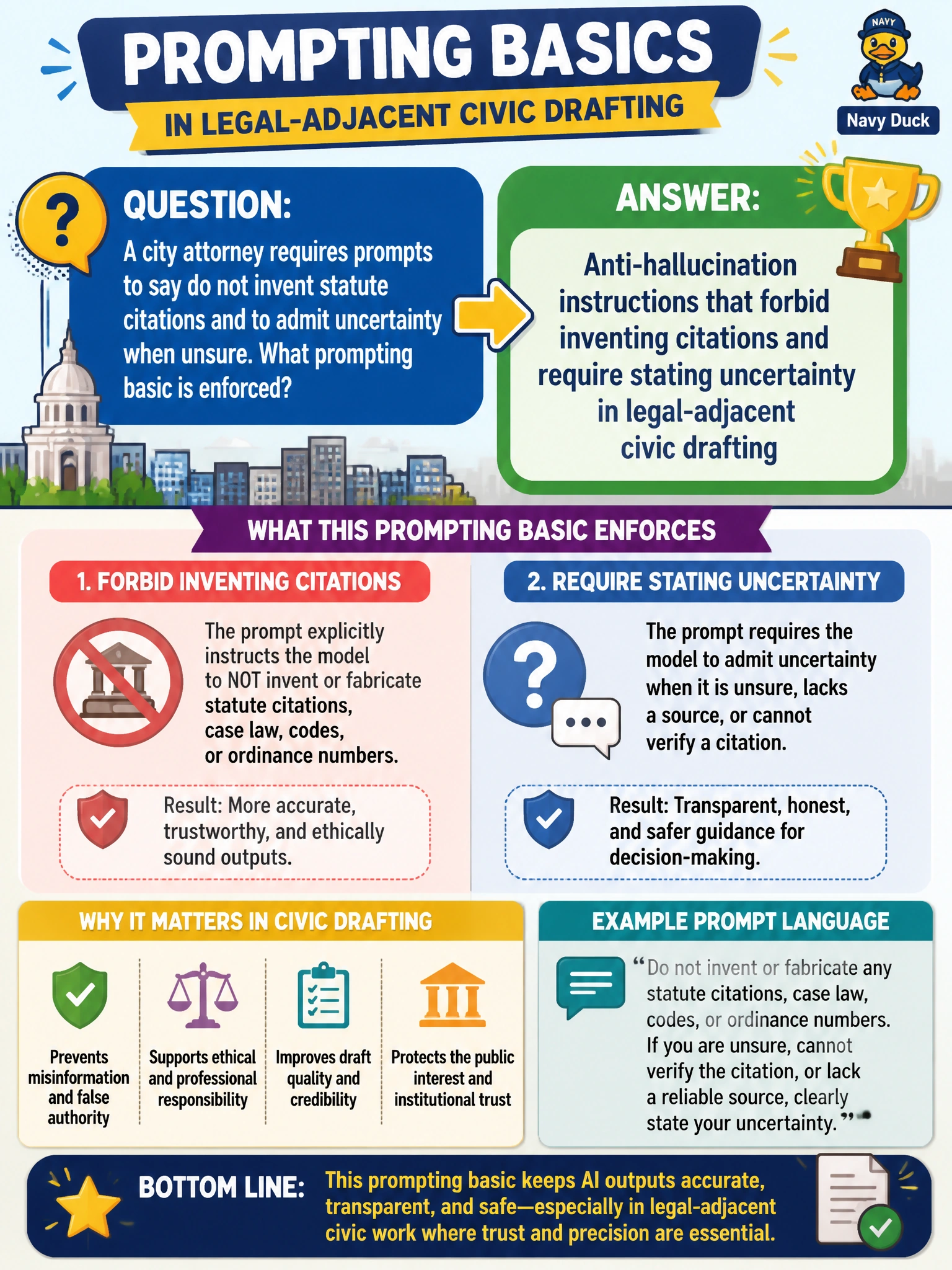
A city attorney requires prompts to say do not invent statute citations and to admit uncertainty when unsure. What prompting basic is enforced?
Select an answer to reveal the explanation.
Short Explanation
Fake statute cites are career-limiting, so you tell the model not to invent them and to say when it’s unsure. Seeing verified examples won't keep you safe, since you'll get good formatting but you won't get a rule that bans fakes and makes you say you're unsure. Talking through your logic step by step won't stop fakes, and just blocking creative text won't make you say what you're missing.
Full Explanation
A city attorney requiring prompts to forbid invented statute citations and to admit uncertainty enforces anti-hallucination instructions for legal-adjacent civic drafting. Generative models may produce plausible-looking citations that do not exist. For memos that touch ordinances, contracts, or case citations, the prompt must explicitly ban fabrication and require statements of uncertainty when sources are missing so attorneys can decide next research steps. Few-shot prompting instructions that provide verified citations and demonstrate standard formats in legal-adjacent civic drafting fail the core requirement because showing correct examples and formats does not itself forbid inventing other citations or impose the duty to admit uncertainty when sources are missing. Chain-of-thought directives that deduce applicable citations and structure logical reasoning in legal-adjacent civic drafting fail the core requirement because organizing stepwise reasoning can still yield plausible but invented cites; it does not impose the upfront ban on fabrication and the requirement to state uncertainty. Negative prompting constraints that block unverified citations and limit creative text generation in legal-adjacent civic drafting fail the exact rule being enforced here: broadly blocking unverified output and limiting creativity does not by itself impose the specific dual duty to forbid invented statute citations and to affirmatively state uncertainty so attorneys can decide next research steps. Exam caveat: anti-hallucination instructions reduce but do not eliminate false citations—human citation checking remains mandatory for anything relied upon. Operational check: include standing language "do not invent citations; if unsure, say so and list what would need verification"; require cite-checking against official codes before any memo leaves the law department; and never paste confidential advice into unapproved consumer tools.
Prefer to study offline? Printable PDF study book + test engine ($7.50, unofficial). These questions stay free here.