
An emergency PIO separates standing policy instructions from variable incident details in a reusable prompt template. What basics idea is shown?
Select an answer to reveal the explanation.
Short Explanation
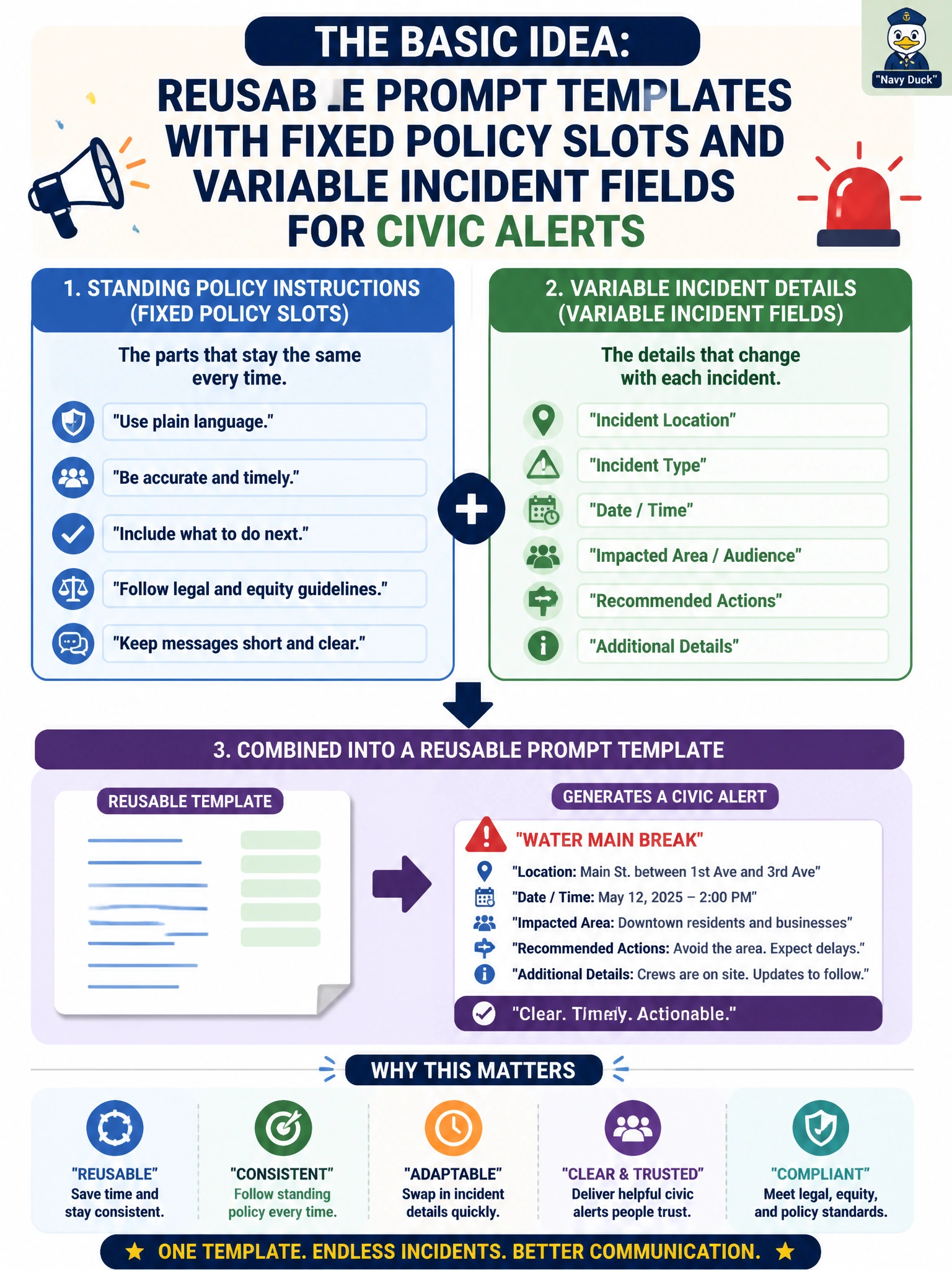
Keep the standing rules in the template and drop today's incident facts into the blanks. That is how PIOs move fast without rewriting policy every storm. Fixing incident variables and varying policy constraints in your reusable template won't give you the fixed-policy and variable-field split you'll need.
Full Explanation
An emergency PIO separating standing policy instructions from variable incident details in a reusable prompt template demonstrates modular prompt design for civic alerts. Fixed slots hold durable policy (evacuation authority language, accessibility lines, rumor-control rules), while variable fields accept today's shelter addresses, times, and hazard specifics. That separation lets PIOs move quickly without rewriting core guidance every incident and reduces accidental reuse of stale variables. Relying on reusable prompt templates with fixed policy instructions and variable incident outputs for civic alerts misplaces incident details as outputs to be generated rather than variable input fields to be supplied, so it does not show fixed slots for standing policy with fill-in fields for today's facts. Using reusable prompt templates with fixed incident variables and variable policy constraints for civic alerts reverses the required separation by fixing what should change each incident and varying what should stay durable, so standing policy would not remain intact across uses. Relying on reusable prompt templates with fixed policy embeddings and variable incident parameters for civic alerts buries policy in opaque embeddings and model parameters rather than explicit reviewable slots and fields, so it does not demonstrate the basic separable-template idea. Exam caveat: templates accelerate drafting but do not authorize unreviewed publication; activation still needs human confirmation of variable fields against the current incident action plan. Operational check: maintain version-controlled templates, highlight mandatory variable fields, run a pre-send checklist (addresses, times, channels), and archive which template version was used for after-action review.
Prefer to study offline? Printable PDF study book + test engine ($7.50, unofficial). These questions stay free here.