
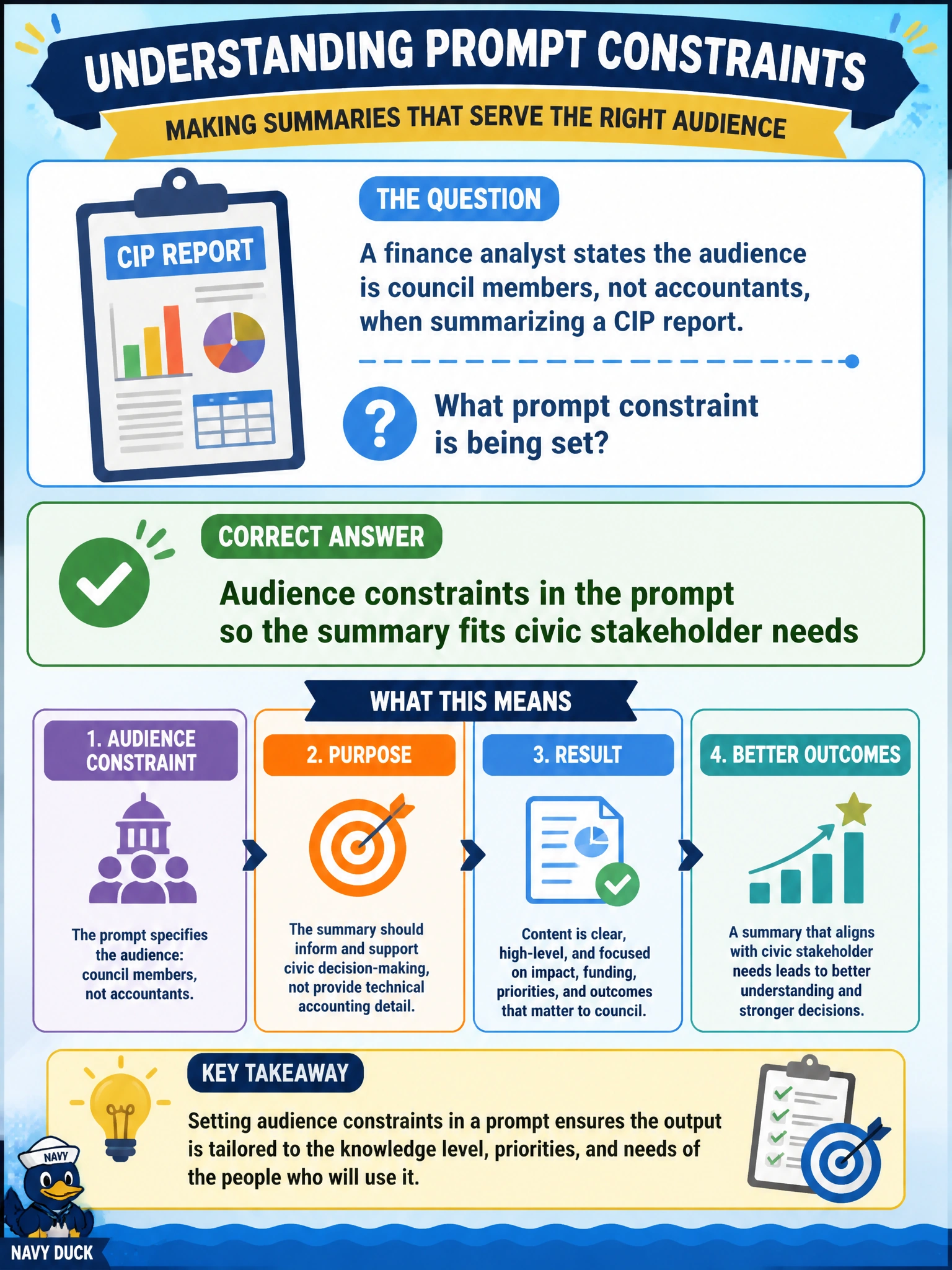
A finance analyst states the audience is council members, not accountants, when summarizing a CIP report. What prompt constraint is being set?
Select an answer to reveal the explanation.
Short Explanation
You'll sound like municipal finance with persona, but you've still got to say who the reader is in the prompt. Audience constraints keep CIP summaries readable for the people who vote. Using a non-technical style is about how it's structured, not who you're writing for, and omitting strict accounting details is about what you cover too.
Full Explanation
A finance analyst stating that the audience is council members, not accountants, when summarizing a CIP report is setting an audience constraint in the prompt. Capital improvement summaries for elected officials need plain framing of priorities, tradeoffs, and timelines rather than dense journal entries. Audience constraints steer vocabulary, detail level, and emphasis so the draft fits civic stakeholder decision needs.
Setting persona constraints in the prompt so the AI assumes a municipal finance profile misses the classification: assuming a municipal finance profile defines who the AI is acting as, but stating the readers are council members, not accountants, is defining who the summary is for, which is an audience constraint that then drives tone, detail, and emphasis. Setting style constraints in the prompt so the summary adopts a non-technical structure describes how to present the output, not who it is for; naming council members over accountants sets the audience, which then guides what structure is appropriate for civic review. Setting domain constraints in the prompt so the summary omits strict accounting details describes what subject matter to limit, not who it is for; naming council members, not accountants, sets the audience, which then guides what level of accounting rigor is appropriate for the briefing.
Exam caveat: audience adaptation must not distort material risks or omit legally required disclosures; simplify language, do not sanitize facts. Operational check: prompt with "audience: city council; avoid unexplained acronyms; include top three project risks"; attach the source CIP excerpt; and have budget staff validate figures before the packet goes to the clerk.
Prefer to study offline? Printable PDF study book + test engine ($7.50, unofficial). These questions stay free here.