
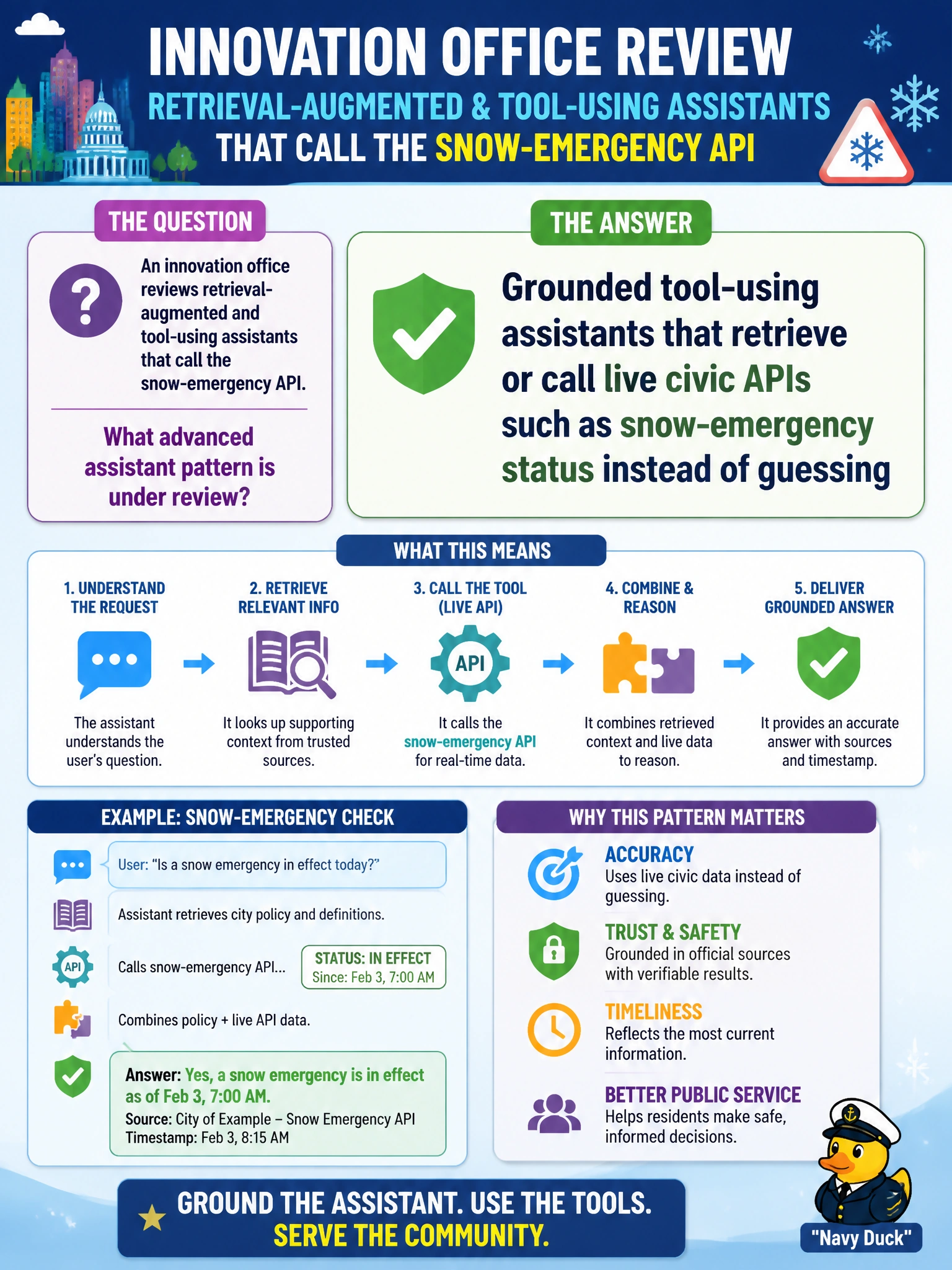
An innovation office reviews retrieval-augmented and tool-using assistants that call the snow-emergency API. What advanced assistant pattern is under review?
Select an answer to reveal the explanation.
Short Explanation
You'll call the live snow-emergency API so you're grounded in current status, not just inferring it from live weather data. Retrieval and tools ground answers in live civic data. If you're just pulling general 311 FAQ vectors or running Python calculations, you're still not calling the live snow-emergency API.
Full Explanation
Advanced civic assistants increasingly use retrieval-augmented generation and tool calling so they can query live municipal systems rather than invent status. An innovation office reviewing assistants that call the snow-emergency API is examining grounded, tool-using patterns: the assistant retrieves or invokes authoritative city data (storm status, parking rules, plow phases) and then explains it. That is the opposite of guessing weather or emergency posture from model priors alone. Grounded tool-using assistants that call live public weather APIs to infer declared snow-emergency status instead of guessing use a live tool but query the wrong authority, so temperature or snowfall readings cannot establish whether the city has officially declared a snow emergency. Grounded tool-using assistants that retrieve live city 311 FAQ vectors to answer snow-emergency status instead of guessing retrieve general background guidance rather than the authoritative live declaration, so they can miss whether a snow emergency is currently active. Grounded tool-using assistants that run live Python code interpreters to compute declared snow-emergency status instead of guessing may be helpful for data analysis, but computation alone cannot create an official declaration and they do not call the snow-emergency API and therefore are not the grounded tool-using pattern under review. Exam caveat: a tool call can still fail, return stale caches, or be misinterpreted by the generator—grounding is necessary but not sufficient. Operational check: authenticate API access, display the retrieved status and timestamp to residents, fail closed or escalate when the snow-emergency API is unreachable, and prohibit free-form invention of emergency declarations.
Prefer to study offline? Printable PDF study book + test engine ($7.50, unofficial). These questions stay free here.