
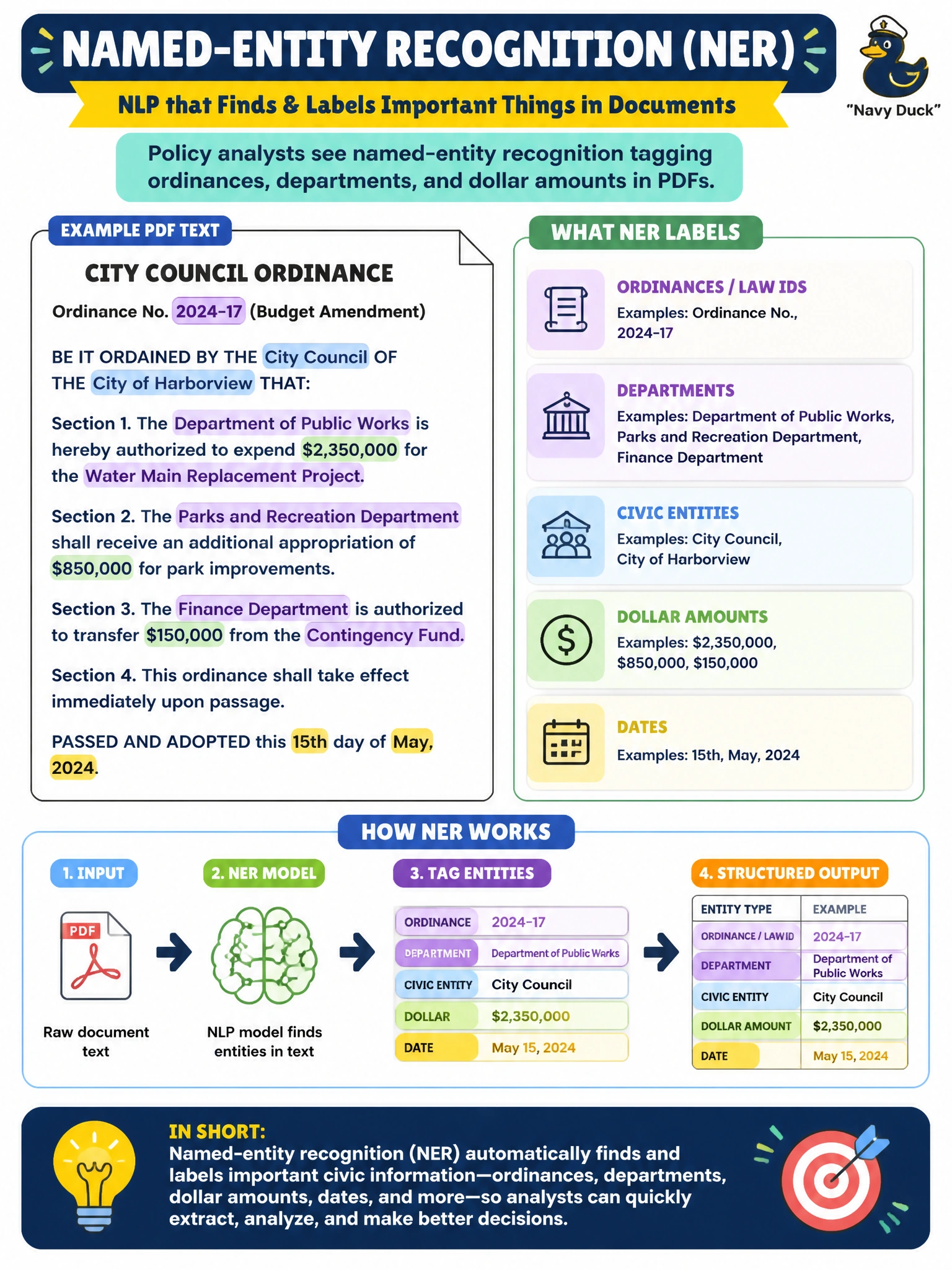
Policy analysts see named-entity recognition tagging ordinances, departments, and dollar amounts in PDFs. What NLP building block is shown?
Select an answer to reveal the explanation.
Short Explanation
NER is the highlighter that tags ordinance names, departments, and dollar figures in dense PDFs. You'll get structure from chaos — it's not NER that assigns grammatical roles such as nouns, verbs, and adjectives, since that's grammar labeling, not entity tagging, and it's not NER that shortens documents containing them, since that picks sentences rather than tagging entities. NER that scores entities such as ordinances, departments, and dollar amounts for tone isn't the building block either, since you'll get attitude scores, not entity labels.
Full Explanation
Named-entity recognition (NER) is an NLP technique that locates and labels entity types in text—such as ordinance citations, department names, and dollar amounts—inside municipal PDFs and memos. Policy analysts use NER to structure dense documents so they can search, filter, and cross-reference civic entities without manually highlighting every occurrence. NER organizes information already present; it does not invent legal authority or move money.
Named-entity recognition that assigns grammatical roles such as nouns, verbs, and adjectives to words in documents describes part-of-speech tagging, not NER; it identifies word classes like noun or verb rather than labeling which spans are ordinances, departments, or dollar amounts. Named-entity recognition that scores entities such as ordinances, departments, and dollar amounts for tone in documents describes sentiment analysis, not NER; it measures attitude as positive, negative, or neutral rather than locating and labeling named entities from municipal documents. Named-entity recognition that shortens lengthy documents containing ordinances, departments, and dollar amounts for review describes extractive summarization, not NER; it selects representative sentences to condense text but does not locate or label specific entity types such as ordinances, departments, and dollar amounts.
Exam caveat: NER models confuse similar entity types (person vs. organization, ordinance vs. bill number) and struggle with scanned OCR noise common in older municipal PDFs. Operational check: validate entity types on a sample of ordinances and budget PDFs, keep human review before any downstream automation that emails departments or updates trackers, and never wire NER outputs directly to payment or transfer systems.
Prefer to study offline? Printable PDF study book + test engine ($7.50, unofficial). These questions stay free here.