
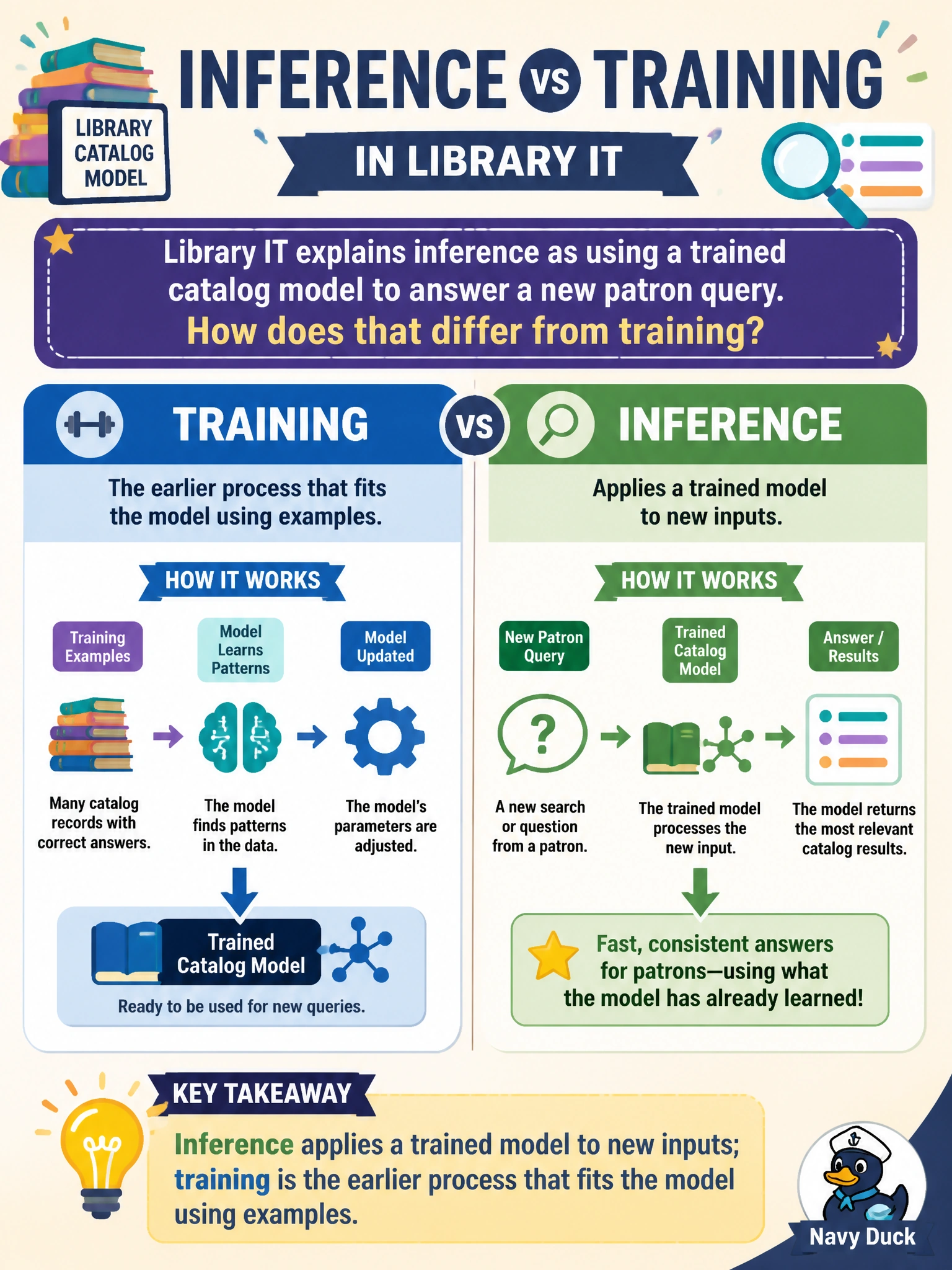
Library IT explains inference as using a trained catalog model to answer a new patron query. How does that differ from training?
Select an answer to reveal the explanation.
Short Explanation
Training is practice season with the catalog examples; inference is game day when a new patron query shows up. You've got the answer part right when you use the already-trained model, but training isn't tuning weights with the test examples — that's leakage, while training is the earlier practice that fits the model with training examples. You'll miss it if you call training just caching examples — that's memorizing — or picking with held-out accuracy — that's selecting, since training is fitting the model with examples.
Full Explanation
Library staff using a trained catalog assistant need the distinction that inference applies a trained model to new inputs—such as a patron query—whereas training is the earlier process that fits the model using examples. At inference time the municipal tool produces rankings or answers from fixed learned parameters (or a governed service), which is operationally different from the compute- and data-heavy training stage. That literacy prevents confusing every search with a full retrain. Saying inference applies a trained model to new inputs but training is the earlier process that tunes weights using the test examples gets inference right but misdescribes training data; tuning on test examples leaks answers and ruins evaluation, whereas training is the earlier process that fits the model using training examples while keeping test examples held-out. Saying inference applies a trained model to new inputs but training is the earlier process that fits models by caching examples gets inference right but mistakes storage for learning; caching examples is memorization without fitting parameters to generalize, whereas training is the earlier process that fits the model using examples. Saying inference applies a trained model to new inputs but training is the earlier process that picks the model using held-out accuracy gets inference right but mislabels validation as training; picking with held-out accuracy is model selection, whereas training is the earlier process that fits the model using examples. Exam caveat: some systems support online or continual learning, but essentials literacy still treats training and inference as conceptually distinct stages with different controls and costs. Operational check: document when the library model was last trained, what runs at query time, and how staff escalate when inference quality drops without triggering an ad-hoc retrain on live patron data.
Prefer to study offline? Printable PDF study book + test engine ($7.50, unofficial). These questions stay free here.