
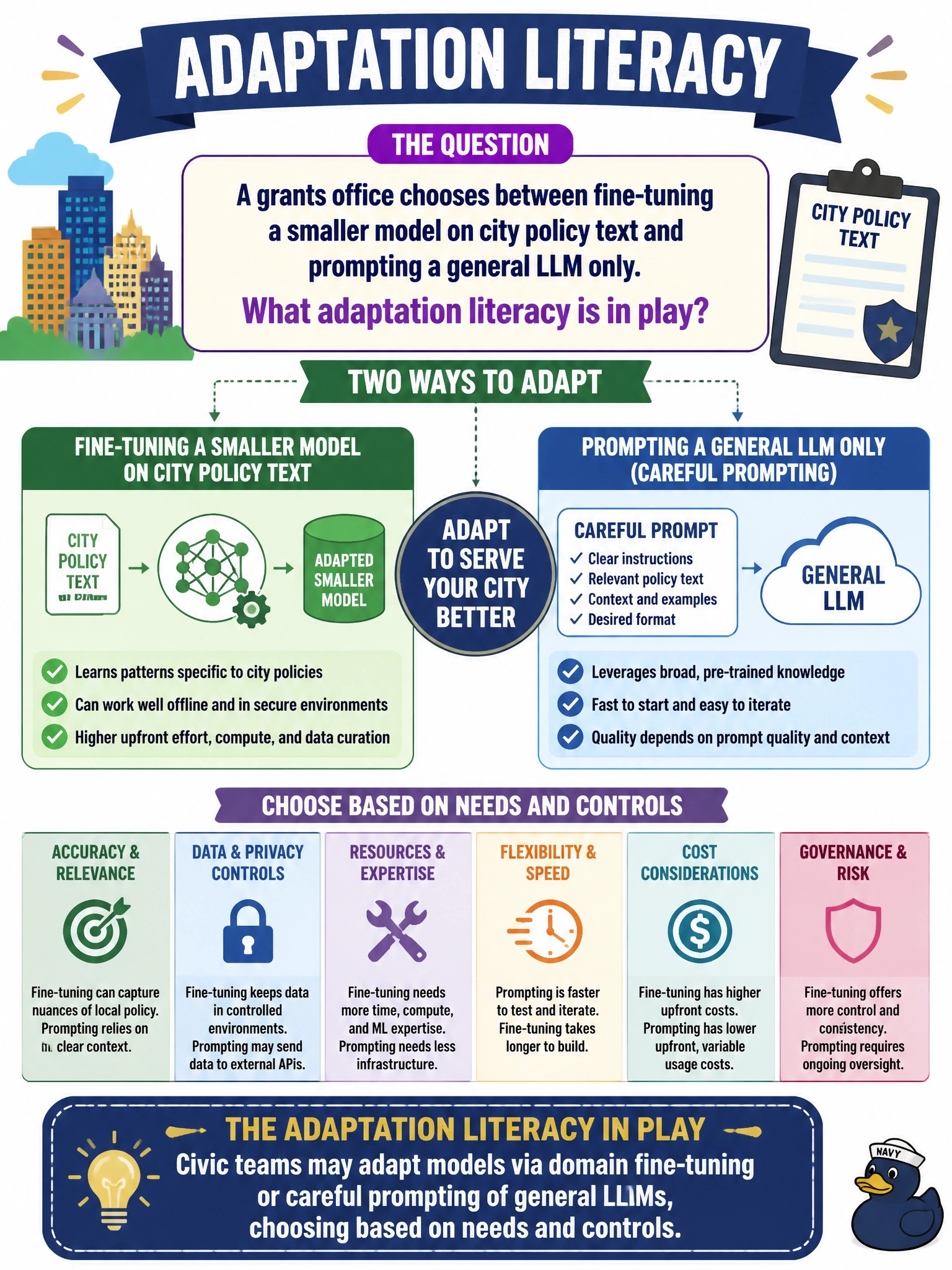
A grants office chooses between fine-tuning a smaller model on city policy text and prompting a general LLM only. What adaptation literacy is in play?
Select an answer to reveal the explanation.
Short Explanation
Sometimes you tailor a smaller model with city policy fabric; sometimes you just ask a general LLM carefully—both are adaptation paths. When you fine-tune, you're updating weights, which won't expand its context window, and prompting won't revise weights for future drafts. If you pick a smaller fine-tuned model, you'll gain local focus but you won't boost zero-shot reasoning on later grants drafts.
Full Explanation
A grants office choosing between fine-tuning a smaller model on city policy text and prompting a general LLM only is exercising adaptation literacy: civic teams may adapt models via domain fine-tuning or careful prompting of general models, selecting based on control needs, data sensitivity, latency, and cost. Fine-tuning can embed local policy phrasing more deeply when curated text and governance allow it; prompting can be faster to trial with stronger review and logging when fine-tuning is unnecessary or restricted. Fine-tuning a smaller model on city policy text to expand its context window, choosing controls for future grants drafts confuses training with model architecture—fine-tuning updates weights, it does not expand the context window, which is a fixed limit on input length set by architecture, not enlarged by domain text. Prompting a general LLM with city policy text to revise its model weights, choosing controls for future grants drafts confuses inference with training—prompting affects outputs only at runtime, it does not change model parameters. Choosing a smaller fine-tuned model for city policy work to boost zero-shot reasoning on later grants drafts, with controls misstates the trade-off—fine-tuning specializes the smaller model for local policy and typically narrows generalization, it does not boost zero-shot reasoning on later drafts. Exam caveat: fine-tuning on sensitive grant or client data can create retention and disclosure risks; prompting still risks over-reliance if outputs are not checked against authoritative policy. Operational check: compare the two paths with a small policy Q&A eval set, require human approval before external use, and record whether weights, prompts, or both are the controlled artifacts for the grants office.
Prefer to study offline? Printable PDF study book + test engine ($7.50, unofficial). These questions stay free here.