
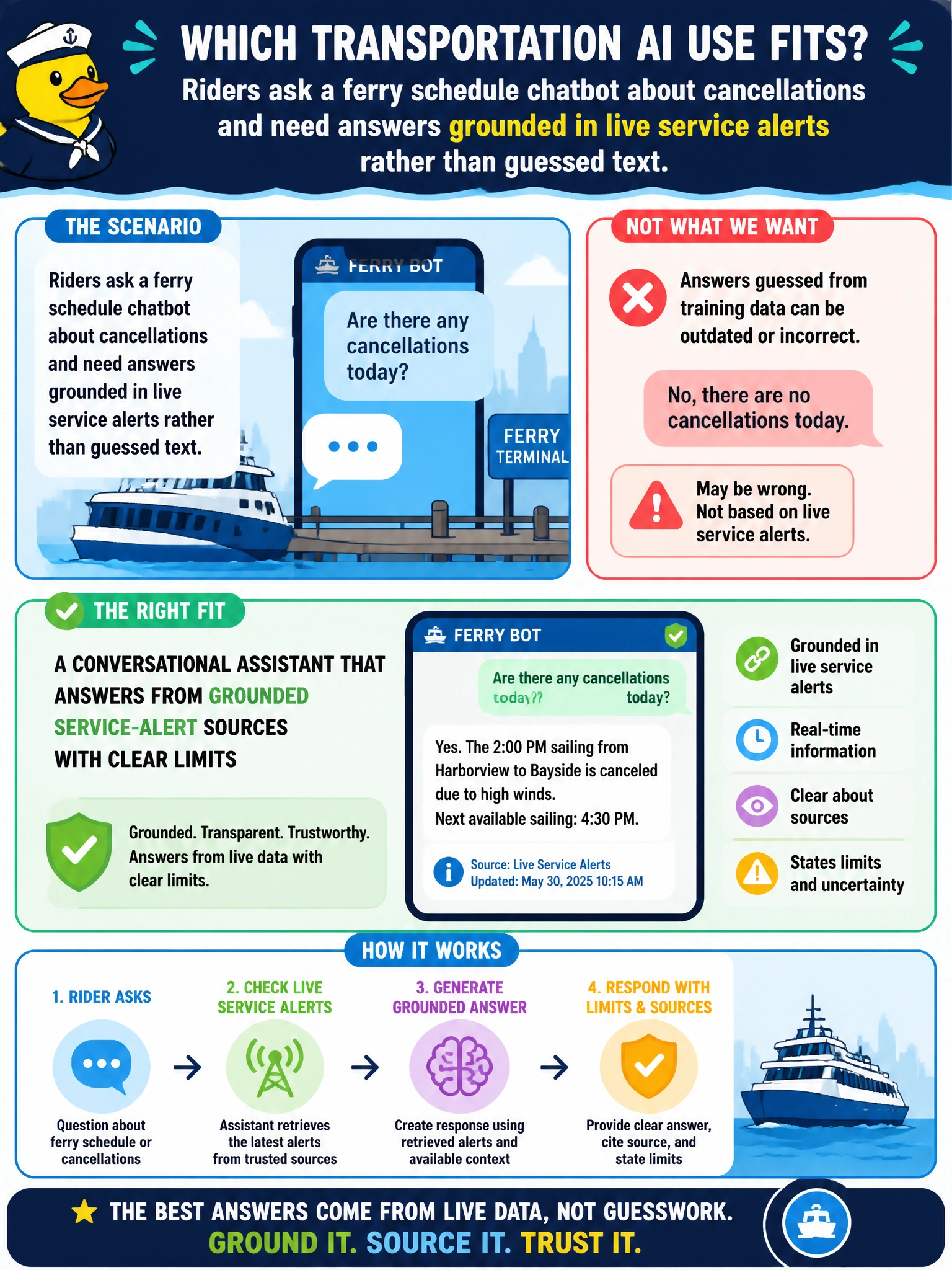
Riders ask a ferry schedule chatbot about cancellations and need answers grounded in live service alerts rather than guessed text. Which transportation AI use fits?
Select an answer to reveal the explanation.
Short Explanation
A ferry chatbot should read the real alert board because timetable sources with cited departures still miss live cancellations. You'll get grounded answers that admit what they can't see. Cited likelihoods from disruption forecasts can't tell you if today's ferry's cancelled, and you'll get outdated answers from cached drafts with cautions.
Full Explanation
Riders asking a ferry schedule chatbot about cancellations and needing answers grounded in live service alerts rather than guessed text need a conversational assistant that answers from grounded service-alert sources with clear limits. Grounding means the bot retrieves or is constrained to published schedules and current alert feeds, and it discloses when information is missing instead of relying on static summaries or cached examples. A conversational assistant that answers from grounded timetable sources with cited departures will rely on scheduled timetable data rather than live service-alert feeds, so it may miss cancellations and give riders outdated departure information. A conversational assistant that answers from grounded disruption forecasts with cited likelihoods relies on predicted disruption likelihoods rather than live service-alert feeds, so it cannot tell riders about current cancellations. A conversational assistant that answers from cached service-alert drafts with stated cautions relies on stale drafts rather than live service-alert feeds, so cautions cannot prevent outdated cancellation answers. Exam caveat: Conversational transit AI is only acceptable when answers are grounded in authoritative service data with explicit uncertainty handling. Relying on timetables alone, disruption forecasts, or cached drafts instead of live alerts is a classic failure mode tested on the exam. Operational check: Wire the assistant to the live alert API or CMS, refuse or escalate when sources are stale, log unanswered intents for ops, and keep a human contact path for accessibility and emergency questions the bot cannot resolve.
Prefer to study offline? Printable PDF study book + test engine ($7.50, unofficial). These questions stay free here.