
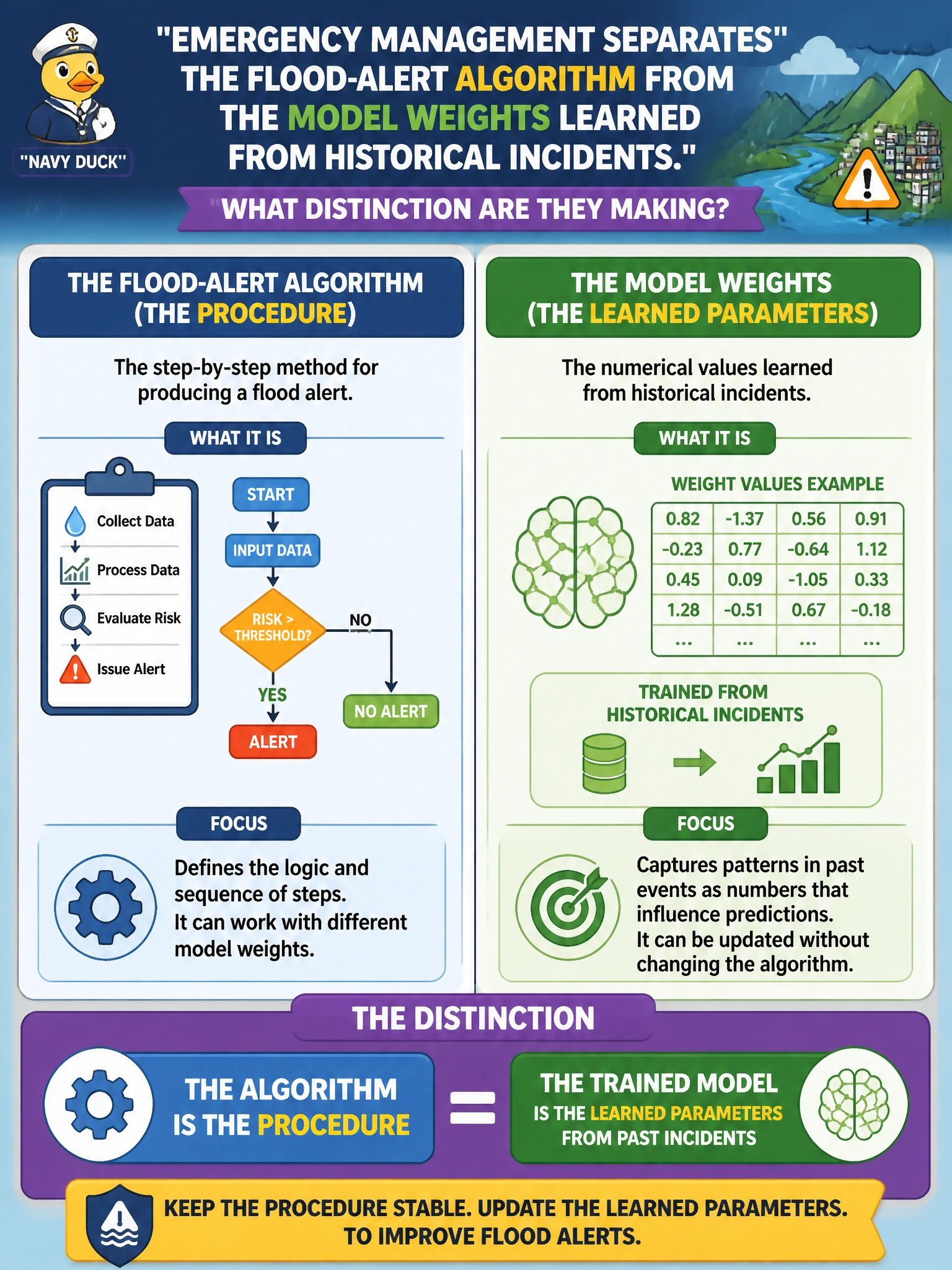
Emergency management separates the flood-alert algorithm from the model weights learned from historical incidents. What distinction are they making?
Select an answer to reveal the explanation.
Short Explanation
The algorithm is the recipe card; the model is the cake after you baked it on last decade’s floods. Same kitchen, different objects. Separating procedure from learned weights keeps the briefing clear.
Full Explanation
Emergency management is distinguishing that the algorithm is the procedure while the trained model is the learned parameters from past incidents. The algorithm is the method—how features are processed, how loss is optimized, how alerts are scored. The model is the concrete artifact produced when that method is applied to historical flood and incident data: weights, thresholds, and calibrated outputs that reflect past patterns. Separating the two prevents staff from treating ‘the algorithm’ and ‘the model’ as interchangeable words. You can keep the same algorithmic approach while retraining a new model after a season of unprecedented flooding; conversely, swapping algorithms changes the learning procedure itself.
Describing the algorithm as the architecture and the trained model as the tuned hyperparameters from past incidents confuses a part and a setting for the distinction itself: the architecture is only the structural part of the procedure, and tuned hyperparameters are configuration choices that guide learning, not the learned parameter artifact. Calling the algorithm the optimizer and the trained model the averaged gradients from past incidents mistakes a step and a training signal for the artifact itself; the optimizer is only the update rule within the broader procedure, and averaged gradients are transient values used during training, not the learned parameters that constitute the trained model. Describing the algorithm as the codebase and the trained model as the initial weights from past incidents mistakes implementation and starting point for the concepts themselves; the algorithm is the procedure the codebase implements, and the trained model is the learned parameters after training on past incidents, not the initial weights before learning.
Exam caveat: algorithm ≠ model. On essentials exams, ‘procedure/method’ versus ‘learned parameters/artifact’ is the expected contrast. Rules engines also have procedures, but ‘model weights learned from incidents’ signals the trained ML artifact.
Operational check: inventory flood-alert components with separate names and owners for code/procedure versus model version, record which historical incident window produced current weights, retrain or recalibrate after major regime shifts, and test alert thresholds against holdout incidents before hurricane or flood season.
Prefer to study offline? Printable PDF study book + test engine ($7.50, unofficial). These questions stay free here.