
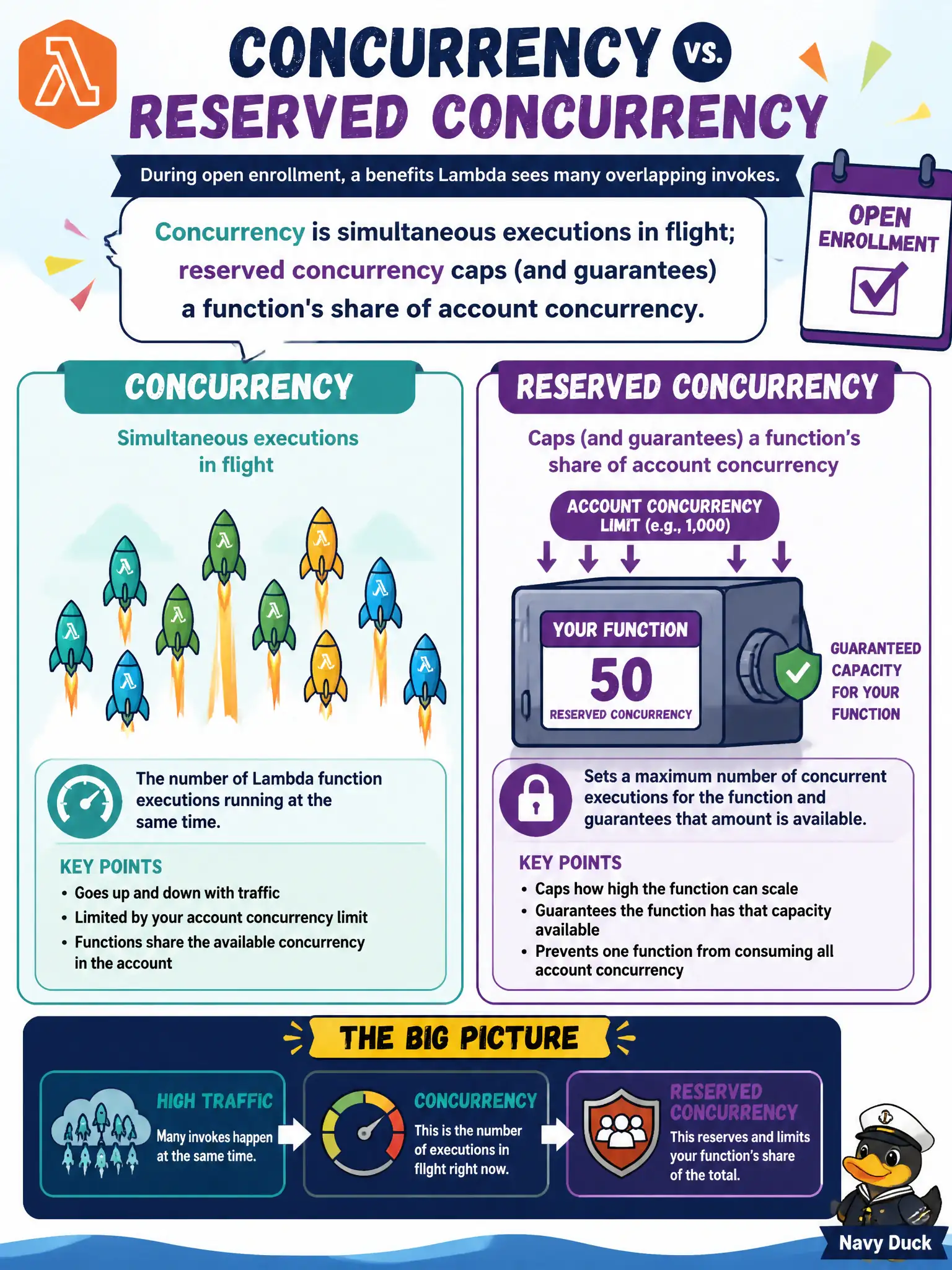
During open enrollment, a benefits Lambda sees many overlapping invokes. How should the developer explain concurrency versus reserved concurrency?
Select an answer to reveal the explanation.
Short Explanation
Picture open-enrollment as checkout lanes: concurrency is how many cashiers are ringing at once. Reserved concurrency puts a hard cap—and a reserved slice—on one function so it can't hog the whole store. That's how you keep one hot path from starving siblings.
Full Explanation
During open enrollment, a benefits Lambda seeing many overlapping invokes should be explained with clear concurrency vocabulary: concurrency is the number of simultaneous executions in flight, while reserved concurrency both caps and guarantees a function's share of account concurrency. Reserved concurrency protects critical municipal functions from noisy neighbors and also prevents a runaway function from consuming the entire account pool.
Concurrency is not the size of the deployment package zip in megabytes.
Reserved concurrency does not permanently disable all scaling for every function in the account; it constrains/guarantees the reserved function's pool.
Concurrency is not limited to EC2 Auto Scaling groups; Lambda concurrency is a first-class concept.
Exam caveat: Know account concurrency versus reserved concurrency versus provisioned concurrency distinctions at Associate level.
Operational check: Chart ConcurrentExecutions during an enrollment load test, set reserved concurrency for the benefits function thoughtfully, leave headroom for other civic functions, and confirm throttling behavior matches expectations when limits are hit. Keep the civic/municipal context in mind: open enrollment can saturate shared account concurrency and starve unrelated city APIs without reservation planning.