
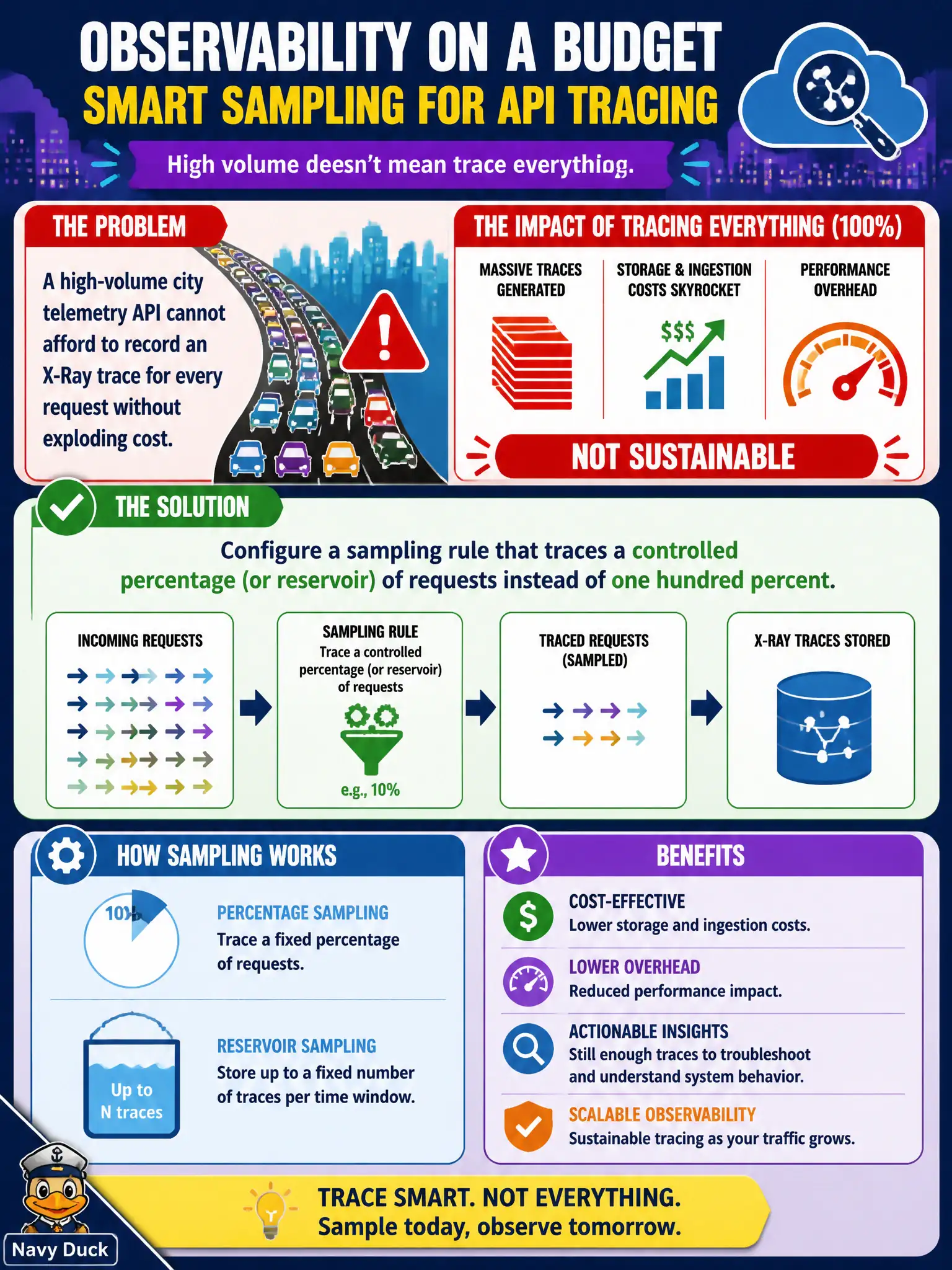
A high-volume city telemetry API cannot afford to record an X-Ray trace for every request without exploding cost. What sampling approach should the developer apply?
Select an answer to reveal the explanation.
Short Explanation
Tracing every single telemetry hit is like filming every car on the freeway in 4K—you'll learn less than you think and the bill will sting. Dial in a sampling rule so you keep a representative slice without recording everything. That keeps service maps useful and the AWS bill sane.
Full Explanation
A high-volume city telemetry API cannot afford an X-Ray trace for every request without exploding cost, so the developer should configure a sampling rule that traces a controlled percentage or reservoir of requests instead of 100%. Sampling preserves enough distributed traces for diagnosis while bounding cost and overhead on busy municipal ingest paths.
Disabling X-Ray entirely and relying only on unstructured console.log removes cross-service visibility when incidents span hops.
Turning on full sampling only in production and never sampling lower environments inverts typical cost/risk practice and can surprise production spend.
Duplicating every request into a second region solely so traces can be free is not a sampling strategy and multiplies cost.
Exam caveat: X-Ray sampling rules are the Associate-level control for trace volume versus cost.
Operational check: Define a sampling rule appropriate to telemetry QPS, verify traces still appear for a subset of requests, monitor X-Ray charges, and keep the ability to temporarily raise sampling during a declared incident window. Keep the civic/municipal context in mind: telemetry bursts during weather events can otherwise make naive 100% tracing unaffordable overnight.